



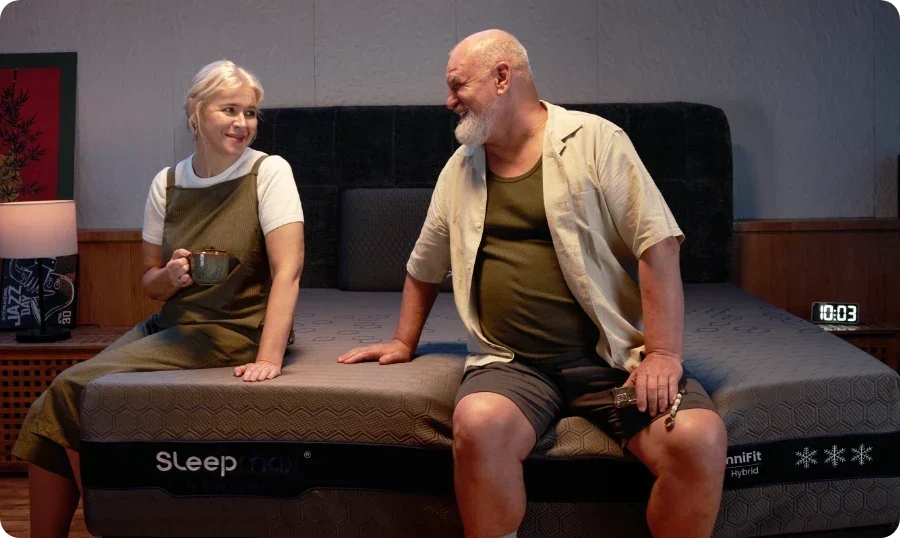
A split king solves a specific problem: it gives each sleeper a separate Twin XL mattress and therefore independent comfort choices. But separate mattresses are not right for every couple. You may want an uninterrupted center, simpler bedding, easier cuddling, or one conventional bed frame. The useful question is therefore not “How do we make one mattress feel like two completely different mattresses?” It is “Which differences can we solve above the mattress, which require changes inside it, and where should we compromise?”
The practical options are a side-specific or zoned topper, adjustable bedding, a configurable mattress with separate comfort components, or a shared mattress selected through an explicit compromise rule. Each addresses a different part of the problem.
Start by Identifying the Actual Conflict
“Firmness” often becomes shorthand for several complaints that need different solutions:
- Surface feel: One partner wants immediate plushness; the other dislikes sinking.
- Pressure relief: A shoulder or hip feels compressed, especially during side sleeping.
- Support: A sleeper feels that the pelvis drops too far or that turning takes too much effort.
- Temperature: Heat buildup is being interpreted as an overly enveloping or soft feel.
- Movement: One person wakes when the other changes position.
- Bed angle: One partner wants the upper body or legs elevated.
Have each person finish three sentences separately:
- “I feel discomfort at…”
- “I want more or less…”
- “The problem is worst when…”
That short exercise prevents a common purchasing error: changing the firmness of the entire bed when only one sleeper needs more surface cushioning, a different pillow, or better motion control.
Also separate preference from a possible health concern. Persistent pain, numbness, breathing difficulty, or other ongoing symptoms deserve appropriate clinical guidance; a bedding change should not be presented as a diagnosis or treatment.
Option 1: Use a Side-Specific or Zoned Topper
A topper is the least disruptive place to begin when the underlying mattress remains supportive and only one partner dislikes its surface feel.
How a half-width setup works
Place a Twin XL-size topper on one side of a king mattress, or use a purpose-made half-width component. This changes the upper comfort layer for one sleeper while preserving the shared mattress underneath.
The concept is simple, but execution matters. Measure the topper and mattress rather than relying only on size labels. Check whether the added height creates an uncomfortable ridge at the center. A fitted protector or deep-pocket sheet may help keep the components together, although it cannot eliminate a major height difference.
A half topper is most promising when:
- one person needs modestly more cushioning;
- both people are satisfied with the mattress’s underlying support;
- the couple wants to retain an unbroken mattress core; and
- the modified sleeper generally stays on their own side.
It is a poor fix when one partner needs the mattress to resist compression more strongly. A soft topper can soften a firm surface, but adding material above a mattress that already feels too soft does not rebuild its support system.
How a zoned topper differs
A zoned topper varies feel by area rather than simply dividing the bed into left and right halves. It may provide different behavior around the shoulders, waist, or hips. This can be useful when the conflict comes from body shape or sleep position rather than a broad preference for “soft” versus “firm.”
For example, the relevant target may be extra shoulder accommodation without adding the same softness beneath the pelvis. Before buying, confirm that the zone layout will actually align with the sleeper’s body. Fixed zoning may miss its intended area when partners differ substantially in height or sleep far above or below the expected position.

Couples considering a removable comfort layer can review the SLEEPMAX Apex Plush Mattress Topper. Treat any topper as a surface adjustment, however—not an automatic repair for sagging, structural wear, or unsuitable deep support.
A low-risk test before ordering
Run a short, reversible test using a folded blanket or another stable layer on the dissatisfied partner’s side. This will not reproduce a real topper’s material behavior, but it can reveal practical issues such as an objectionable center ridge, uneven sheet tension, or a partner who frequently rolls across the dividing line.
Do not treat a successful one-night test as proof of long-term comfort. Use it to evaluate geometry and shared-bed behavior, not durability or final firmness.
Option 2: Change Adjustable Bedding Before the Mattress
Some apparent firmness disputes begin above the mattress. Pillows, protectors, sheets, and pads alter posture, temperature, and the way the surface is perceived.
Match pillows individually
Partners do not need matching pillows. Pillow height and shape affect how the head and neck meet the bed, so a sleeper may blame the mattress when the pillow is the more direct mismatch. Test pillow changes separately from mattress changes so you can tell which variable helped.
Audit the layers covering the mattress
A thick pad can add cushioning across the entire bed, which may please one person and frustrate the other. A taut or poorly fitted protector can also interfere with how the surface contours. Remove optional layers briefly, one at a time, and record what changes.
Temperature deserves its own test. If one sleeper’s complaint is “I sink and get hot,” try changing the bedding and room conditions before assuming that greater mattress firmness is the only answer.
Consider elevation as a separate requirement
Independent head or leg elevation is not the same as split firmness. A single mattress generally cannot give two sleepers fully independent articulation in the way two compatible sleep surfaces can. Couples who mainly want a common incline may still use a conventional adjustable base with a compatible mattress, but partners seeking different positions should verify the complete system’s capabilities before purchase.
Ask the seller:
- Is the exact mattress compatible with the intended base?
- Can each side move independently with one continuous mattress?
- What happens at the center when only one side is raised?
- Which mattress, base, and bedding limitations apply?
Do not infer compatibility from the word “adjustable.” Get the answer for the exact combination under consideration.
Option 3: Choose One Mattress with Configurable Comfort Components
A continuous outer cover does not necessarily mean both sleepers must have identical comfort components underneath. Some mattresses use replaceable internal layers, and some manufacturers may offer side-specific configurations within a shared enclosure.

This approach can preserve a more continuous center than two separate mattresses, but shoppers should verify the design rather than assuming “customizable” means independently configurable by side. Sleep Foundation’s split-king guide illustrates why wording matters: the cited models include multiple firmness choices, while dual firmness is specifically associated with split-king versions. (Sleep Foundation)
Questions worth asking include:
- Are the left and right comfort components genuinely different?
- Is the support core shared or divided?
- Can one side’s component be exchanged without replacing the other?
- Will the center develop a detectable seam or firmness transition?
- Which layer changes are covered by the seller’s written policies?
- Are returns, exchanges, and warranties applied to the full mattress or individual components?
The tradeoff is complexity. A configurable system may require more careful setup and policy review than a conventional mattress. Its advantage is that future adjustment might involve changing a component instead of replacing the entire bed.
Option 4: Use a Deliberate Compromise Rule
When customization is unavailable or unnecessary, a shared mattress can still work if the decision rule is fair and specific. “Meet in the middle” is too vague because firmness labels are not a universal measurement system.
Protect support first, then tune the surface
If one partner clearly needs a more resistant underlying feel while the other mainly wants surface softness, choose the viable supportive base and add targeted cushioning for the second sleeper. This is more practical than selecting an excessively plush mattress and expecting a topper to make one side structurally firmer.
Give priority to the harder-to-modify problem
Rank each complaint by two factors:
- Impact: Does it cause substantial discomfort or repeated sleep disruption?
- Reversibility: Can it be changed inexpensively above the mattress?
A pillow preference is usually easier to modify than inadequate deep support. A mild surface preference may be easier to address than a strong aversion to motion. Let the harder-to-reverse requirement guide the mattress choice, then use bedding to tune the remaining difference.
Agree on a failure rule before purchase
Decide in advance what counts as failure. Examples include recurring discomfort, an unacceptable center ridge, repeated sheet displacement, or one partner consistently avoiding the bed. Also agree on when you will evaluate the setup and which single variable you will change next.
This prevents endless random adjustments. It also keeps the louder or more decisive shopper from becoming the default winner.
Compare the Practical Options
| Option | Best fit | Main limitation | What to verify |
|---|---|---|---|
| Half-width topper | One sleeper wants a softer surface | Height transition or movement at the center | Exact dimensions, thickness, sheet fit, return terms |
| Zoned topper | Relief is needed in specific body areas | Fixed zones may not align with the sleeper | Zone map, orientation, body alignment |
| Individual pillows and bedding | The conflict involves posture or temperature | Cannot correct unsuitable mattress support | Fit, care requirements, compatibility |
| Configurable internal layers | Both partners need meaningful but contained differences | More setup and policy complexity | Side-specific construction and exchange rules |
| Shared compromise mattress | Preferences overlap enough for one core feel | Neither sleeper gets complete independence | Trial, return, warranty, and foundation terms |
| Split king | Partners need independent mattresses or positioning | Center separation and more complex bedding | Mattress and base compatibility, gap management |
How to Test a Shared Setup as a Couple
Use a repeatable test instead of taking turns saying “feels good.”
Test each normal sleep position
Each person should lie in their typical positions long enough to notice shoulder, hip, waist, and lower-back behavior. Then roll, sit near the edge, and get out of bed while the partner remains still.
Test the center deliberately
Cuddle, lie diagonally, and cross the midpoint. With a half topper or configurable construction, check for a ridge, valley, or abrupt change. If the couple regularly uses the full width, center comfort is a core requirement rather than a minor detail.
Change one variable at a time
Do not replace the pillow, topper, protector, and sheets simultaneously. Keep brief notes for each partner covering pressure, ease of movement, temperature, and disturbance. A simple record is more useful than trying to reconstruct several nights from memory.
Read the written policies
Before purchase, confirm the applicable return or trial process, required foundation, condition standards, fees, and who handles transportation. Do not rely on a salesperson’s general description when the written terms are available.
When comparing a topper with a full mattress change, start at SLEEPMAX and review the relevant product and support information for the exact item under consideration.
FAQ
Can one topper make only half of a king mattress softer?
Yes, a correctly sized half-width topper can modify one side’s surface. The likely practical issues are a height difference, movement, sheet fit, and a noticeable transition at the center. It will not restore a worn or unsupportive mattress core.
Can a topper make one side firmer?
It may change the immediate surface sensation, but it cannot reliably rebuild deep support in a mattress that compresses too much. If insufficient support is the real complaint, assess the mattress rather than stacking a nominally firm topper over it.
Is a dual-firmness mattress the same as a split king?
No. A split king consists of two Twin Long mattresses. A dual-firmness mattress may instead place different comfort configurations within one outer mattress, depending on its construction.
What is the best first step for couples on a budget?
Diagnose the conflict before buying anything. Test pillows and removable bedding, then consider a side-specific topper if the mattress is still supportive and only one sleeper needs a softer surface.
When is a split king still the clearer choice?
It becomes more compelling when partners require genuinely independent mattresses, substantially different firmness constructions, or separate adjustable positions. The tradeoff is the physical division at the center and the bedding and compatibility questions that come with it.

Leave a comment
This site is protected by hCaptcha and the hCaptcha Privacy Policy and Terms of Service apply.