



A guest bed has an unusual job: it must accommodate people with different bodies, sleep positions, temperature preferences, and sensitivities without being rebuilt for every visit. The most practical solution is not an extreme mattress chosen for one person. It is a neutral base that can be adjusted at the surface and reset easily between guests.
The core strategy is simple: start with broadly accommodating support, keep a removable topper available for guests who want more cushioning, and use bedding that is easy to wash and layer. That gives you more control than trying to predict every visitor’s ideal mattress.
Start with the Guests You Actually Host
Before choosing a frame or mattress, write down who normally stays overnight. A room used by one adult twice a year has different requirements from a room regularly shared by couples, children, older relatives, or long-term visitors.
Consider these questions:
- Do you usually host one person or two?
- Are any frequent guests side sleepers who ask for a softer surface?
- Do older visitors need a bed that is easy to enter and leave?
- Does the room also serve as an office, exercise area, or playroom?
- Do guests commonly report sleeping hot?
- How much time can you spend cleaning and resetting the bed?
Room size matters alongside guest count. It is recommended to match the mattress dimensions to the room and the number of people normally hosted. Full and queen sizes often work in guest rooms.
Use painter’s tape to mark the proposed bed footprint on the floor. Then check whether doors, drawers, closets, and walking routes still work. Repeat the test with any pullout, trundle, or folding mechanism fully open.
Build Around Neutral Support
“Neutral support” means choosing a base that avoids pronounced softness or rigidity. It does not mean that one firmness will suit everyone. It means the permanent part of the bed should be broadly usable, while preference-specific changes happen in removable layers.
A medium-firm mattress is commonly presented as a guest-room compromise. For a permanent guest room, place the mattress on a compatible, stable foundation and follow the mattress and frame manufacturers’ assembly instructions. Avoid improvised supports whose spacing, load limits, or fasteners are unknown. If you are constructing a platform yourself, the safe dimensions and structural design must come from the relevant product instructions and local requirements, not a generic online measurement.

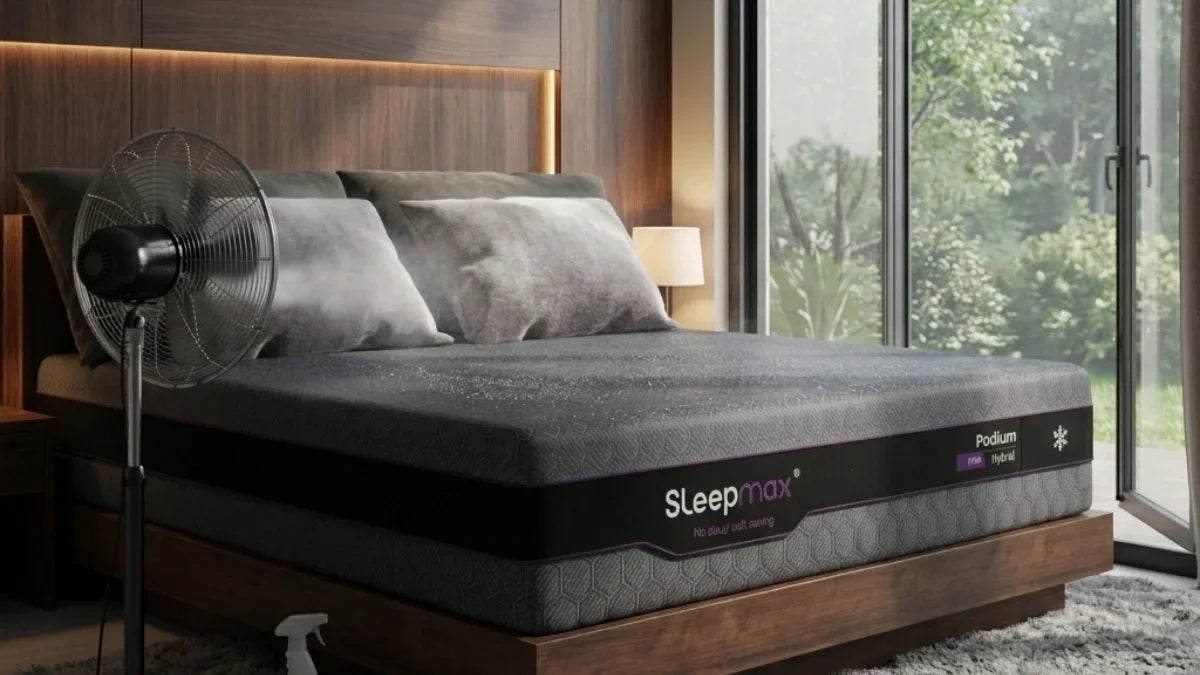
The SLEEPMAX OmniFit Hybrid Mattress is one option to review when comparing a permanent guest-room base. Evaluate it against the same criteria as any candidate: surface feel, ease of movement, partner disturbance, temperature management, compatible foundation, care instructions, and trial or warranty terms. Confirm current product details on the product page before buying.
Adjust the Surface Instead of Replacing the Bed
A removable topper is the most useful adjustment layer because it can change the surface for a particular guest without altering the underlying mattress.
Keep the base bed in its neutral configuration for most visitors. Add a topper when a guest prefers more cushioning, then remove and store it after laundering or cleaning it according to its care label. The SLEEPMAX Apex plush mattress topper is a brand-profile option worth considering for this role; verify its current dimensions, construction, care directions, and compatibility before purchase.
A topper cannot repair a sagging, unstable, or unsuitable mattress. It is a preference adjustment, not structural restoration. If the base has visible damage or no longer provides an even sleeping surface, inspect it under the manufacturer’s guidance before hosting another guest.
Store the topper flat or as its instructions specify. Protect it from moisture and do not compress it in a way the manufacturer prohibits. Label its storage bag so another household member can identify and prepare it correctly.
Configure the Bed by Sleeper Type
The goal is not to diagnose guests or promise a particular physical outcome. It is to provide simple choices they can control.
Side sleepers
Side sleepers often prioritize cushioning around the shoulders and hips. Begin with the medium firm mattress, then offer the removable topper if the guest wants a more cushioned surface. Provide pillows of different lofts rather than guessing which one is correct. Put clean protectors and cases on both, and tell the guest that alternatives are available.
Back sleepers
Start back sleepers on the neutral base without automatically adding the plush topper. Leave the topper accessible rather than installing it by default. A choice offered before bedtime is more useful than a complicated adjustment after the guest is tired.
Stomach sleepers
Do not presume that a plush surface is helpful. Prepare the neutral base first and let the guest opt into additional cushioning. A thinner pillow option may also be useful, but avoid labeling any pillow as medically corrective.
Combination sleepers
For guests who change positions, prioritize ease of movement and avoid excessive layering. Fit the sheets securely so loose fabric does not bunch as the sleeper turns. Offer the topper as an option, not as a permanent component.
Couples and light sleepers
For two guests, verify that the mattress dimensions and room layout provide usable space and whether the mattress provdies good motion isolation. Also address disturbances outside the mattress: rattling frames, a headboard touching the wall, bright indicator lights, and noisy doors can undermine an otherwise suitable setup.
Hot sleepers
Use breathable, removable bedding layers that guests can add or remove independently. A sheet, light blanket, and separate warmer layer are more adaptable than one heavy covering.
Do not rely solely on words such as “cooling.” Ask what material or construction supports the claim, read care requirements, and check whether protectors or toppers change the intended feel. SLEEPMAX offers cooling bedding among its product categories, but current specifications should be confirmed on the relevant product page.
Older guests and people with limited mobility
Prioritize an unobstructed route, stable bedside support, accessible lighting, and a bed height the known guest can manage. Do not assume that a low platform, high pillow-top bed, or floor mattress is universally accessible.
If a guest has a medical condition, disability, or post-operative restriction, ask what setup they already use and encourage them to follow guidance from their qualified clinician. A general guest-room article cannot determine a safe configuration for an individual medical need.
Children and occasional visitors
Use age-appropriate products and follow all manufacturer warnings. Do not add improvised rails, stacked mattresses, or unsupported extensions. For children, caregivers should approve the bed arrangement before use.
Choose a Bed Format That Fits the Room
A standard bed is usually the simplest option when the room is dedicated to sleeping. In a multipurpose room, the format must balance nightly comfort with conversion effort and storage. Consider the tradeoffs:

| Bed format | Best fit | What to verify |
|---|---|---|
| Standard bed | Dedicated guest room | Foundation compatibility, room clearance, guest capacity |
| Storage bed | Bedroom needing enclosed storage | Drawer clearance, assembly instructions, usable pathways |
| Daybed | Office or sitting room with one frequent guest | Mattress compatibility, seating depth, back cushions |
| Murphy-style cabinet or wall bed | Room that must stay open during the day | Installation requirements, mattress limits, operating clearance |
| Sleeper sofa | Living area where seating matters daily | Open dimensions, mattress feel, mechanism operation |
| Folding or inflatable option | Infrequent, temporary hosting | Setup effort, storage, care directions, floor clearance |
Make the Bedding Easy to Wash and Reset
Easy-care bedding is the third part of a flexible guest bed. Every removable layer should have a known cleaning process.
Build a simple linen kit for each bed:
- Mattress protector with a readable care label
- Two fitted sheets, so one can be used while the other is washed
- Clean pillow protectors and pillowcases
- Lightweight blanket
- Separate warmer layer
- Washable duvet cover or other removable outer cover
- Clearly labeled storage bag for the topper
Keep care labels attached or record the instructions in a household note. Do not assume every protector, topper, or pillow can be washed and dried using the same settings.
Before a guest arrives, inspect the mattress, frame, topper, protector, and linens. If anything is damp, visibly contaminated, damaged, or strongly odorous, take it out of service and follow the maker’s cleaning or replacement instructions. Masking a problem with fragrance does not make the bed ready.
Use This Compact Buying Checklist
Before purchasing, confirm:
- The size suits both the room and the usual number of guests.
- The base mattress has a neutral, broadly usable feel.
- A removable topper can provide optional extra cushioning.
- The foundation is explicitly compatible with the mattress.
- The bed can be opened, closed, and walked around safely in the actual room.
- All removable bedding has understandable care instructions.
- Replacement sheets and protectors are easy to obtain in the chosen size.
- Frequent guests can enter and leave the bed comfortably.
- Couples have enough sleeping space and the frame does not rattle.
- Trial, return, delivery, assembly, and warranty terms have been read on the seller’s current pages.
For a folding, cabinet, or convertible bed, also ask which mattress dimensions and weights are permitted, what installation is required, and whether regular inspection or maintenance is specified. Treat missing compatibility information, unclear care instructions, an unstable display model, or pressure to ignore manufacturer directions as red flags.
Prepare the Room for Arrival
Make the final setup easy for the guest to understand. Put the topper on only when requested or when you already know the visitor’s preference. Leave spare pillows and the extra blanket where they are visible, not hidden in an unfamiliar closet.
Add a reachable light, a clear route to the door, a place for a phone or glasses, and enough open space for luggage. Check that blinds or curtains operate normally and that the room can be ventilated or temperature-adjusted using the home’s existing controls.
A small note can explain where clean extras are stored and invite the guest to request the topper. That removes the social friction of asking without making unsupported promises about what the bed will do.
FAQ
What firmness is best for a guest bed?
A medium-firm feel is commonly recommended by guest-room retailers as a broad compromise, but no firmness suits everyone. A neutral base plus an optional removable topper is more adaptable than an extreme surface.
Should the topper stay on all the time?
Not necessarily. Install it for guests who prefer more cushioning, and store it according to its instructions when it is not needed. This preserves the neutral starting surface.
Is a full or queen mattress better?
Choose according to room clearance and normal occupancy. A queen may offer couples more space, while a full may preserve space in a smaller room. Tape out both footprints before buying.
What is the best guest bed for an office?
A daybed, cabinet bed, wall bed, or sleeper sofa may work, depending on the available open footprint and conversion effort. Verify installation, mattress compatibility, and operating clearance for the exact model.
How can I accommodate hot and cold sleepers?
Use separate, removable layers: sheets, a lighter blanket, and an additional warm covering. This lets the guest adjust the bed without remaking its support system.
What should I replace between guests?
Wash or replace used linens according to their labels, inspect protective layers, and provide clean pillowcases and covers. Follow product-specific care instructions rather than applying one cleaning method to every material.


Leave a comment
This site is protected by hCaptcha and the hCaptcha Privacy Policy and Terms of Service apply.