You're not alone. If you've found yourself staring at the ceiling at 2 a.m., scrolling through your phone, wondering why sleep just won't come—you're in good company. Nearly half of all adults struggle with sleep at some point, and for many, it becomes a frustrating nightly battle.
This guide breaks down what's really happening when you can't sleep, why your tired brain won't shut off, and what actually works to get you back to sleeping soundly. No gimmicks, just practical advice backed by the latest research.
Most people use "insomnia" as a catch-all term, but sleep problems aren't one-size-fits-all. Sometimes you can't fall asleep. Other times, you crash hard but wake up at 3 a.m. and can't drift back off. Then there are the nights when you feel like you slept, yet wake up completely exhausted.
The Chinese Sleep Health White Paper from 2025 found that adults are averaging just 6 hours and 44 minutes of sleep—well below the recommended 7 to 8 hours. If you're in your 30s or 40s, you're probably feeling this the most. Middle-aged adults are getting the least sleep, often juggling work, kids, and whatever life throws at them.
Before diving into why you can't sleep, it helps to understand what's supposed to happen when everything goes right.
Think of this as your master timekeeper, located in a part of your brain called the hypothalamus. It responds to light—morning sunlight tells your body it's time to wake up, while darkness signals it's time to wind down.
This is the buildup of "sleepiness" the longer you stay awake. The longer you're awake, the stronger this drive becomes, until eventually, it pushes you to sleep.
When these two systems align—your clock says it's nighttime AND your sleep drive has built up—you naturally drift off. Easy, right?
Here's where things get interesting: Your brain produces a hormone called melatonin that acts like a chemical messenger announcing "bedtime." This kicks in a couple hours before your usual bedtime, preparing your body for sleep.
But here's the problem—melatonin is extremely sensitive to light, especially the blue light from phones, tablets, and computers. Harvard Medical School found that using screens just two hours before bed can delay that melatonin signal by three hours. No wonder so many of us struggle to fall asleep until past midnight.
This is the classic paradox: you're physically exhausted, your eyes are heavy, yet your mind won't shut off.
Your nervous system is stuck in "on" mode. Even if you're lying in bed, part of your brain is still alert, scanning for threats, worrying about tomorrow, replaying conversations from the day. This heightened state makes it physically difficult to transition into deep sleep.
If you're going to bed at 10 p.m. but your internal clock thinks bedtime is midnight, you'll struggle. This mismatch often happens from irregular schedules—staying up late on weekends, then trying to crash early on weeknights.
The Anxiety Loop
You get into bed and immediately think, "Please let me sleep tonight, I have so much to do tomorrow." This creates pressure. Sleep is supposed to happen automatically, but when you try to force it, you paradoxically make it harder. The more you worry about not sleeping, the more awake you feel.
Here's what's most commonly keeping people awake:
| What's Disrupting Your Sleep |
How Many People It Affects |
What It Does to Your Night |
| Stress and anxiety |
About 65% of us |
Adds 45-60 minutes before you fall asleep |
| Bedroom that's too light or noisy |
Around 40% |
Cuts sleep quality by 15-20% |
| Going to bed and waking up at different times |
Roughly 35% |
Reduces deep sleep by 25% |
| Screens before bed |
72% of adults |
Cuts melatonin by half, delays sleep |
Some sleep disruptors are obvious—stress, late coffee, an uncomfortable bed. But others fly under the radar.
Beyond just delaying when you feel sleepy, blue light exposure creates deeper problems:
Research from 2025 shows that chronic blue light exposure doesn't just mess with your sleep timing—it actually changes your gut bacteria. Studies found that evening screen time reduces beneficial gut bacteria by 40%, which then affects how your body produces chemicals needed for sleep.
And here's something most people don't consider: blue light at any time of day affects your body's internal clock genes. It messes with genes that control your metabolism and fat storage, which may partly explain why poor sleep and weight gain tend to go together.
Your gut and brain are connected through what's called the gut-brain axis. At night, good gut bacteria produce chemical messengers that help you sleep—things like GABA (which calms your nervous system) and tryptophan (a building block for melatonin).
When researchers compared people with insomnia to good sleepers, they found some striking differences:
- People with insomnia had 78% less of the gut bacteria that produce calming chemicals
- They had four times more of the gut bacteria associated with inflammation and stress
This creates a vicious cycle: poor sleep messes up your gut bacteria, and messed-up gut bacteria make it harder to sleep.
It's not just about feeling stressed at bedtime. When stress becomes chronic, it literally rewires your nervous system to stay on high alert. Your stress hormones stay elevated when they should drop at night, your body temperature stays higher, and your muscles remain tense.
Studies from 2025 found that people under chronic stress had 150% more nighttime awakenings and significantly less deep sleep—the restorative stage where your body repairs itself.
One night of poor sleep? You'll be groggy, irritable, and maybe reach for an extra coffee. But chronically missing sleep creates real problems:
Your Brain Suffers
You're not just "tired"—your cognitive performance drops. A 2024 study from the University of Michigan found that just one night without sleep diminishes how your brain consolidates memories. Even after catch-up sleep, these memory problems persist. And a 2026 study showed that analyzing just one night of your sleep patterns can predict your risk of over 130 different health conditions, from Parkinson's disease to heart disease.
Your Physical Health Takes a Hit
Sleep deprivation increases your blood pressure, your blood sugar becomes less stable (making diabetes more likely), and your immune system works less effectively. The Centers for Disease Control warns that consistently sleeping less than six hours raises your risk of heart problems and stroke.
Your Mood Crashes
Without enough sleep, the emotional centers of your brain become 60% more reactive, while the rational centers that help regulate emotion become less active. Small frustrations feel overwhelming, and even good days can leave you feeling down.
Everyone has trouble sleeping sometimes. But when does it become actual insomnia?
Here's the breakdown:
-
Occasional insomnia: You have trouble sleeping a few nights a month, especially during stressful times. This usually resolves on its own.
-
Chronic insomnia: You're struggling at least three nights a week for three months or more. Your daytime functioning is affected—you're tired, moody, or having trouble concentrating.
About 10-15% of adults deal with chronic insomnia, and for many, it persists for years if untreated.
Here's what's interesting: Insomnia and sleep apnea (where you stop breathing repeatedly during sleep) often occur together. This combination is called COMISA, and it's actually more common than people realize. If you're treating one but not the other, you might still struggle to feel rested.
If you've been searching "how to fall asleep fast" at 3 a.m., you've probably tried plenty of quick fixes. Here's what research shows actually works, starting with techniques you can use tonight.
This feels counterintuitive, but here's the deal: if you've been lying there for 20 minutes and sleep isn't coming, staying in bed trains your brain to associate bed with being awake.
So get up. Go to another room. Keep the lights low. Do something boring—read a paper book (nothing stimulating), fold laundry, listen to calm music. Don't look at your phone. Return to bed only when you feel sleepy again.
You might have to do this multiple times in a night, and that's okay. It's called stimulus control, and it's one of the most effective techniques for breaking the bed-awake association.
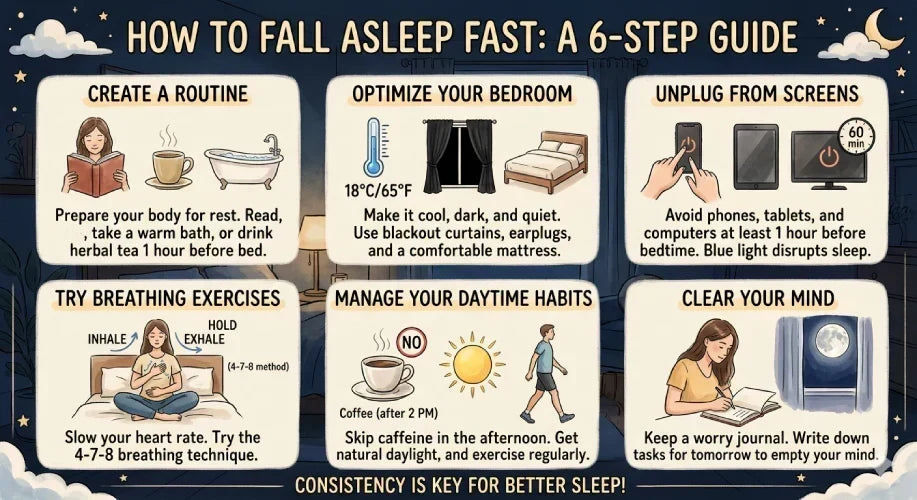
The 4-7-8 breathing technique is simple but effective:
- Exhale completely through your mouth
- Breathe in quietly through your nose for 4 seconds
- Hold your breath for 7 seconds
- Exhale completely through your mouth for 8 seconds
- Repeat 4-5 times
This triggers your parasympathetic nervous system—your body's "relaxation response"—slowing your heart rate and calming your mind.
When your mind won't stop running through tomorrow's to-do list or replaying conversations, try visualization:
Picture yourself walking through a grocery store. Not rushing—slowly walking down each aisle, mentally selecting items with attention to detail. The color of that apple, the texture of that bread, the label on that cereal box. The mundane detail of this visualization is exactly what makes it work—it engages just enough mental energy to keep you from racing thoughts, without being stimulating enough to keep you awake.
You can't control when you fall asleep, but you can control when you wake up. Set a consistent wake time and stick to it, even on weekends. Within 7-10 days, this regularity helps anchor your circadian rhythm, making it easier to fall asleep at night.
Create a buffer zone between the chaos of your day and sleep:
- 2 hours before bed: Dim the lights in your home. Bright overhead lights signal "awake time" to your brain.
- 1 hour before bed: Put screens away. Yes, it's hard. But it makes a huge difference.
- 30 minutes before bed: Do something relaxing—a warm shower (the temperature drop afterward helps), light stretching, or reading.
Make your bedroom a sleep sanctuary:
- Temperature: Aim for 20-24°C (68-75°F). Your body temperature needs to drop slightly for sleep, and a room that's too warm prevents this.
- Darkness: Use blackout curtains or an eye mask. Even tiny amounts of light can disrupt melatonin production.
- Noise: If you live somewhere noisy, try white noise or earplugs.
- Your bed: Make sure your mattress and pillow actually support your body. Research shows medium-firm mattresses reduce pressure points and improve sleep quality by 25-30%.
If you've been struggling with sleep for months, there's a proven treatment that works better than sleeping pills long-term.
It's called Cognitive Behavioral Therapy for Insomnia (CBT-I), and it's considered the gold standard by sleep medicine organizations worldwide.
CBT-I isn't just relaxation techniques or sleep tips—it's a structured program that addresses the thoughts, behaviors, and patterns keeping you awake. It typically includes:
Stimulus Control: Strengthening the connection between your bed and sleep (and breaking the bed-wake association)
Sleep Restriction: Temporarily reducing time in bed to increase your sleep drive and make your sleep more efficient
Cognitive Restructuring: Challenging and changing unhelpful thoughts about sleep (like "I must get 8 hours or I'll be useless tomorrow")
Sleep Hygiene: Optimizing your sleep environment and daily habits
Studies show CBT-I helps 70-80% of people with chronic insomnia, and the benefits last long after treatment ends. Unlike sleeping pills, you're not taking anything or becoming dependent on anything—you're actually retraining your brain to sleep better.
You can work with a sleep specialist trained in CBT-I, or use digital programs that guide you through the process with some remote coaching.
It might be. A study in the Journal of Chiropractic Medicine found that proper mattress support improved sleep efficiency by 15% and reduced nighttime awakenings by 30%. If your mattress is sagging, doesn't support your spine properly, or you wake up with aches and pains, it's definitely not helping.
What to look for:
- Medium-firm support (too soft and you sink, too firm and you get pressure points)
- Good support that keeps your spine in a neutral position, regardless of whether you sleep on your side, back, or stomach
- Temperature regulation (memory foam that sleeps hot will have you waking up sweaty)
- Motion isolation (if you have a partner who moves around, you don't want to feel every shift)
A good mattress lasts 7-10 years. If yours is older than that, or you're consistently waking up uncomfortable, it might be time for an upgrade.
The short answer: most adults need 7-9 hours. But the longer answer is that individual needs vary, and quality matters as much as quantity.
Here's the breakdown by age:
- Adults (18-64): 7-9 hours is recommended, with 6-10 hours acceptable
- Older adults (65+): 7-8 hours is recommended, with 5-9 hours acceptable
Quality Sleep Indicators:
- You fall asleep within 30 minutes of getting into bed
- You don't wake up more than 1-2 times per night
- You're asleep for at least 85% of the time you're in bed
- You feel refreshed upon waking
Some people claim they function fine on 5-6 hours, and a tiny percentage (less than 1%) actually can due to genetic factors. For the rest of us, chronically shorting ourselves on sleep impairs performance, mood, and health, even if we feel "used to it."
Most sleep problems can be addressed with the strategies above. But sometimes there's an underlying issue that needs medical attention.
Red flags that mean it's time to see a sleep specialist:
You might have sleep apnea if:
- You snore loudly (especially if someone says you gasp or choke in your sleep)
- You wake up unrefreshed regardless of how long you sleep
- You're excessively sleepy during the day
- You have high blood pressure that's hard to control
Untreated sleep apnea is serious—it strains your heart, increases diabetes risk, and can lead to cognitive decline. A sleep study can diagnose it, and treatments like CPAP can be life-changing.
You might need professional insomnia treatment if:
- You've struggled with sleep for 3+ months
- Sleep problems affect your daily life (work, mood, relationships)
- Self-help strategies haven't helped
Other signs that need evaluation:
- Restless legs syndrome (uncomfortable sensations in your legs when you lie down, relieved by moving)
- Acting out dreams or thrashing during sleep
- Sudden sleep attacks during the day
Your mind is probably still in "alert mode." Hyperarousal is a real phenomenon—your nervous system remains activated even when your body is fatigued. This is especially common after high-stress days or when you're anxious about not sleeping.
Occasional insomnia often resolves. But chronic insomnia (persisting 3+ months) rarely improves without intervention. The longer it persists, the more entrenched the patterns become.
It depends on how severe and prolonged it is. Partial improvement can happen within days, but full recovery may take weeks. The key is consistency—regular sleep schedules matter more than trying to "make up" for lost sleep on weekends.
They can help short-term, but they're not a long-term solution. The American Academy of Sleep Medicine recommends behavioral treatments like CBT-I as first-line. If you do use medications, do so under medical supervision for short periods only.
Short naps (10-20 minutes) can be refreshing. Longer naps or napping too late in the day can interfere with nighttime sleep. If you're struggling with insomnia, it's usually best to avoid napping entirely to build your sleep drive for nighttime.
Back sleeping is generally best for spinal alignment. Side sleeping is better for snoring and sleep apnea. Stomach sleeping is the worst for your neck and back. The best position is whatever allows you to sleep comfortably and wake up without pain.
Yes—regular exercise improves sleep quality and duration significantly. Just avoid vigorous workouts within 3 hours of bedtime, as they can leave you too alert to sleep.
Definitely. Heavy meals close to bedtime, caffeine after mid-afternoon, and alcohol before bed all disrupt sleep. Foods containing magnesium (like nuts and leafy greens) or tryptophan (like turkey and milk) may help promote relaxation.
If tonight's the night you're struggling, remember: get out of bed if you've been awake for 20 minutes, keep the lights low, do something boring, and only return to bed when you're genuinely sleepy. Try the 4-7-8 breathing technique. Don't look at the clock.
For longer-term improvement, start with these fundamentals:
- Set and stick to a consistent wake time
- Create a bedtime routine that doesn't involve screens
- Make your bedroom cool, dark, and quiet
- Evaluate whether your mattress and pillow are actually comfortable
- Get morning sunlight exposure to help reset your circadian rhythm
If you've been struggling for months, consider CBT-I or consult a sleep specialist. Sleep problems are incredibly common, and effective treatments exist. You don't have to live with poor sleep forever.





Leave a comment
This site is protected by hCaptcha and the hCaptcha Privacy Policy and Terms of Service apply.