


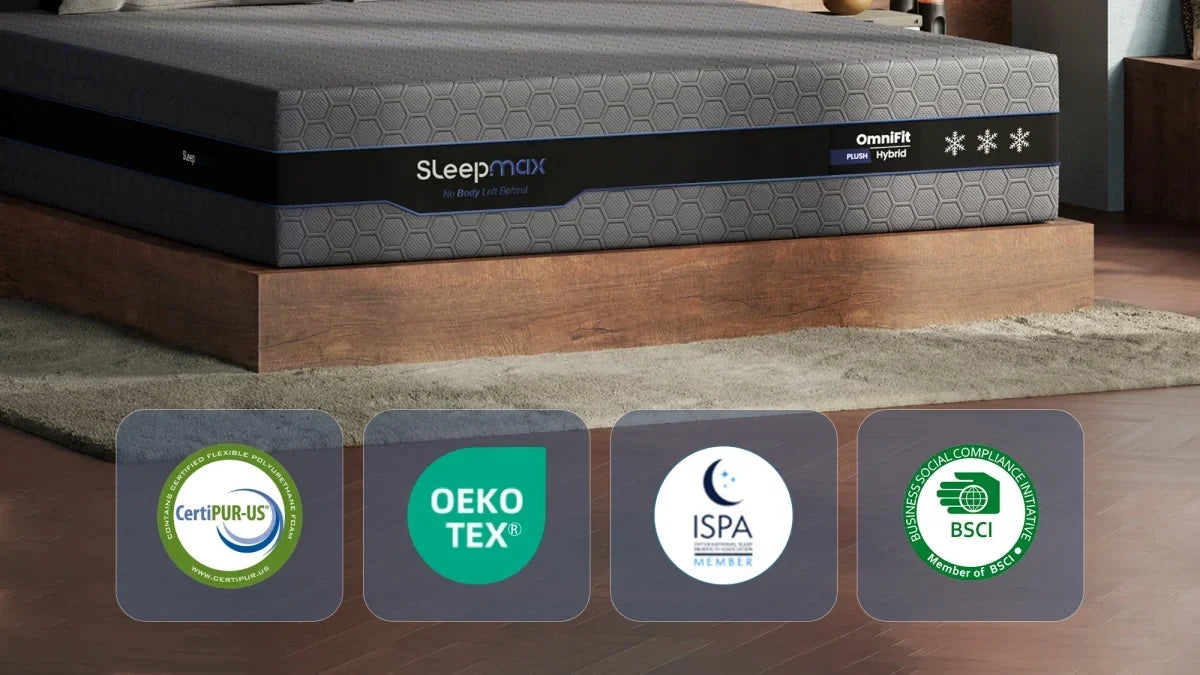
CertiPUR-US, OEKO-TEX, GREENGUARD Gold, GOTS, and GOLS, you will find different mattress certifications when shopping for one. What do they mean, and what matters most for you?
In this guide, we'll introduce the most common mattress certifications, explain what each one actually covers, and show you what to look for when comparing certified mattresses.
What Do Mattress Certifications Certify?
You need to understand what part of the mattress was certified first. A mattress is made from multiple components: foam, fabric, latex, springs, flame-resistant materials, and other layers. A certification may apply to only one of these components rather than the entire mattress.
Component vs. Finished Product
For example, CertiPUR-US applies specifically to flexible polyurethane foam. According to the CertiPUR-US certification program, certified foam is tested for content, emissions, and durability by independent accredited laboratories. That does not mean CertiPUR-US certifies every material in the mattress.
So when a mattress says "made with CertiPUR-US certified foam," it means the qualifying foam has been tested, rather than every component of the finished mattress carries that certification.
The Most Important Mattress Certifications to Know
| Certification / Standard | What It Mainly Covers | What It Can Tell You | What It Does NOT Prove |
| CertiPUR-US® | Flexible polyurethane foam | Foam content, emissions, and durability criteria | Entire mattress is certified |
| OEKO-TEX® STANDARD 100 | Textiles/components | Tested for harmful substances | Entire mattress is chemical-free |
| GREENGUARD Gold | Finished products/material emissions | Stricter limits on VOC emissions | Mattress contains no chemicals |
| GOTS(Global Organic Textile Standard) | Organic textiles | Organic fiber content plus processing criteria | All mattress materials are organic |
| GOLS(Global Organic Latex Standard) | Organic latex | Organic natural rubber latex | Entire mattress is organic |
1. CertiPUR-US®: A Key Certification for Foam
If you're buying a memory foam or hybrid mattress, CertiPUR-US is one of the most useful certifications to understand.
The program evaluates flexible polyurethane foam for criteria covering chemical content, emissions, and physical performance. According to the current CertiPUR-US criteria, certified foam must:
- Be made without formaldehyde
- Be made without ozone-depleting substances
- Be made without phthalates regulated by the U.S. Consumer Product Safety Commission (CPSC).
- Be made without mercury, lead, and other heavy metals.
- Meet low-VOC emission requirements.
- Be screened for relevant hazardous chemicals.
However, don't turn "CertiPUR-US certified" into a "non-toxic mattress." Even CertiPUR-US itself does not permit certified foam to be marketed with broad claims such as "chemical-free" or "non-toxic." The certification applies to qualifying foam.

All foam layers used in our Sleepmax hybrid mattresses, including conventional support foam, memory foam, and cooling gel memory foam, are CertiPUR-US® certified. This means the qualifying foam meets CertiPUR-US® requirements for chemical content and low-VOC emissions, including restrictions on ozone-depleting substances, certain phthalates, heavy metals, and other regulated substances.
How to verify it: Check the brand or manufacturer in the official CertiPUR-US directory. If the company is not listed, CertiPUR-US says it cannot vouch for the use of certified foam.
2. OEKO-TEX® STANDARD 100: Focused on Textiles
OEKO-TEX® STANDARD 100 is especially relevant to the fabrics and other textile components that come into contact with your skin. Unlike CertiPUR-US, which focuses specifically on flexible polyurethane foam, STANDARD 100 is a textile safety standard that tests the certified article for harmful substances.
Depending on the product and applicable requirements, testing can include:
- Azo dyes that can release certain prohibited aromatic amines.
- Formaldehyde and other regulated chemical residues.
- Phthalates and other plasticizers.
- Heavy metals, including lead, cadmium, mercury, arsenic, and chromium.
- Pesticide residues found in certain textile fibers.
- Chlorinated phenols, including substances such as pentachlorophenol and other regulated chlorophenols.
- PFAS-related substances and other regulated chemicals covered by the current STANDARD 100 requirements.
- Allergenic and carcinogenic dyes and pigments, where applicable.
- Nitrosamines and nitrosatable substances, which are subject to specific limits under the standard.
OEKO-TEX® also regularly reviews and updates its limit values. The current standard states that its requirements are reviewed at least once a year to account for new scientific findings and regulatory developments.
Why does the Product Class matter?
One detail that mattress shoppers often miss is that OEKO-TEX® STANDARD 100 has four Product Classes, and the requirements become stricter as the potential for skin contact increases:
- Product Class I: Products for babies and toddlers. This has the strictest requirements and limit values.
- Product Class II: Products that come into direct skin contact, such as bed linens and underwear.
- Product Class III: Products without direct skin contact, such as jackets and coats.
- Product Class IV: Home textiles and decorative materials, such as curtains and upholstery fabrics.
For a mattress, the cover and other components that directly touch your skin are particularly relevant. If a mattress cover carries an OEKO-TEX® STANDARD 100 certification, you should still check exactly what the certificate covers and which Product Class applies.

For instance, the Sleepmax best affordable hybrid mattress is certified under OEKO-TEX® STANDARD 100 (Product Class I). This means the certified textile components are tested against the standard's strict limits for harmful substances.
How to verify it: Look for the OEKO-TEX label or certificate number on the product or packaging, then enter the number into the official OEKO-TEX Label Check to verify the certification.
3. GREENGUARD / GREENGUARD Gold: Indoor Air Quality
If you're mainly concerned about mattress off-gassing and indoor air quality, GREENGUARD Gold is worth looking for. Unlike certifications that focus on a specific material, GREENGUARD evaluates chemical emissions from the finished mattress into indoor air.
GREENGUARD Gold uses stricter emission limits than standard GREENGUARD and evaluates emissions from more than 360 VOCs, including formaldehyde and other chemicals. It also includes health-based criteria for additional chemicals and requires compliance with the California Department of Public Health's Section 01350 indoor-emissions standard.
For mattress shoppers, this makes GREENGUARD Gold particularly relevant to mattress off-gassing safety and indoor air quality.
However, GREENGUARD Gold does not mean a mattress is chemical-free. It indicates that the finished product meets specific limits for chemical emissions into indoor air—not that it contains no chemicals at all.
4. GOTS: When Organic Textiles Matter
GOTS is more relevant when you're specifically shopping for organic cotton, wool, or other organic textile materials. It covers organic fiber content and requirements throughout textile processing and manufacturing.
Under the current GOTS standard, products labeled "Organic" must contain at least 95% certified organic fiber content, while the "Made with organic materials" grade requires at least 70%.
5. GOLS: For Organic Latex
For latex mattresses, GOLS (Global Organic Latex Standard) is the certification to know.
GOLS focuses on organically grown natural rubber latex and establishes requirements for products made with certified organic latex. The GOLS standard also addresses approved additional materials and supply-chain requirements.
If you're comparing natural latex mattresses, GOLS can provide more useful information than a generic natural or eco-friendly claim.
What Certifications Matter Most When Buying a Mattress?
It depends on your priority:
- Concerned about foam chemicals or off-gassing? Look for CertiPUR-US and/or GREENGUARD Gold.
- Concerned about textile safety? Look for OEKO-TEX® STANDARD 100.
- Want organic cotton or wool? Look for GOTS.
- Want organic latex? Look for GOLS.
- Want a fiberglass-free mattress? Look for an explicit fiberglass-free statement and verify the flame-barrier material.
- Want durability? Look beyond certifications and examine construction, material quality, and actual durability testing.
FAQ
Is CertiPUR-US the same as being non-toxic?
No. CertiPUR-US certification applies to qualifying flexible polyurethane foam and establishes requirements for content, emissions, and durability. It does not certify every material in the finished mattress, and the program itself does not authorize broad "non-toxic" claims.
Which mattress certification is best?
There isn't one universal best mattress certification. CertiPUR-US is particularly useful for foam, GREENGUARD Gold is relevant to VOC emissions, OEKO-TEX® STANDARD 100 focuses on textiles, GOTS covers certified organic textiles, and GOLS focuses on organic latex. The best one depends on what you want to verify.
Does a certified mattress mean it won't be off-gassing?
Certifications can establish emissions limits or material requirements, but a new mattress may still have an initial odor. Mattress off-gassing is particularly common with compressed foam mattresses. If you're sensitive to smells, allow the mattress to air out in a well-ventilated room before use.
Can mattress certifications prove a mattress is fiberglass-free?
No. There is currently no universal "fiberglass-free mattress certification". If avoiding fiberglass is important to you, look for an explicit manufacturer statement identifying the flame-barrier material and confirming that the mattress is fiberglass-free.
What is the difference between CertiPUR-US vs GOTS vs GOLS?
It lies in the material being tested and whether the certification focuses on chemical safety or organic standards:
- CertiPUR-US applies to flexible polyurethane foams (like memory foam and support foam), testing them for low VOC emissions, heavy metals, and harmful chemicals. It does not mean the foam is organic.
- GOTS evaluates organic textiles (such as organic cotton or wool covers and fill), requiring at least 70% to 95% certified organic fiber content alongside strict processing standards.
- GOLS specifically certifies natural rubber latex, ensuring it is grown organically and processed according to environmental and human health standards.


