


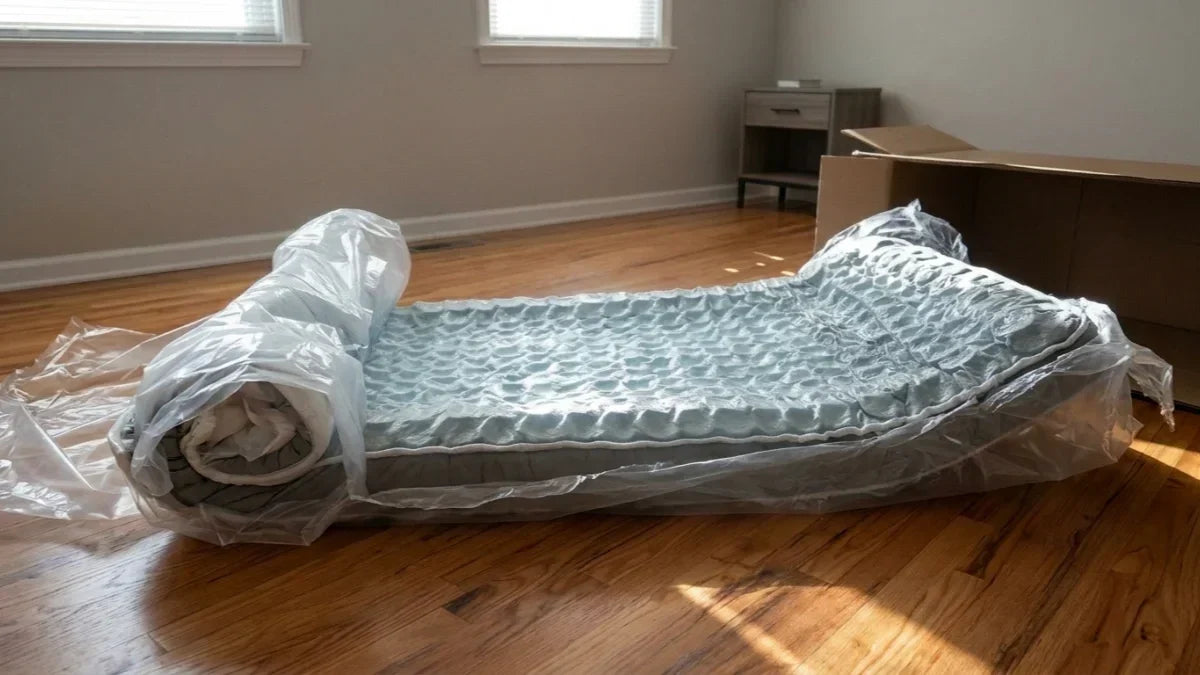
Mattress smells bad the moment you open the box? The new mattress smell is unpleasant, but does it mean your mattress is dangerous?
What you’re noticing is commonly called mattress off-gassing. It refers to the release of volatile organic compounds (VOCs) from certain materials as they come into contact with air. The smell usually becomes less noticeable as these compounds dissipate.
What Is Mattress Off-Gassing?
Mattress off-gassing is the release of VOCs and other airborne compounds from materials used in a mattress, particularly certain foams, adhesives, fabrics, and other components.
VOCs are chemicals that can evaporate into the air at room temperature. According to the U.S. Environmental Protection Agency (EPA), VOCs can come from many ordinary household products and furnishings, and indoor concentrations can sometimes be higher than outdoor levels. [1]
Foam mattresses are particularly relevant because polyurethane foam can emit VOCs. Research published in Environmental Science & Technology found that VOC emissions from polyurethane mattresses varied depending on environmental conditions, with higher temperatures increasing emissions. [2]
That doesn't mean every new mattress produces the same chemicals or poses the same level of exposure. Materials, manufacturing processes, mattress construction, room temperature, ventilation, and other factors can all affect emissions.
Is New Mattress Smell Harmful?
A noticeable smell doesn't tell you whether a mattress is safe or unsafe. What matters is what chemicals are being released, at what concentration, and for how long.
The EPA notes that exposure to some VOCs can cause symptoms such as eye, nose, and throat irritation, headaches, dizziness, and nausea. However, the health effects vary substantially between individual compounds and depend on factors such as exposure level and duration. [1]
This is why it's difficult to make a blanket statement that every new mattress smell is either harmless or dangerous. If the odor is strong enough to cause irritation, headaches, nausea, or breathing discomfort, you don't need to force yourself to sleep on the mattress. Increasing ventilation and reducing your exposure is a more sensible approach.
How Long Does Mattress Off-Gassing Last?
It depends. Some mattresses may have a noticeable odor for only a few days, while others may take longer for the odor to become difficult to detect.
Research on memory foam mattresses found that some emissions had short half-lives measured in 4 to 12 hours, while other modeled compounds had longer decay periods of around 24 days. Overall emissions declined substantially after the initial installation period. [3]
So, pay more attention to:
- Is the odor becoming weaker?
- Does the room have adequate ventilation?
- Does the smell cause any physical discomfort?
- Has the manufacturer provided specific airing instructions?
Is Memory Foam Toxic?
You can't determine whether a memory foam mattress is “toxic” simply because it smells.
Memory foam is generally a type of polyurethane foam, and polyurethane foam can release VOCs. However, the presence of VOC emissions does not by itself establish that a mattress will cause harmful health effects.

In the 2022 study of two memory foam mattresses, researchers measured several VOCs after installation. Emissions declined over time, and the modeled concentrations were below available health-based benchmarks for the individual chemicals evaluated. [3]
At the same time, that study examined only two mattresses, so its findings shouldn't be treated as proof that every memory foam mattress has the same emission profile.
If you're particularly sensitive to odors or want to minimize exposure, looking at the manufacturer's material information and relevant certifications can be more useful than judging a mattress solely by its smell.
How to Speed Up Mattress Off-Gassing
If your new mattress smells stronger than expected, ventilation is your most useful tool.
The EPA recommends increasing ventilation to reduce indoor concentrations of VOCs and other pollutants.
1. Remove the Packaging
Take off all plastic packaging as soon as you are ready to set up the mattress. Don't leave the mattress sealed longer than necessary. Once unpacked, it can begin expanding and airing out.
2. Open the Windows
If weather and outdoor air quality allow, open windows to increase the exchange of indoor and outdoor air. Cross-ventilation can be particularly useful if you have windows on opposite sides of the room.
3. Use a Fan

A fan can help move air around the room and toward an open window. You don't need to blast the mattress directly with a high-powered fan. The goal is to improve overall air circulation and ventilation.
4. Let the Mattress Air Out Before Sleeping on It
If the smell is strong, consider giving the mattress additional time to air out before using it. Follow the manufacturer's setup instructions first. Some compressed mattresses also need time to fully expand before they are ready for normal use.
5. Keep the Room Cool and Well Ventilated
Temperature can affect VOC emissions. One study found that elevated heat significantly increased VOC emissions from polyurethane mattresses. That doesn't mean you should intentionally heat your bedroom to accelerate off-gassing. Instead, focus on normal, comfortable room conditions combined with good ventilation.
If you prefer a hybrid mattress but are concerned about the smell that can come with a new mattress in a box, the construction matters. Hybrid mattresses combine foam comfort layers with a coil support system, so their off-gassing potential depends largely on the type and amount of foam used. The coil system itself generally produces little to no off-gassing odor.
Sleepmax builds its mattresses around a hybrid construction, combining foam comfort layers with a pocketed coil support system. Sleepmax cooling hybrid mattress is a nice option if you prefer a refreshing sleep experience, better cushioning, and good support. As with any mattress that contains foam, allowing it to fully expand and air out in a well-ventilated room after unboxing can help the initial odor dissipate.
Mattress Off-Gassing: What Actually Helps?
| Method | How it helps | Worth trying? |
| Remove plastic packaging | Allows materials to release trapped odors | Yes |
| Open windows | Increases fresh-air exchange | Yes |
| Use a fan | Improves air circulation and ventilation | Yes |
| Leave the mattress in a closed room | Limits air exchange | No |
| Add strong fragrances | Masks the odor rather than removing emissions | Not recommended |
| Deliberately heat the mattress | May increase VOC emissions | No |
| Follow manufacturer instructions | Provides product-specific setup guidance | Yes |
Try your best to reduce the concentration of airborne compounds by improving ventilation rather than trying to cover up the smell.
When Should You Be Concerned About a New Mattress Smell?
A mild chemical smell that gradually decreases is different from an odor that remains extremely strong or causes physical symptoms.
Consider stopping use temporarily and contacting the manufacturer if:
- The odor remains unusually strong for an extended period.
- You experience persistent headaches, nausea, eye irritation, or breathing discomfort around the mattress.
- The mattress has an unusual chemical odor that doesn't seem to be fading.
- The product arrived damaged or has an unexplained material defect.
- The mattress doesn't match the manufacturer's stated specifications.
If you experience significant or persistent symptoms, particularly breathing difficulties, seek appropriate medical advice rather than assuming the mattress is the cause.
The Bottom Line on Mattress Off-Gassing
A new mattress smell is usually related to the release of volatile compounds from mattress materials, and foam mattresses can emit VOCs after manufacturing and installation.
That doesn't mean “new mattress smell = toxic mattress.” Research on specific memory foam mattresses has found that emissions can peak shortly after installation and decline over time, with the tested mattresses showing modeled concentrations below available health-based benchmarks.
If you're dealing with a strong odor, the most practical response is straightforward: remove the packaging, give the mattress time to expand, increase ventilation, and follow the manufacturer's instructions.
FAQ
Is it safe to sleep on a mattress that smells like chemicals?
If the odor is strong enough to cause headaches, nausea, eye irritation, or breathing discomfort, it would be a great option to stop using it temporarily, increase ventilation, and contact the manufacturer for product-specific guidance.
How can I remove the new mattress smell faster?
The most practical approach is to remove the packaging, improve fresh-air ventilation, open windows when appropriate, and use fans to increase air circulation. Avoid deliberately heating the mattress simply to accelerate off-gassing, since higher temperatures can increase VOC emissions from polyurethane mattresses.
References
[1] https://www.epa.gov/indoor-air-quality-iaq/volatile-organic-compounds-impact-indoor-air-quality
[2] https://pubmed.ncbi.nlm.nih.gov/31290311/
[3] https://pubmed.ncbi.nlm.nih.gov/35588879/


