


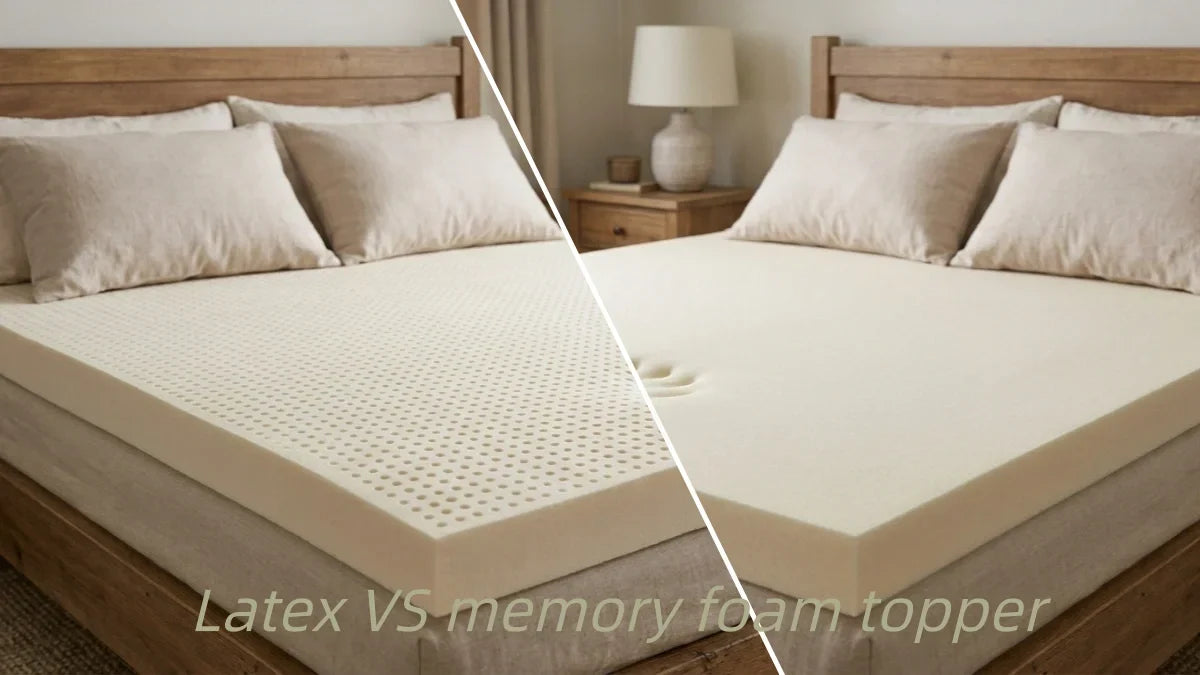
If you wake up with pressure or discomfort around your shoulders and hips, adding a mattress topper to your mattress may help make the surface more comfortable. Two of the most common options are latex and memory foam. In this article, we'll compare the two and help you choose based on your sleep preferences and specific needs.
Latex vs Memory Foam Topper: an Overview
Memory foam responds to body heat and pressure, allowing your body to sink gradually into the material. This creates the familiar contouring or "hugging" sensation and can be particularly useful for pressure relief.
Latex also conforms to the body, but it has a more responsive feel. Instead of sinking deeply into the topper, you tend to feel as though you are resting on top of it. It is generally more breathable and resilient than traditional memory foam.
| Feature | Latex Topper | Memory Foam Topper |
| Feel | Responsive, buoyant | Slow, body-hugging |
| Pressure relief | Good | Excellent |
| Bounce | High | Low |
| Ease of movement | Easier to change positions | More effort to move |
| Temperature | Generally cooler | More likely to retain heat |
| Motion isolation | Good | Excellent |
| Durability | Generally high | Varies by foam quality |
| Best for | Hot sleepers, combination sleepers | Pressure relief, side sleepers |
These are general guidelines rather than guarantees. Density, firmness, thickness, construction, and the mattress underneath all affect the final feel.
Latex Mattress Topper: Pros and Cons
Latex is made from rubber, although not every latex topper is made from natural rubber. Latex toppers may use natural latex, synthetic latex, or a blend.

Two common manufacturing methods are Dunlop and Talalay.
Dunlop Latex
Dunlop latex is generally denser and tends to have a firmer, more grounded feel. It can work well when you want to add some firmness and support without losing the responsive character of latex.
Talalay Latex
Talalay latex typically has a lighter, springier feel and a more consistent structure. It is often chosen by sleepers who want the pressure-relieving qualities of latex without feeling stuck in the material
Pros of Latex
More responsive than memory foam: Latex has a naturally bouncy feel, so it responds quickly when you change positions.
Easier to move around on: Because latex does not let you sink deeply into the mattress, it is generally easier to change positions and get in and out of bed.
More breathable: Its open-cell structure and less-contouring feel can allow more airflow around your body and through the material.
Provides cushioning without deep sinkage: Latex can cushion pressure points while keeping you feeling more on top of the mattress rather than deeply surrounded by it.
Typically durable: High-quality latex can maintain its shape and performance for many years with proper care.
Useful for combination sleepers: Its responsive feel makes it easier to move between your back, side, and stomach positions during the night.
Cons of Latex
Usually costs more than memory foam: Natural latex in particular tends to be more expensive because of its material and manufacturing process.
Has more bounce and less motion isolation: The responsive nature of latex can make it easier to feel movement from a partner compared with more motion-absorbing memory foam.
Does not provide the same deep body hug as memory foam: Latex cushions your body without creating the slow, sinking sensation associated with traditional memory foam.
Some people simply do not like its springy feel: If you prefer a mattress that feels soft, slow-moving, and closely conforming, the bounce of latex may not feel comfortable.
Memory Foam Mattress Topper: Pros and Cons
Memory foam is a type of viscoelastic polyurethane foam. It responds to pressure and body heat, gradually conforming to your shape. That makes memory foam particularly effective when your main complaint is pressure around the shoulders, hips, or other weight-bearing areas.

Pros of Memory Foam
Deep contouring and a hug feeling: Memory foam closely conforms to your body, creating the deep, hug feeling that many sleepers enjoy.
Excellent pressure relief: Its contouring properties help distribute body weight and cushion pressure-prone areas such as the shoulders and hips.
Strong motion isolation: Memory foam absorbs movement well, so you are less likely to feel your partner moving on the other side of the bed.
Helps soften a mattress that feels too firm: A memory foam comfort layer can add cushioning and contouring to a mattress with a firmer support core.
Usually more affordable than latex: Memory foam is widely available at different price points, making it an accessible option for shoppers on a budget.
Cons of Memory Foam
Can retain more body heat: Traditional memory foam can hold onto heat because of its dense, close-contouring structure, although some newer designs use cooling materials or open-cell construction to improve temperature regulation.
Slower response can make movement harder: Its slow response and deep contouring can make changing positions or getting out of bed feel more difficult.
Some models have noticeable new-foam odors: New memory foam toppers can release odors from manufacturing-related volatile compounds, although the intensity and duration vary by product.
Too much sinkage can reduce the sense of support: If you sink too deeply into the comfort layers, the mattress may feel less supportive and make it harder to move around.
Latex or Memory Foam Mattress Topper for Back Pain?
If you are choosing a topper specifically because your back hurts, start with the mattress underneath rather than the topper material alone.
A topper can adjust surface comfort, but it cannot completely correct a mattress with severe sagging or deep impressions. Sleep Foundation recommends replacing a mattress when significant wear or indentations are causing discomfort rather than relying on additional cushioning.
For a mattress that is simply too firm, memory foam may provide more noticeable pressure relief because it contours closely around the body.
Latex can be useful when you want cushioning without excessive sinkage. Its responsiveness may also make it easier to change positions during the night.
Your body weight matters, too. Heavier sleepers generally need enough firmness and support to prevent excessive sinkage, while lighter sleepers may prefer a softer surface.
So, pay attention to create a sleep surface that cushions pressure points while allowing your body to remain properly supported.
Latex or Memory Foam Mattress Topper for Side Sleepers?
Memory foam is often a natural fit because its close contouring allows the shoulders and hips to sink into the topper rather than pressing against a firm mattress surface.
Latex can also work for side sleepers, particularly if you prefer a less-sinking feel. A softer or thicker latex topper can provide cushioning while retaining more responsiveness.

If your current mattress feels painfully firm around your shoulder and hip, consider memory foam first. If it already provides enough cushioning but feels flat, unstable, or too warm, latex may be worth considering.
Latex vs Memory Foam Topper: Which Should You Choose?
1. If you tend to sleep hot but still want a memory foam feel → Choose cooling memory foam.
Look for features such as gel, PCM, graphite, copper, or an open-cell design that can help reduce heat buildup.
2. If you tend to sleep hot and prefer a responsive feel → Choose latex.
Latex is naturally breathable and less conforming, so you are less likely to sink deeply into a heat-trapping surface.
3. If your mattress is in good condition but feels too firm → Choose memory foam.
Memory foam provides deeper contouring and can add more cushioning to a firm mattress, especially around the shoulders and hips.
4. If you are a side sleeper → Choose memory foam.
Its deeper contouring can provide more cushioning around pressure-prone areas such as the shoulders and hips.
5. If you are a back or stomach sleeper → Choose latex.
Latex has a more responsive feel and provides cushioning without the same degree of sinkage as memory foam.
6. If you are a combination sleeper → Choose latex.
The quicker response makes it easier to change positions without feeling stuck in the topper.
7. If you sleep with a partner who moves a lot → Choose memory foam.
Memory foam generally absorbs movement better, so you are less likely to feel your partner changing positions during the night.
8. If you want a softer, hug-like feel → Choose memory foam.
It slowly conforms to your body and creates the familiar sinking, cradling sensation.
9. If you prefer a bouncy, “on-top” feel → Choose latex.
Latex responds quickly to movement and provides more bounce instead of allowing you to sink deeply into the surface.
10. If durability is your priority → Choose latex.
Latex is generally more durable than memory foam, although the actual lifespan still depends on the quality and construction of the topper.
11. If you are shopping on a tighter budget → Choose memory foam.
Memory foam toppers are generally available at a wider range of lower price points than latex toppers.
Follow this simple rule: choose memory foam for deeper cushioning and pressure relief, and choose latex for cooler sleep, easier movement, and a more responsive feel.
How Thick Should Your Topper Be?
Thickness determines how dramatically the topper changes your mattress.
A 1- to 2-inch topper is better when you want a relatively subtle adjustment. It can add some cushioning without completely changing the underlying feel.
A 3-inch topper creates a more noticeable transformation and provides deeper contouring.
A 4-inch topper can substantially alter the feel of a mattress, but it also increases the risk of excessive sinkage if the underlying mattress is already soft.
Your body weight and sleeping position matter here. A lightweight side sleeper may not need the same thickness as a heavier sleeper who wants significant pressure relief.
If your mattress is still structurally sound but feels too firm, a topper can be a practical way to adjust it. If the mattress has major sagging or permanent impressions, a topper is unlikely to fix the underlying support problem, and you should consider purchasing another comfortable mattress online or in a physical store instead.
Latex vs Memory Foam Topper: The Bottom Line
The key difference between latex vs memory foam topper is bounce vs hug. Memory foam lets you sink into the surface. Latex lets you rest more on top of it.
For deep pressure relief and a slower, cushioned feel, memory foam is usually the more natural choice. For cooling, responsiveness, and easier movement, latex has some clear advantages.
If you like memory foam but want a more comfortable surface without the feel of traditional thick memory foam, a cooling design can be another option. For example, the Sleepmax memory foam mattress topper is designed as a plush comfort layer for changing the feel of an existing mattress.
Ultimately, the best mattress topper is the one that corrects the specific problem with your current mattress rather than simply using the material with the most popular reputation.
FAQ
Can a mattress topper fix a bad mattress?
No, a mattress topper cannot fix a mattress with severe sagging, broken support, or deep permanent indentations. If the mattress is still structurally sound but feels too firm, too soft, or lacks enough cushioning, a topper can change the surface feel and make it more comfortable.
If your mattress is sagging, first check whether the problem comes from the mattress itself or from the bed frame or foundation. If the mattress has a deep permanent dip or damaged support system, replacing it is a better long-term solution than adding another layer on top.
Is gel memory foam better than regular memory foam?
Gel-infused memory foam is mainly designed to help manage heat, but the addition of gel does not make a topper more supportive or durable.
If you like the contouring feel of memory foam but sleep hot, look for a topper with cooling features and a breathable construction. You can also consider latex if temperature regulation is a higher priority.
Is latex better for hot sleepers?
Latex can be a good option for hot sleepers because its responsive, breathable structure generally allows more airflow than closely contouring memory foam. If you tend to sleep hot, look for a latex topper with a breathable cover and open construction. Also consider the mattress underneath, since heat can still build up if the underlying mattress retains a lot of heat.


