


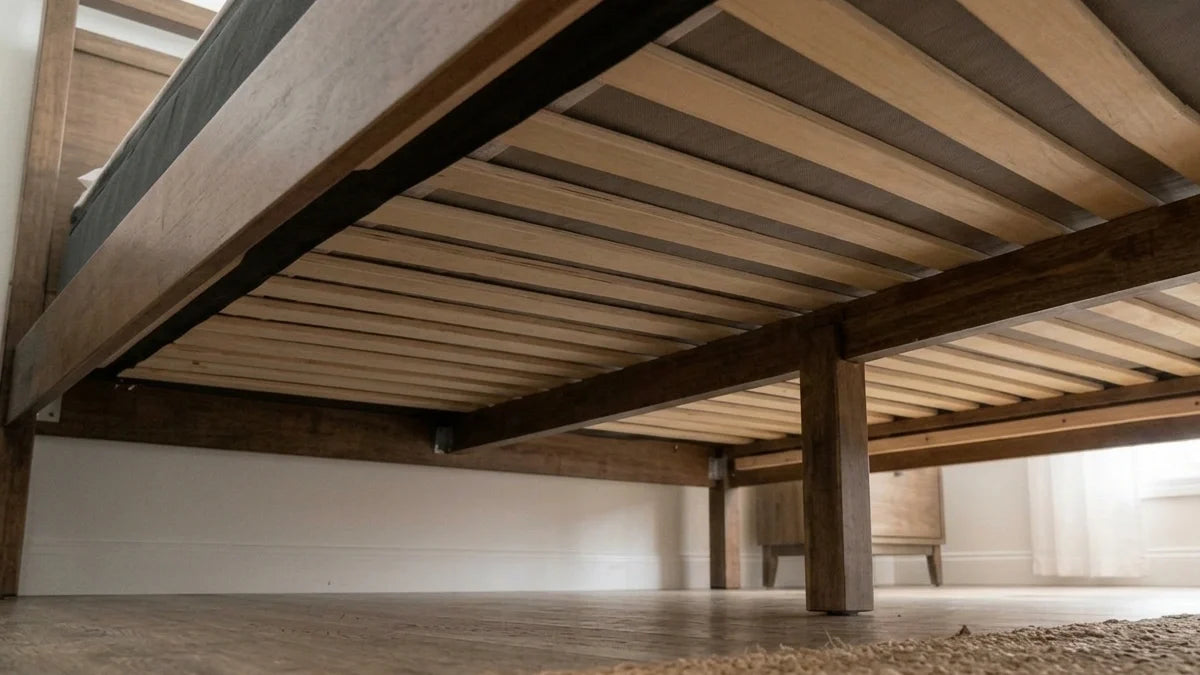
Yes, almost every queen bed frame needs center support. A queen mattress is 60 inches wide and 80 inches long, and two sleepers put a lot of concentrated weight right in the middle of that span. Without a center rail and at least one support leg that reaches the floor, the slats bow, the mattress sags, and your warranty can be at risk.
This guide explains why center support matters, how many support legs a queen bed frame needs, which other bed sizes need center support, and what to do if your frame doesn't have enough support.
The Short Answer: Yes, in Almost Every Case
A queen bed frame with slats or a metal grid needs a center support system, which usually means a center rail running head to foot with one or more legs touching the floor. The side rails carry the edges of the mattress, but they can't hold up the middle on their own.
There are a few exceptions. A solid platform base, a heavy-duty frame with thick cross supports, or an adjustable base designed for a queen mattress may not need a separate center beam. Always check the manufacturer's instructions for your specific frame.
Why a Queen Bed Frame Needs Center Support
The Span Problem
Slats on a queen frame stretch roughly 60 inches from one side rail to the other. Even strong wooden slats will flex over a span that long when they carry a mattress and two people. A center rail cuts that unsupported span in half, which keeps the slats flatter and much less likely to bend or crack.
Weight From Two Sleepers

Queen beds are the most popular size for couples, so the load is often heavy. It isn't just the static weight of the mattress and sleepers. Rolling over, sitting on the edge, and climbing in and out of bed all create sudden, concentrated pressure. Over months and years, that pressure is what damages a frame that lacks support.
What Happens Without Center Support
- Mattress sagging: The middle of the mattress dips because nothing is holding it level.
- Bent or broken slats: Slats carry more load than they were designed for and eventually warp or snap.
- Squeaking and wobbling: A flexing frame creates noise and movement every time you shift.
- Premature mattress wear: Foam and coils break down faster when the base is uneven.
How Many Center Support Legs Does a Queen Bed Frame Need?
Most queen bed frames use one center rail with at least one leg that touches the floor. Many well-built frames use two or three legs along the rail to spread the load, especially for heavier mattresses.
Heavier mattresses and heavier sleepers call for more support. Here is a general guide, though you should always follow your frame manufacturer's recommendations:
| Queen Mattress Type | Support Recommendation |
| Memory foam | Center rail with at least one floor leg, tight slat spacing |
| Innerspring | Center rail with one or two floor legs |
| Hybrid | Center rail with two or more floor legs |
| Latex | Center rail with two or more floor legs, sturdy slats |
If you and your partner are on the heavier side, or you have a thick, dense mattress, add extra legs when needed.
Which Beds Need Center Support? Twin, Full, Queen, King, and Cal King
The wider the bed, the more important center support becomes. Queen, King, and California King frames almost always need it, Full frames usually benefit from it, and Twin frames can often go without. Here is a quick comparison by size:
| Bed Size | Dimensions (in) | Center Support Needed? | Typical Center Legs |
| Twin | 38 x 75 | Usually not required | 0 to 1 |
| Twin XL | 38 x 80 | Usually not required, helpful for heavier mattresses | 0 to 1 |
| Full | 54 x 75 | Recommended | 1 |
| Queen | 60 x 80 | Yes | 1 to 2 |
| King | 76 x 80 | Yes, always | 2 to 3 |
| California King | 72 x 84 | Yes, always | 2 to 3 |
Leg counts are general ranges. Your frame manufacturer's instructions always come first.
Twin and Twin XL Bed Frames
Twin and Twin XL mattresses are only 38 inches wide, so the slats span a much shorter distance and the side rails can usually carry the load. Many twin frames have no center rail at all. If you use a thick hybrid or latex mattress, or an adult sleeps on it every night, a center rail with one leg is a smart upgrade.
Full Bed Frames
Most full frames don't come with a center rail with a single support leg. Consider adding one if your bed usually holds heavy sleepers or has people who move a lot on it.
Queen Bed Frames
Queen frames span 60 inches and are the most common couples' bed size, so they need a center rail and at least one leg that reaches the floor. Heavier mattresses call for two.
King and California King Bed Frames
King and Cal King frames carry the most weight across the widest spans, so center support is essential. A king bed spans 76 inches, and a Cal King is 84 inches long, which makes a longer center rail necessary. Look for frames with two or three center legs. Many king mattresses are paired with split box springs, and those also need support through the middle of the frame.
Do Different Types of Beds Need Center Support?
Slatted platform beds: Yes, in Queen size and larger. Slats alone can't hold up the middle.
Solid platform beds and storage beds with solid decks: Usually not, because the solid surface spreads the weight. Check the weight rating.
Metal bed frames with a box spring: Yes. The center support bar keeps the box spring from bowing in the middle.
Adjustable bases: These have their own built-in support, so a separate center rail isn't needed. Follow the base manufacturer's setup instructions.
Bunk and loft beds: These are usually twin or full, and the slats are designed for the span. Check the mattress thickness and weight limits.
Center Support and Your Mattress Warranty
Most mattress warranties require a properly supported base. In many cases, that means a frame with a center support system and slats spaced no more than about 3 inches apart. If a sagging problem is traced back to inadequate support, the manufacturer may consider the damage a result of improper use and decline a warranty claim.

Before you buy a frame, read the warranty terms for your mattress. You can find our policy details on the warranty page.
What If Your Queen Bed Frame Has No Center Support?
If your frame doesn't have center support, you have several options. Which one makes sense depends on the frame's condition and how it was built.
Add a Center Support Beam
Adjustable metal center support beams are made for this purpose. They span the head to foot of the frame and attach to the side rails or the head and foot boards. Measure the inside length of your frame first so you buy the right size.
Add Extra Support Legs
If your frame has a center rail but it doesn't touch the floor, adjustable support legs can fix that. Measure the distance from the rail to the floor and pick legs that can be adjusted to fit.
Add More Slats or Replace Worn Ones
If your slats are spaced too far apart, loose, or cracked, replace them or add extra slats to close the gaps. This is a simple fix that makes a noticeable difference.
Replace the Frame
If the frame is wobbly, bent, or cracked, or if you can't add support easily, replacing it is often the safest and most cost-effective option.
How to Check Whether Your Bed Frame Has Enough Support
You can check your frame in a few minutes. Take the mattress off and follow these steps:
- Look for a center rail. Check underneath the frame for a rail running from the headboard to the footboard.
- Make sure the legs touch the floor. Center legs that hover above the floor aren't doing their job.
- Measure the slat spacing. Use a tape measure to check the gap between each pair of slats. It should be about 3 inches or less.
- Test the slats. Press down on the middle of a few slats. They should feel firm, not bouncy or bent.
- Compare against your warranty. Make sure the frame meets the requirements in your mattress warranty.
Signs Your Queen Bed Frame Lacks Proper Support
- A visible dip or body impression in the middle of the mattress
- Slats that are bent, cracked, shifted, or flipped
- Creaking or squeaking when you move
- A mattress that feels soft or uneven sooner than expected
- A frame that wobbles or shifts when you sit on the edge
If you're noticing a dip in your mattress, check the frame first. A lack of support is a common reason for sagging, and fixing the frame may solve the problem. Our guide on why a mattress sags in the middle goes into more detail.
FAQ
How many slats does a queen bed frame need?
The number depends on slat width and the gap between them. As a general guide, a standard queen frame uses roughly 13 to 16 slats to keep the gaps at about 3 inches or less. Frames with narrower slats need more. If you can fit more than a 3-inch gap between slats on your frame, add extra slats or replace the base.
Why can’t slats alone replace center support?
Adding more slats improves the surface, but it doesn't solve the span problem. Every slat still stretches across the full width of the frame. Without a center rail underneath, those slats will gradually bend, crack, or pop out of their brackets.
Can I use a queen mattress on a bed frame without center support?
You can, but it isn't recommended. The mattress will likely sag in the middle over time, and your warranty could be affected.
How many legs should a queen bed frame have?
Most have five to six legs: four corner legs plus one or two center legs. Heavier mattresses and sleepers benefit from additional center support. Follow your frame manufacturer's guidelines.
How far apart should slats be on a queen bed frame?
Most mattress warranties call for slats spaced no more than about 3 inches apart. Check your specific warranty for the exact requirement.
Can the wrong bed frame void my mattress warranty?
Yes. If the damage is traced to a base that doesn't meet the warranty's support requirements, the claim may be denied. Read the terms before you buy.
Final Thoughts
A queen bed frame almost always needs center support, and the same goes for King and Cal King frames. The center rail keeps the middle of the mattress from sinking, the slats give the mattress a flat and breathable surface, and together they protect both your sleep and your warranty. If you're not sure whether your current frame is up to the job, a quick check underneath can save you from a sagging mattress later.
Ready to pair a supportive frame with a mattress that fits the way you sleep? Explore the Sleepmax hybrid mattress and find the right match.


