


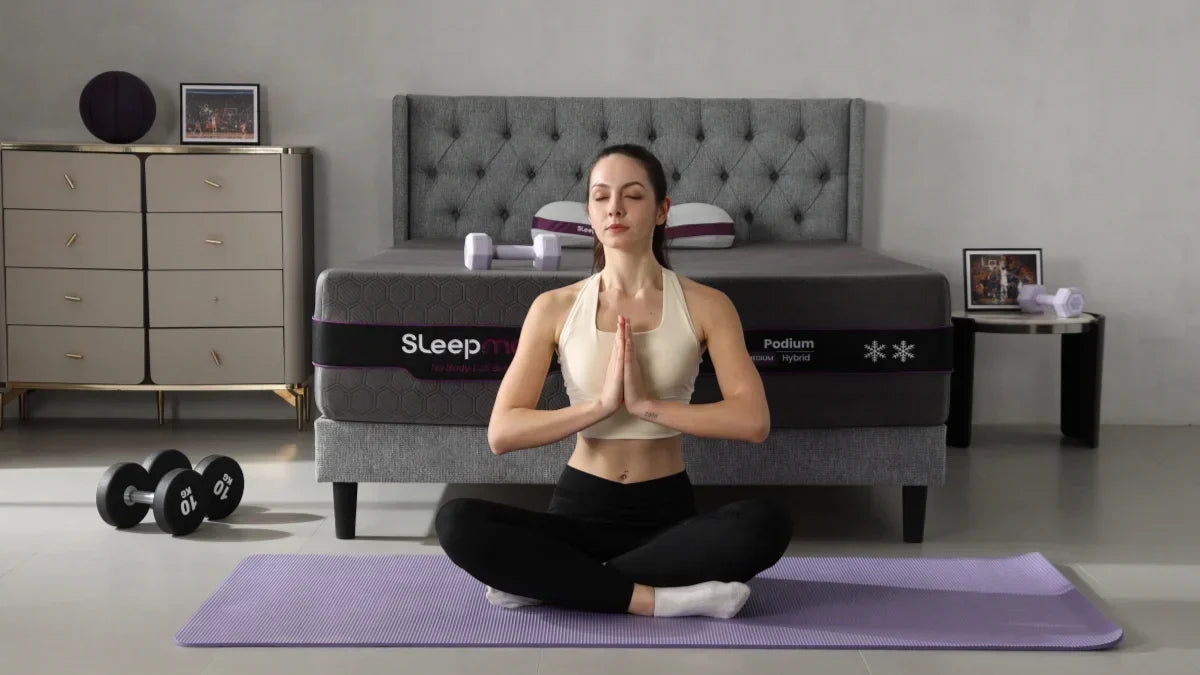
A recovery-oriented bedroom is not a substitute for sleep. It is a way to remove friction from sleep: excess heat, disruptive light, intermittent noise, an inconsistent schedule, or a surface that repeatedly wakes you.
That distinction matters when shopping. A mattress, sheet set, fan, or blackout shade may solve a specific environmental problem, but no product can compensate for chronically insufficient sleep or an erratic routine. A review of athlete sleep practices describes sleep as playing a key role in post-exercise recovery, fatigue reduction, and the reversal of processes associated with exercise fatigue (Doherty et al.).
This guide is educational, not medical advice. It focuses on practical bedroom conditions and purchasing decisions rather than diagnosing poor recovery, insomnia, pain, or a sleep disorder.
Start with Sleep, Not Products
Exercise recovery depends on a wider routine that includes sleep, nutrition, movement, and planning. Johns Hopkins presents these as accessible areas to address when making recovery part of an exercise routine (Johns Hopkins University). The bedroom belongs inside that system; it is not the whole system.
Before buying anything, identify what actually interrupts sleep. Common observations include waking hot, noticing streetlight through the curtains, being disturbed by a partner’s movement, or staying alert after a late workout. Write down the interruption rather than jumping directly to a product category.
A useful order of operations is:
- Protect a repeatable sleep and wake routine.
- Address obvious heat, light, and noise.
- Evaluate whether the mattress or bedding is contributing to awakenings.
- Change one variable at a time.
- Seek professional help when symptoms suggest something beyond room setup.
Consistency deserves particular attention. Guidance on athletic performance and sleep includes creating an appropriate sleep environment while also addressing behaviors such as evening caffeine, alcohol, and electronics (Sleep Foundation). In other words, curtains and cooling sheets cannot neutralize a routine that keeps pushing sleep later.
Define the recovery problem precisely
“Poor recovery” is too broad to guide a purchase. Separate it into observable problems:
| Observation | First area to investigate | What not to assume |
|---|---|---|
| Waking sweaty or throwing off covers | Room temperature, airflow, bedding layers | That a new mattress is automatically necessary |
| Waking when a partner turns | Bed stability, mattress motion transfer, bed-frame movement | That firmness alone predicts isolation |
| Morning pressure discomfort | Sleep position, pillow height, mattress support and pressure response | That the softest option will be best |
| Difficulty settling after training | Workout timing, wind-down routine, temperature and stimulation | That bedding is the sole cause |
| Early waking from traffic or daylight | Noise control and window treatment | That sleep duration is only a scheduling issue |
This problem-first approach keeps the bedroom focused on sleep continuity. It also prevents an expensive purchase from becoming a substitute for a simpler environmental correction.
Control Temperature First
Temperature is often the most practical place to begin because exercise, climate, bedding, sleepwear, airflow, and mattress construction can all influence how warm the bed feels. Sleep guidance for athletes commonly includes maintaining an appropriate sleep environment (Sleep Foundation).

Avoid treating one thermostat number as universally correct. The useful target is a room and bed climate that lets you fall asleep and remain asleep without repeatedly seeking or shedding warmth. Humidity, season, air movement, another sleeper, and personal preference all change the experience.
Separate room heat from bed heat
Run a simple diagnostic before replacing the mattress:
- If the entire room feels stale or warm, start with ventilation, air conditioning, or a fan where appropriate.
- If the room feels comfortable but heat builds under the covers, reduce or change bedding layers.
- If only the contact area against the mattress feels hot, examine the protector, topper, foam layers, and fitted sheet.
- If a partner is the main heat source, separate blankets can give each sleeper control without changing the whole bed.
A waterproof protector, thick topper, dense comfort layer, heavy duvet, and heat-retaining sleepwear can operate as a stack. Evaluate the stack rather than blaming the most visible item.
Shop for adjustability, not cooling language
“Cooling” can refer to several different mechanisms: airflow, moisture handling, reduced insulation, or a surface that initially feels cool. Those are not interchangeable. Ask what component is intended to manage heat and whether it works passively or needs power.
For bedding, consider layer weight, weave, fit, care requirements, and whether you can remove one layer without losing comfort. For a mattress, look at the full construction description instead of relying on the name of a single fabric or foam. If meaningful construction information is unavailable, treat broad temperature claims cautiously.
Shoppers considering a hybrid can review the SLEEPMAX Podium Hybrid Mattress as one commercial option, but it should be evaluated against the sleeper’s actual heat, pressure, and partner-disturbance problems. The priority remains uninterrupted sleep and a consistent routine, not buying a product because it is marketed around recovery.
Reduce Light and Noise
A dark, quiet bedroom is easier to evaluate than a vague promise of “better sleep.” Stand in the room after lights-out and identify exact sources: an illuminated charger, a hallway gap, vehicle headlights, an early sunrise, plumbing, traffic, pets, or notifications.

Control light at the source
Start with low-cost corrections:
- Cover or remove unnecessary indicator lights.
- Charge the phone outside immediate reach if notifications or checking behavior are disruptive.
- Use window coverings that address the direction and timing of incoming light.
- Check light leakage around the sides and bottom, not only through the center of a curtain.
- Keep a safe, accessible path for nighttime movement rather than making the room hazardous.
Electronics also affect routine, not merely brightness. Athlete-oriented sleep guidance recommends staying away from electronics in the hours before bedtime (Sleep Foundation). A practical interpretation is to create a repeatable cutoff or move stimulating activities away from the bed.
Treat intermittent noise differently from steady noise
A steady fan or ventilation sound may be less disruptive for some people than unpredictable doors, voices, or traffic. First fix controllable sources: rattling bed hardware, a vibrating phone, loose vents, or a television left on. Then consider earplugs, sound masking, door seals, or room layout according to safety, comfort, and household needs.
Do not mask sounds you need to hear for safety, caregiving, alarms, or emergencies. The goal is fewer unnecessary awakenings, not total sensory isolation.
Make the Bed Support Sleep Continuity
A recovery-friendly bed should help the sleeper stay comfortable and should not create frequent awakenings through heat, pressure, unstable support, or partner movement. “Recovery mattress” is not a standardized answer to those issues. Translate the label into testable criteria.
Match the surface to the sleeper
Consider:
- Usual sleep position and whether pressure builds at the shoulders, hips, or other contact areas.
- Whether the midsection feels adequately supported rather than hammocked or pushed upward.
- Whether position changes require excessive effort.
- Whether the edge feels stable enough for the way the sleeper enters, exits, or uses the bed.
- Whether a partner’s movement regularly travels across the surface.
- Whether the mattress, protector, sheets, and covers together trap unwanted heat.
Firmness labels are comparative descriptions, not a complete fit assessment. Body shape, sleep position, comfort-layer design, and support construction all affect the result. Test the bed in the positions used at home and pay attention to pressure, alignment, ease of movement, and temperature rather than showroom first impressions alone.
Audit the entire sleep system
The mattress is only one component. A poorly supported foundation can introduce movement or sagging sensations. An unsuitable pillow can affect neck comfort even when the mattress fits well. A thick topper changes both surface feel and heat retention. Tight sheets can alter the feel of a plush surface, while loose or bunching layers can become distracting.
For couples, test the setup together when possible. One sleeper may need more pressure relief while the other prioritizes ease of movement or a cooler surface. Separate blankets, adjustable room airflow, or different pillow choices can solve individual problems without forcing a compromise on every element.
SLEEPMAX describes its broader range around hybrid mattresses and cooling bedding for pressure relief, motion isolation, temperature regulation, and everyday recovery. Those are brand positioning statements, not medical outcomes. Buyers can use SLEEPMAX to compare the available product categories, then verify whether the published details address their specific sleep interruption.
Keep Training and Sleep Schedules Compatible
The most technically sophisticated bedroom cannot create time for sleep. Protect the schedule first, especially when work, commuting, family duties, and training compete for the same evening hours.
A review of athlete practices links sleep with post-exercise recovery and fatigue reduction (Doherty et al.). That supports treating sleep as part of the training plan rather than whatever remains after training is finished.
Build a repeatable post-workout transition
The routine should be simple enough to repeat:
- Finish necessary recovery tasks without turning them into an open-ended evening.
- Dim unnecessary light and reduce stimulating media as bedtime approaches.
- Prepare the room temperature and bedding before getting into bed.
- Keep equipment, laundry, and work materials from taking over the sleep area.
- Record whether late sessions consistently coincide with difficulty settling.
If a particular training time repeatedly disrupts sleep, discuss scheduling and recovery with a qualified coach or healthcare professional as appropriate. Do not use supplements, extreme cooling, or major training changes based solely on forum advice.
Test Changes without Guessing
A short, structured bedroom audit is more informative than changing the mattress, thermostat, curtains, and bedtime simultaneously. Keep the process low burden so the tracking itself does not become another source of stress.
Establish a baseline
For several ordinary nights, note:
- Approximate bedtime and wake time.
- Workout type and whether it ended unusually late.
- Whether the room or bed felt too warm, too cold, noisy, or bright.
- The main reason you remember waking.
- Morning comfort, including any recurring pressure area.
- Whether a partner, pet, or device interrupted sleep.
This is not a medical sleep study and cannot diagnose a disorder. It is a purchasing and environment log.
Change one variable
Choose the most plausible problem and make one reversible adjustment. Examples include removing a heavy layer, changing fan placement, covering a light source, tightening bed-frame hardware, or separating blankets. Keep the rest of the routine reasonably stable, then compare the same observations.
A product purchase becomes easier to justify when low-cost tests point to a persistent issue. If removing a topper reduces overheating but creates pressure discomfort, for example, the decision is no longer simply “buy something cooler.” The requirement is a surface layer that balances pressure comfort with less insulation for that sleeper.
Evaluate products against the identified problem
Before ordering, verify the product description, dimensions, care instructions, compatible foundation requirements, return or trial terms, and warranty conditions on the seller’s current pages. Brand policies can change, so save the version that informed the decision and confirm any unclear condition with the seller.
Be cautious when a seller:
- Promises medical recovery outcomes without appropriate evidence.
- Uses “cooling” without explaining the relevant material or construction.
- Treats one firmness as suitable for every body and sleep position.
- Omits basic construction or care information.
- Makes it difficult to find the applicable trial, return, or warranty terms.
Know When the Bedroom Is Not the Main Problem
Environmental changes are appropriate for environmental problems. They are not a diagnosis or treatment for persistent insomnia, breathing problems during sleep, significant pain, injury, or unexplained daytime impairment.
Seek prompt professional medical advice when sleep or recovery problems are persistent, worsening, affecting safety or daily function, or accompanied by concerning symptoms. Urgent symptoms, severe injury, breathing difficulty, chest pain, fainting, confusion, or another possible emergency warrant urgent or emergency care rather than a bedding experiment.
Also involve a qualified professional before pushing through significant pain or making major training changes after illness or injury. A comfortable bedroom can support rest, but it cannot determine whether a symptom comes from training load, a health condition, medication, stress, or another cause.
FAQ
What is the best sleep environment for exercise recovery?
Start with a room that supports uninterrupted sleep: comfortably cool, dark, quiet, and free from unnecessary alerts or stimulation. Pair that environment with a repeatable sleep schedule. The best setup is the one that addresses the sleeper’s observed disruptions rather than following a product label.
Do i need a special recovery mattress?
No special label guarantees better recovery. Evaluate whether a mattress provides suitable pressure comfort, stable support, manageable heat, easy movement, and acceptable partner isolation. Sleep itself takes priority over recovery-themed marketing.
Should i make the room as cold as possible?
No. Aim for comfortably cool rather than extreme cold. Adjust airflow, humidity, sleepwear, and bedding layers as well as the thermostat. A temperature that causes shivering or discomfort is not a useful recovery strategy.
Can cooling sheets fix a hot mattress?
They may change the feel of the bedding layer, but overheating can come from the room, protector, topper, comfort layers, duvet, sleepwear, or another sleeper. Diagnose the stack before expecting one sheet set to solve every source of heat.
How can couples create a better recovery bedroom?
Identify each person’s main disruption. Separate blankets, individual pillows, improved frame stability, airflow adjustments, and stronger motion isolation may address different needs. Test the complete setup together when possible.
When should i talk to a healthcare professional?
Get professional advice when sleep difficulty, pain, breathing concerns, unusual fatigue, or poor recovery persists, worsens, or affects safety and daily functioning. Use urgent or emergency services for potentially serious or rapidly developing symptoms.
Sources
- The Sleep and Recovery Practices of Athletes
- Workout Recovery: Sleep, Nutrition, Movement, Planning
- Sleep, Athletic Performance, and Recovery
- Poor sleep after harder workout — r/AdvancedRunning


