


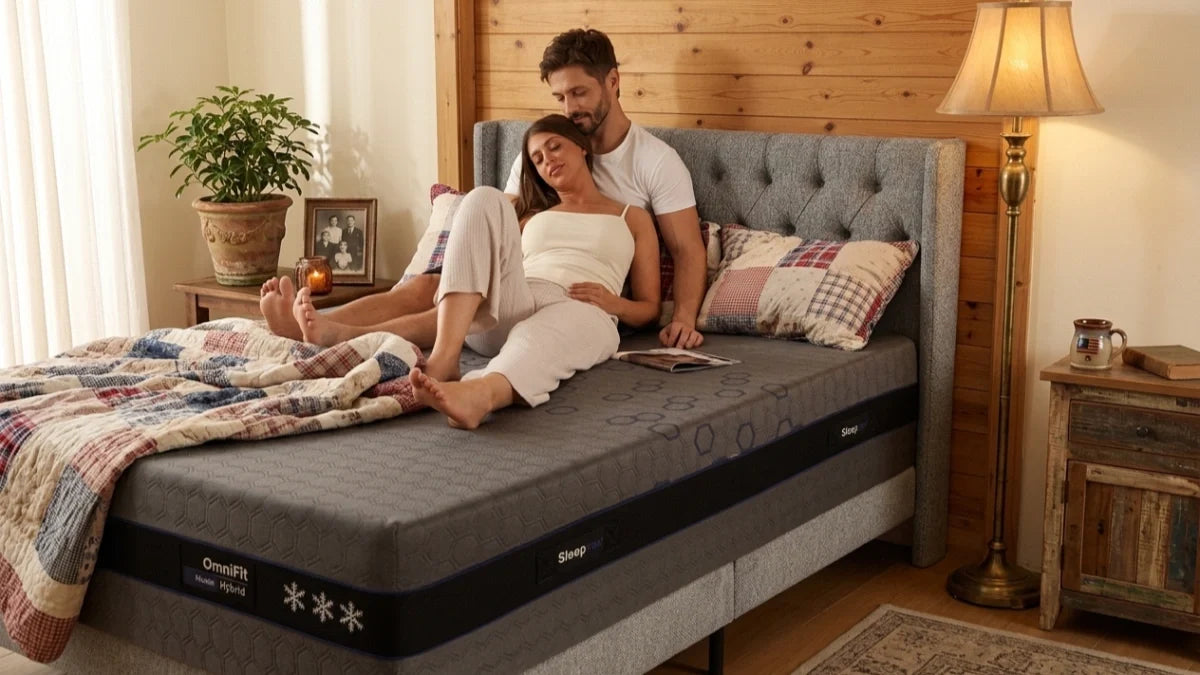
For most couples, sharing a bed is simply what you do. Nobody sits down and decides it. But lately, "sleep divorce" has become a popular phrase, and more people are asking whether they would sleep better on their own.
It is a fair question. So what does the research actually say about sleeping next to someone you love?
The short answer: the evidence leans positive, but it is far from settled. Below are seven benefits that studies have linked to sharing a bed with a partner, followed by an honest look at where the science runs out and when sleeping together stops working.
1. You May Fall Asleep Faster and Sleep Longer
According to the American Academy of Sleep Medicine's release, people who shared a bed with a partner most nights reported less severe insomnia, less fatigue, and more time asleep than those who never did. They also fell asleep faster, stayed asleep longer once they drifted off, and had a lower sleep apnea risk.
The findings were presented at SLEEP 2022 and published as an abstract in the journal Sleep (Fuentes et al., 2022). Because it is a conference abstract built on self-reported surveys, it shows an association, not proof that sharing a bed causes better sleep.
2. You May Get More REM Sleep, With Fewer Interruptions
REM sleep is the stage most closely tied to memory and emotion regulation. In a 2020 sleep-lab study in Frontiers in Psychiatry (Drews et al.), 12 young, healthy heterosexual couples slept both alone and together while researchers recorded their brain activity. Sleeping together was associated with about 10% more REM sleep and less fragmented REM sleep.
The same study found that partners' sleep stages were more closely synchronized when they slept together, and that they moved their limbs more. It is promising but small. A 2021 review in Sleep Health points out that results beyond REM sleep are inconsistent across the few lab studies that exist.
3. Feeling Safe May Help Lower Stress
Sleep is easier when your body feels secure, and a partner can provide that. A sleep expert quoted by Mattress Clarity explains that sleeping next to someone you love can create feelings of protection and security, which may reduce anxiety and lower cortisol, the body's main stress hormone.
The Arizona data points the same way. As Sleep Review notes, partner bed-sharers had lower depression, anxiety, and stress scores, while sleeping with children was linked to more stress.
4. It Is Linked to Better Mental Health and a Happier Relationship

The Arizona team also found that sleeping with a partner was associated with greater social support and higher satisfaction with life and relationships. Sleeping alone was associated with higher depression scores and lower social support (AASM release).
Cause and effect likely run in both directions. The Sleep Health review (Andre et al., 2021) describes sleep quality and relationship quality as bidirectional, so a good relationship may help you sleep, and good sleep may help the relationship. In the sleep-lab study above, couples with a deeper relationship also showed more synchronized sleep (Drews et al., 2020).
5. Synced Sleep May Support Your Heart
It may not be the bed itself that matters most, but whether you and your partner sleep on the same schedule. A 2017 study by Gunn and colleagues in Sleep (PubMed) followed 46 healthy married couples aged 18 to 45 who shared a bed at least four nights a week. Using wrist actigraphy, researchers measured how often partners were asleep and awake at the same time. Couples with higher sleep-wake concordance had lower nighttime blood pressure and lower C-reactive protein, a marker of inflammation.
The effects were modest, and the blood pressure link was stronger in women. Everyone in the study shared a bed, so it compares couples who sync up more with couples who sync up less, not bed sharing with sleeping alone. The couples were also healthy and free of sleep disorders, and the authors note that for couples with a sleep disorder, higher concordance could even add to health risk. The design was cross-sectional, so it cannot show cause. A shared bedtime is an easy habit to try, but it is not a treatment.
6. Your Partner Can Spot Problems You Cannot
Many people with a sleep disorder do not realize it, and a bed partner is often the first to notice. The American Academy of Sleep Medicine advises that loud, frequent snoring is a warning sign to take seriously, and that snoring paired with choking, gasping, or silent breathing pauses is a strong indicator of sleep apnea. A sleep specialist quoted by WebMD makes the same point: sleeping with a partner can help people learn they have a sleep disorder.
7. You May Feel More Rested, And That Counts
Here is a twist worth knowing. A 2021 scoping review by Andre, Lovallo, and Spencer in Sleep Health found that across bed-sharing pairs, people generally rated their sleep as better when sharing a bed, even though objective measures of sleep were generally worse.
For couples, the review draws on two earlier studies. In a 1994 actigraphy study in Sleep by Pankhurst and Horne (PubMed), most people said they slept better with a partner and seemed unaware of any downside, and women reported being disturbed by a partner yet still rated their sleep better than when alone. A 2017 study in Behavioral Sleep Medicine by Spiegelhalder and colleagues (PubMed) likewise found that both sexes believed their sleep was better when co-sleeping. Both findings are as the review summarizes them.
That does not make the benefit imaginary. How rested you feel shapes your mood and patience the next day, and the review suggests the comfort of a partner may reflect a real need for closeness and safety. But "I sleep better with my partner" and "my sleep is measurably better" are two different claims, and the research supports
the first more strongly than the second.
When Sharing A Bed Does Not Help
Not every shared bed is a restful one. In the Arizona analysis, the benefits did not extend to children. People who often slept with a child reported more severe insomnia, greater sleep apnea risk, and less control over their sleep.
Partners can be the problem too. The Sleep Health review notes that some studies found women's sleep more fragmented when sharing a bed, and that men tend to move more during sleep. It names movement and heat as common sleep disruptors across bed-sharing pairs.
If that sounds familiar, you are not alone. A 2023 survey of 2,005 U.S. adults by the American Academy of Sleep Medicine found that more than one-third occasionally or consistently sleep in another room to accommodate a bed partner (AASM). The AASM's spokesperson framed "sleep divorce" as people simply prioritizing sleep. If snoring is the reason, the AASM recommends getting it checked, since it can be a sign of sleep apnea.
How To Get The Benefits Of Sleeping Together
If you want to keep sharing a bed and sleep well, a few small changes go a long way:
- Match your bedtimes where you can. Sleeping in sync appears to be part of the benefit.
- Settle the small disagreements. Light, noise, and temperature are the usual culprits. Separate bedding, an eye mask, or headphones for late-night screens can solve a lot.
- Look at your mattress. If you wake up every time your partner turns over, the problem may not be your partner. Sleepmax hybrid mattresses with individually wrapped coils are designed to absorb movement, so one person's tossing is less likely to travel across the bed. Edge support and enough room to spread out matter too.
- Talk about it early. Resentment builds quietly, and a calm conversation beats a slow sleep deficit.
FAQ
Is it healthier to sleep with your partner or alone?
Research links sleeping with a partner to better self-reported sleep and mental health. But most studies are correlational, so no one can say sharing a bed is healthier for everyone. If a partner's snoring or movement keeps you awake, sleeping apart may be the healthier choice.
Is sleeping apart bad for a relationship?
Not by itself. Sleep experts say the arrangement matters less than whether both partners are getting enough rest and communicating openly.
How can couples sleep better in the same bed?
Align bedtimes, agree on light, noise, and temperature, and make sure your mattress limits motion transfer so one person's movement does not wake the other.
The Bottom Line
Sleeping next to someone you love can come with real benefits, from faster sleep onset and steadier REM to lower reported stress and an earlier warning if something is wrong. But the research is mostly observational, and objective measures often look worse even when people feel better, so no one can say the bed alone causes these benefits.


