


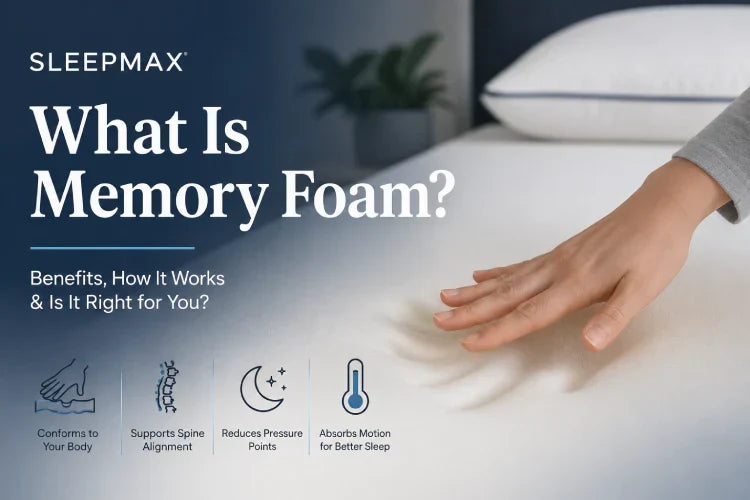
If you’ve been shopping for a new mattress, you’ve almost certainly come across the term “memory foam.” It shows up everywhere—from premium mattress brands to affordable bed-in-a-box options. But what exactly is memory foam? Why do so many people swear by it? And is it the right choice for you?
In this guide, we break down everything you need to know about memory foam: its fascinating origins, how it works on a scientific level, its pros and cons, the different types available today, and how to choose the best memory foam mattress for your sleep style.
What Is Memory Foam?

Memory foam is a type of polyurethane foam that has been engineered to be highly viscoelastic—meaning it is both viscous (slow to move) and elastic (able to return to its original shape). Technically, it belongs to the family of open-cell polyurethane polymers, a structure that allows the material to compress under pressure and then slowly spring back once that pressure is removed.
In everyday terms: when you press your hand into memory foam and pull it away, you’ll see a slow, gradual return to the original shape—hence its other common name, “slow-rebound foam.” In Chinese, it is widely known as ji yi mian (记忆棉), which literally translates to “memory cotton.”
Two defining properties set memory foam apart from ordinary foam:
Temperature sensitivity: Memory foam softens as it warms up (absorbing your body heat) and firms up in cooler environments.
Pressure sensitivity: It responds to the weight and shape of your body, contouring precisely to your curves to distribute pressure evenly.
The Fascinating History of Memory Foam
Memory foam was not invented for beds—it was born in space. In the 1960s, NASA’s Ames Research Center developed the material to protect astronauts from the intense g-forces experienced during rocket launches and re-entries. The goal was simple: create a cushioning material that could absorb and redistribute extreme pressure without breaking down under repeated use.
After NASA released the technology to the public domain, the material found its way into aircraft seats, football helmets, and medical equipment—particularly hospital beds and wheelchair cushions, where pressure sores were a serious concern.
By the 1990s, the Swedish company Tempur-Pedic had adapted NASA’s technology into the first commercial memory foam mattress. The product was a revelation—and sparked a multi-billion-dollar industry that continues to expand today, with dozens of brands offering memory foam mattresses in a wide range of styles, densities, and price points.
How Does Memory Foam Work?
The science behind memory foam is surprisingly elegant. The material is made of billions of tiny open cells—interconnected air pockets that compress and allow air to flow between them when pressure is applied. This open-cell structure is what gives memory foam its characteristic slow-sinking sensation.
When you lie down on a memory foam mattress, your body heat warms the foam beneath you, causing it to soften and mold precisely to your shape. The areas bearing the most weight (shoulders, hips, lower back) sink slightly deeper, while lighter areas receive gentle support. The result is a surface that feels custom-made for your body.
Once you get up, the foam slowly returns to its flat shape—a process that typically takes anywhere from a few seconds to a minute, depending on the foam’s density and formulation.
Types of Memory Foam
Not all memory foam is created equal. Over the decades, manufacturers have developed several variations to address the material’s original limitations—particularly its tendency to trap heat.
1. Traditional Memory Foam
The original formulation. Dense, pressure-relieving, and excellent at contouring. The main drawback is heat retention, as the dense cell structure limits airflow.
2. Gel Memory Foam
Gel beads or gel layers are infused into the foam to absorb and dissipate heat. Gel memory foam sleeps noticeably cooler than traditional memory foam, making it a popular choice for hot sleepers.
3. Open-Cell Memory Foam
Engineered with a more porous internal structure, open-cell foam allows greater airflow than traditional variants. It’s softer to the touch but still highly conforming.
4. Plant-Based Memory Foam
A portion of the petroleum-based polyurethane is replaced with plant-derived oils (such as soy or castor oil). Plant-based foam tends to sleep cooler, off-gas less, and is considered more eco-friendly.
Pros and Cons of Memory Foam Mattresses
Like any mattress material, memory foam has genuine strengths and real limitations. Here’s an honest overview:
|
✅ PROS |
❌ CONS |
|
Exceptional pressure relief for shoulders, hips, and lower back |
Tends to retain body heat (especially traditional foam) |
|
Excellent motion isolation — ideal for couples |
Slow rebound can make it harder to change sleeping positions |
|
Conforms to multiple sleep positions (side, back, stomach) |
New mattresses may off-gas a chemical odor initially |
|
Silent — no squeaks or springs |
Not ideal for those who prefer a firmer, more responsive sleep surface |
|
Durable — high-density foam can last 10+ years |
May be too soft and “sinking” for heavier sleepers unless high-density foam is used |
Who Should Sleep on a Memory Foam Mattress?
Memory foam is not a one-size-fits-all solution, but it does excel for specific types of sleepers:
Memory Foam Is a Great Choice If You:
Sleep on your side and experience shoulder or hip pain
Share a bed and are easily disturbed by your partner’s movements
Suffer from back pain or joint discomfort and need targeted pressure relief
Prefer a quiet, noise-free sleep environment
Enjoy a “hungged-in” or cradling sleep sensation
You Might Want to Consider Alternatives If You:
Sleep hot and sweat easily during the night
Prefer a bouncy, responsive surface (innerspring or latex may suit you better)
Change sleep positions frequently throughout the night
Are a heavier sleeper needing extra firm, high-support construction
How to Choose a Memory Foam Mattress: Key Factors
Ready to shop? Here are the most important factors to consider:
1. Density
Density is measured in pounds per cubic foot (PCF) or kilograms per cubic meter (kg/m³). It’s the single most important indicator of foam quality and durability.
Low density (3–4 PCF / below 50 kg/m³): Softer, lighter, more affordable, but may wear down faster.
Medium density (4–5 PCF / 50–65 kg/m³): The sweet spot for most sleepers—good balance of comfort, support, and longevity.
High density (5+ PCF / above 65 kg/m³): Firmer, more durable, best for heavier sleepers and long-term use.
2. Thickness
Most memory foam mattresses range from 6 to 14 inches (15–36 cm) in total height. The memory foam comfort layer is typically 2–6 inches thick, sitting on top of a denser support base. A thicker comfort layer gives a deeper, more enveloping feel—but 3–4 inches of quality foam is sufficient for most people.
3. Certifications
Always look for third-party certifications that verify the foam is free from harmful chemicals. The most trusted include:
CertiPUR-US®: U.S. standard certifying foam is made without ozone-depleting chemicals, flame retardants, heavy metals, or formaldehyde.
OEKO-TEX® Standard 100: International certification ensuring no harmful substances are present in the finished product.
4. Cooling Features
If you tend to sleep warm, prioritize gel-infused foam, open-cell construction, ventilation channels (perforated or wave-patterned foam), or a breathable cover material like Tencel or bamboo-derived fabric. These features significantly improve thermal regulation.
Memory Foam vs. Other Mattress Types
How does memory foam stack up against other popular mattress materials?
Memory Foam vs. Innerspring: Innerspring mattresses are more bouncy, breathable, and responsive. Memory foam wins on pressure relief and motion isolation. Innerspring wins on cooling and edge support.
Memory Foam vs. Latex: Latex is naturally bouncy, cooler, and more eco-friendly. Memory foam offers deeper contouring and better motion isolation. Latex is more durable but typically costs more.
Memory Foam vs. Hybrid: Hybrid mattresses combine a memory foam comfort layer with a pocketed coil support system. This gives you the contouring of foam with the breathability and responsiveness of springs—often the best of both worlds.
How to Care for Your Memory Foam Mattress
A quality memory foam mattress can last 8–12 years or more with proper care. Here are some simple maintenance tips:
Use a mattress protector: Shields against spills, sweat, and allergens. Memory foam is not washable, so prevention is key.
Rotate regularly: Rotate your mattress 180 degrees every 3–6 months to prevent uneven wear. Most memory foam mattresses are one-sided (do not flip).
Keep it dry: Avoid introducing moisture. If the mattress gets wet, blot (don’t rub) and allow it to air dry completely before replacing bedding.
Air it out: Periodically strip the bed and open windows to let the mattress breathe. This is especially helpful for reducing any initial off-gassing odor.
Vacuum the surface: Use a handheld vacuum with an upholstery attachment every few months to remove dust, dead skin cells, and allergens.
Final Thoughts
Memory foam has come a long way from its origins as a NASA shock-absorber material. Today, it’s one of the most widely used and well-researched mattress materials in the world—and for good reason. Its ability to contour to the body, relieve pressure points, and minimize motion transfer makes it an excellent choice for a wide range of sleepers.
That said, no mattress material is perfect for everyone. The best mattress is the one that fits your unique sleep habits, body type, and personal preferences. Whether you run hot at night, deal with chronic back pain, or simply want a quieter, more peaceful sleep—understanding what memory foam is and how it works puts you in a much better position to make an informed choice.

Leave a comment
This site is protected by hCaptcha and the hCaptcha Privacy Policy and Terms of Service apply.