


Walk into any mattress showroom and you'll hear the same question dozens of times a day: "What's the real difference between a king and a queen?" It's not a silly question. The answer isn't just about 16 inches of width—it's about whether your bedroom feels like a retreat or a furniture obstacle course, whether you'll spend $850 or $1,700 on the mattress alone, and whether you'll actually sleep better or just take up more floor space.
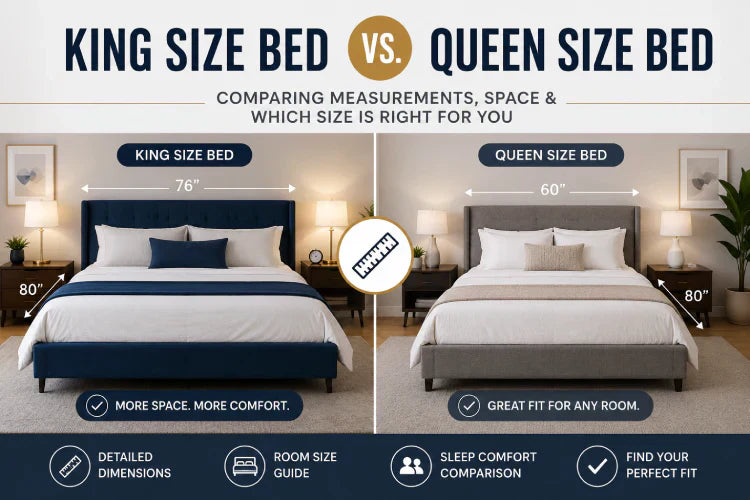
Here's the deal: both sizes are 80 inches long. The entire difference is width. A queen measures 60 × 80 inches. A king measures 76 × 80 inches. That's it—16 inches separates them. But those 16 inches ripple through every part of the decision, from room layout to sheet prices to whether your partner's tossing and turning keeps you up at 3 AM.
What Are the Exact King Size Bed vs Queen Measurements?
Let's get the numbers straight first, because a shocking number of online sources get this wrong or mix in non-standard sizes.
A king gives each sleeper 38 inches of personal width—roughly the same as a twin mattress. On a queen, each person gets 30 inches. For context, a standard crib mattress is 27 inches wide. So sharing a queen isn't dramatically different from sleeping in an oversized crib, and that's worth sitting with for a moment.
Thing is, 30 inches per person works fine for millions of couples. The question isn't whether it's "enough"—it's whether it's enough for you.
For more bed sizes and mattress sizes, you can refer this article-Mattress Sizes and Dimensions Guide (2026)
How Much Room Do You Actually Need for Each Size?
This is where most buyers mess up. They fall in love with a king in the store and forget to measure their bedroom. Or they assume their 10 × 12 foot master can handle a king because it "should" be big enough.
Queen bed room requirements:
King bed room requirements:
I'll be honest—cramming a king into a 10 × 12 room isn't an upgrade. It's a daily annoyance. You'll squeeze past the bed every morning. Nightstands become optional. The room feels smaller than it is. A queen in that same space? Leaves enough breathing room that the bedroom actually functions as a bedroom.
Pro tip from interior designers: use painter's tape to outline the mattress dimensions on your floor before buying. Walk around it. Imagine nightstands. See if you can open your closet door. It takes 10 minutes and saves a $1,700 mistake.
Is a King Size Bed Really Worth the Extra Cost?
The short answer: it depends on who's sleeping in it. The longer answer involves some math that most people skip.
Mattress pricing (mid-range averages, 2025–2026):
That's a $150–$500 premium for the king, or roughly 20–40% more from the same brand for the same model. But the cost doesn't stop at the mattress.
Bottom line: over a 10-year mattress lifespan, upgrading from queen to king adds roughly $800–$2,000 in total costs when you factor in bedding replacements. That's $6–$17 per month. Not life-changing money, but not nothing either.
Where it is worth it: couples where one or both people are restless sleepers, families where kids or pets join the bed, anyone over 6 feet tall who sleeps with a partner, and anyone who spends significant time in bed reading or working. That extra 8 inches per person genuinely reduces sleep disruption—studies on co-sleeping show that physical space correlates with sleep quality in shared beds.
Where it isn't worth it: solo sleepers (a queen is already more space than one person needs), budget-conscious buyers in smaller apartments, and anyone who moves frequently (kings are a pain to get through narrow hallways and up stairs).
What About California King—Is That Better Than Either?
This question comes up constantly, and the answer surprises people.
A California King is 4 inches narrower and 4 inches longer than a standard king. It actually has less total surface area—32 square inches less. The Cal King was designed for tall sleepers who don't need the extra width. If you're over 6'2" and your feet hang off a standard king, the Cal King solves that. But if width is what you're after, the standard king wins.
Honestly, for most buyers the California King creates more problems than it solves. Sheets are harder to find, bed frames are less common, and the narrower width means less elbow room. It's a niche size for a niche need.
Can Two Adults Actually Sleep Comfortably on a Queen?
Yes. Millions of couples do. A queen mattress has been the most popular mattress size for couples in the US for decades, and that's not because people don't know kings exist.
On a queen, each person gets 30 inches of width. For context, that's roughly the shoulder-to-shoulder space of two adults lying side by side with arms at their sides. It works—until someone sprawls, or flips, or a golden retriever hops up between you at 2 AM.
The data backs this up. Sleep surveys consistently show that couples who upgrade from queen to king report fewer sleep disturbances, but the improvement is most dramatic for:
If you and your partner are both calm sleepers in a smaller bedroom, a queen is plenty. No need to spend the extra money.
How Do You Choose Between King and Queen for a Shopify Store Purchase?
Buying online changes the decision slightly. You can't lie down on it first, so the room-measurement step matters even more.
Before you click "add to cart":
The Quick Decision Guide
Still on the fence? Here's a simplified breakdown:
Go with a Queen if:
Go with a King if:
The Bottom Line
The king size bed vs queen measurements question isn't really about 16 inches. It's about whether those 16 inches improve your life enough to justify the cost, the space, and the logistical hassle. For couples in spacious master bedrooms—especially those sharing with kids or pets—the king is almost always worth it. For everyone else, the queen remains the smartest all-around choice: enough room for two, fits in most bedrooms, easier on the wallet, and bedding that's available everywhere.
Don't overthink it. Measure the room, be honest about how you actually sleep (not how you wish you slept), and pick accordingly. The best mattress size is the one that lets you wake up without remembering you were ever uncomfortable.


Leave a comment
This site is protected by hCaptcha and the hCaptcha Privacy Policy and Terms of Service apply.