


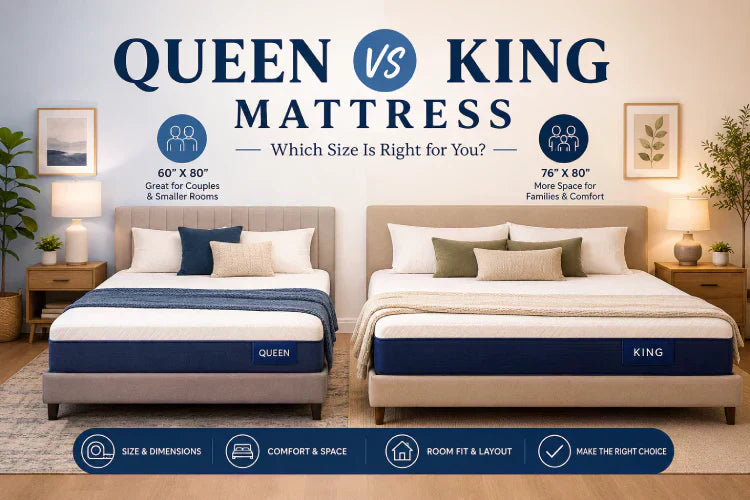
Queen VS King mattress, which is better for you? Choosing the big one migh seem the right answer. Not quite. The 16-inch width difference between these two best-selling sizes carries real consequences for bedroom layout, sleep quality, moving logistics, and long-term cost. This guide breaks down every dimension that matters, from surface area calculations to elevator diagonal requirements, with data most comparison articles skip entirely.

What You're Actually Getting
A standard queen mattress measures 60 inches wide by 80 inches long (152 × 203 cm). A standard king—sometimes called an Eastern king—measures 76 inches wide by 80 inches long (193 × 203 cm). The length is identical. The only difference is the wide. King has addition more 16 inches of width, which translates to 26.7% more total surface area. The king mattress area is 6,080 square inches and queen mattress is 4,800.

For couples, that width gap matters more than it sounds. A queen gives each sleeper 30 inches of personal space—roughly the width of a crib. A king provides 38 inches per person, which happens to equal one full-size twin XL mattress.
In practical terms, a king mattress is two twin XLs placed side by side, and that's no coincidence. The king size originated in the 1940s when retailers began displaying two twin beds pushed together as a single unit, according to industry historical records from The Bedding Mart.
What the Market Data Shows
Queen dominates globally. Queen-size products capturing approximately 46% market share—from Grand View Research reports in 2024—making it the single most popular size worldwide. King holds roughly 25–30% but is growing faster, with a projected CAGR of 6.7% through 2030 compared to the overall market's 6.5%. The global mattress market reached reached $46.48 billion in 2024. So, the two size mattress have a total $33 billion sales.
In the United States specifically, Better Sleep Council survey data shows about 47% of adults sleep on a queen and 25% on a king. A more recent academic study published in Frontiers in Sleep (2025, n = 1,055) found 50.4% on queen and 30.9% on king or California king, with both sizes showing significantly higher satisfaction than twin.
Perhaps the most revealing statistic comes from Mattress Nerd's survey of over 2,000 American adults: king owners report the highest satisfaction rate at 62%, compared to 39% for queen owners. The "buy bigger, regret nothing" pattern holds consistently across surveys—king buyers rarely wish they'd chosen smaller, while queen buyers frequently cite partner disturbance and insufficient space for children or pets.
Price: The Real Cost of 16 Extra Inches
The mattress price gap between queen and king ranges from 15% to 27% depending on the brand and tier. Here are current examples from major manufacturers:
● Nectar Classic: Queen $799, King $999 (+$200, 25%)
● Casper Original: Queen $950, King $1,150 (+$200, 21%)
● Purple Original: Queen $1,099, King $1,399 (+$300, 27%)
● Tempur-Pedic Cloud Supreme: Queen $3,599, King $4,299 (+$700, 19%)
● Sealy Response Performance: Queen $579–$1,749, King $849–$2,349 (+$270–$600, 34–47%)
The premium isn't limited to the mattress itself. A king-size bed frame adds $100–$400 more than its queen counterpart. King bedding costs 30–50% more per set. Mattress protectors run $20–$50 higher. All told, the first-year cost difference between a queen setup and a king setup lands somewhere between $350 and $1,150. Over a 10-year ownership period, replacing bedding three times adds another $90–$300 to the king premium.
Sleep Quality: The 43% Difference Nobody Talks About
Size affects more than comfort—it measurably impacts motion transfer between sleep partners. Chinese manufacturer Chen Shang Home Furnishing conducted controlled testing comparing the two sizes using identical pocket spring construction at 900 springs per square meter. The results: when one partner rolls over on a 1.5 m mattress, the other partner experiences an average displacement of 2.1 cm. On a 1.8 m mattress, that figure drops to 1.2 cm—a 43% improvement in motion isolation.
This isn't a trivial difference. Research consistently links partner disturbance to reduced sleep efficiency, and the 43% improvement aligns with the satisfaction gap seen in consumer surveys. For light sleepers sharing a bed, those extra 16 inches may matter more than any mattress material or firmness upgrade.
The calculation is also worth doing for body size. If two partners' combined shoulder width exceeds 90 cm (about 35 inches), a queen leaves less than 6 cm of buffer per person on each side. That's barely enough room to turn over without elbow contact.
Room Size: The Hard Constraint
A queen mattress fits comfortably in a 10 × 10 foot room (roughly 3 × 3 meters), provided there's some planning around furniture placement. A king demands at minimum a 12 × 12 foot space (3.6 × 3.6 meters), with 13 × 14 feet being the comfortable minimum for a fully furnished bedroom.
The guideline that matters most: leave 24–30 inches (60–76 cm) of clearance on all three exposed sides of the bed. In a typical 12 m² Chinese apartment bedroom, a 1.5 m mattress leaves about 60 cm of walking space between the bed edge and a standard-depth wardrobe. A 1.8 m mattress in the same room reduces that clearance to roughly 30 cm—functional but tight.
For rooms between 12 and 15 m², the decision comes down to furniture count. A bedroom with just a bed and one nightstand can accommodate a king. Add a wardrobe, desk, or second nightstand, and queen becomes the more livable choice.
The Moving Problem: Will It Even Fit Through the Door?
This is the dimension most buyers forget to check until the delivery truck arrives. A king mattress at 76 × 80 inches (193 × 203 cm) presents genuine challenges in 15–20% of older apartment buildings.
Elevator clearance is the primary gate. A standard residential elevator needs a diagonal measurement of at least 1.8 meters to accept a double mattress. For a king, that minimum rises to about 80 inches (203 cm). Many buildings constructed before the 2000s have elevators that fall short. The correct technique involves tilting the mattress at a 30-degree angle, with one person entering the elevator first to support the top edge.
Stairwell landings present a second constraint. The landing diagonal should exceed the mattress width by at least 20 cm. In older six-story walkups without elevators, movers use a "crab walk" technique that can navigate a 1.8 m mattress through a 1.2 m turning radius—but it requires professional skill and isn't guaranteed.
Material matters too. Innerspring mattresses tolerate slight bending (up to about 15 degrees) but will suffer permanent coil wire damage if folded. Latex mattresses must never be folded—creases become permanent. Palm fiber mattresses must remain flat. Memory foam, the basis of most bed-in-a-box products, compresses and rolls for shipping, which is why direct-to-consumer brands default to this material.
When a king simply won't fit, a split king—two twin XL mattresses (38 × 80 inches each) placed side by side—solves the problem. Each half fits through any standard doorway. The tradeoff is a potential gap between the halves and a slightly higher price than a one-piece king.
How "King" and "Queen" Became Bed Sizes
The regal naming convention is pure marketing, not engineering. Before the 1950s, American couples primarily shared full-size (double) beds measuring just 54 inches wide—giving each person a mere 27 inches, narrower than a standard crib. As postwar home sizes expanded and average male height increased (the percentage of American men 6 feet or taller rose from 4% in 1900 to over 20% by 1959), demand for larger beds grew.
Mattress companies responded by introducing "queen" and "king" as premium designations. Between 1953 and 1963, king bed ownership rose from approximately 1% to 5.5% of households. The California king emerged in the 1960s when a Los Angeles mattress company created a longer, narrower variant (72 × 84 inches) marketed to Hollywood's tall elite. The International Sleep Products Association (ISPA) formalized standard dimensions in 1973. Queen surpassed full as America's best-selling mattress size in 1999—a position it has held ever since.
The Decision Framework
Three questions, in order of priority:
1. Does your room allow a king? Measure the room, subtract 60–76 cm per side for clearance, and see what remains. If the answer is no, the decision is made.
2. Who's sleeping in it? Solo sleepers and quiet couples in smaller rooms do fine on a queen. Couples where one partner tosses and turns, families sharing a bed with children or pets, or anyone with a shoulder-width combination above 35 inches should strongly prefer a king.
3. What's the full cost? Add up the mattress, frame, bedding, and any delivery surcharges for oversized items. If the total king premium feels manageable, the satisfaction data strongly favors going bigger.
One pattern is clear from the research: king owners rarely downgrade on their next purchase, while queen owners frequently upgrade. The 43% improvement in partner disturbance alone makes the case for king when space and budget permit. But when they don't, a well-chosen queen with motion-isolating construction—pocket springs or memory foam—can close much of that gap without requiring a larger room.

Leave a comment
This site is protected by hCaptcha and the hCaptcha Privacy Policy and Terms of Service apply.