


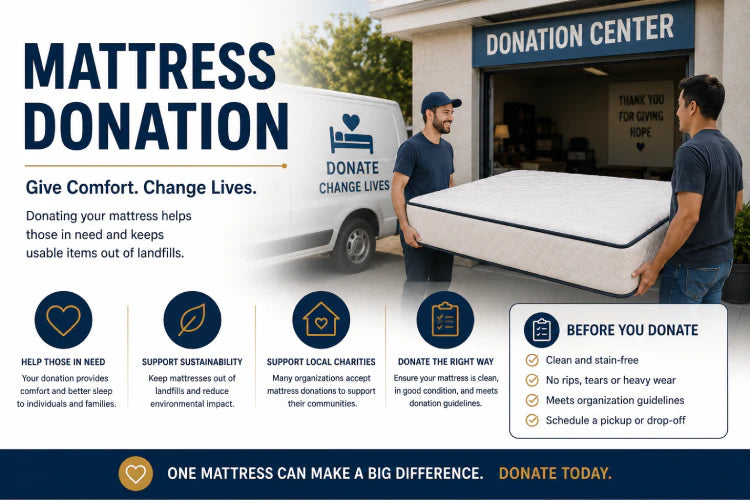
About 15 to 20 percent of all mattresses sold online get returned. That number alone should make you pause. The mattress-in-a-box boom made buying easier — and returning easier — but it also created a quiet logistics nightmare. Most of those returns? Straight to the dump.
Not because they’re ruined. Because reselling a mattress that’s been in someone’s bedroom for 90 nights runs headfirst into state health codes, brand liability policies, and a mattress industry that has never figured out reverse logistics at scale.
That’s the bad news. The good news is that a mattress you’re done with — whether it’s a 5-year-old hybrid that’s lost its edge support or a guest-room foam mattress that’s seen maybe 30 nights of use — can land somewhere useful. It just takes knowing where to point it.
The Numbers Are Worse Than You Think
Eighteen to twenty million mattresses hit American landfills every year. Let that sit for a second. At roughly 40 cubic feet per king-size unit, you’re looking at landfill volume that accumulates faster than any municipal waste program can manage.
A mattress takes somewhere between 80 and 120 years to break down. During those decades, the polyurethane foam slowly leaches isocyanates and flame retardant compounds into the surrounding soil. Polybrominated diphenyl ethers — the flame retardant class used in most pre-2015 mattresses — are persistent organic pollutants. They don’t wash away. They bioaccumulate.
The mattress industry hasn’t exactly been rushing to fix this. Why would they? Every old mattress in a landfill is a customer who just bought a new one. The economic incentive runs in one direction. A handful of states — California, Connecticut, Rhode Island, Oregon — now tack a small recycling fee onto each new mattress sale to fund take-back programs. It’s a start. The rest of the country has no such mechanism.
So the math lands on you: the person standing in a bedroom trying to figure out what to do with a queen-size block of foam and steel that you really don’t want to drag to the curb.
What “Mattress Donation” Actually Means
Most people picture their old mattress going to a family in need — pulled from the back of a truck, set up in a child’s bedroom, solving a problem.
That happens. But here’s the part donation guides rarely spell out: a large percentage of mattresses dropped off at donation centers get rejected at intake. Even the ones that get accepted might not end up where you think. Many large nonprofits — including some of the names I’ll mention below — run their own recycling partnerships. A mattress that’s clean but older than 5 to 7 years often goes straight to the shredder, not to a home.
I’m not saying this to discourage you. The opposite. Understanding how the system actually works means you’ll have better odds of getting your mattress somewhere useful instead of contributing to the 75 percent landfill rate.
Is Your Mattress Actually Donatable?
Charities aren’t being difficult. They’re protecting vulnerable populations from bed bugs, mold exposure, and fiberglass contamination — a risk that’s more common than most people realize.
A mattress that’s clean, structurally intact, under 7 years old, and free of stains — you’re in good shape. Minor surface wear won’t disqualify it. These are what shelters and furniture banks actually want. If there are faint stains or a light odor, you’re in borderline territory. Some organizations will still take it after a deep clean. Others won’t. This is where a phone call saves everyone time.
Sagging, broken springs, visible mold, or — and I can’t stress this enough — any sign of bed bugs: game over. That mattress needs disposal, not donation.
The fiberglass question deserves its own paragraph. A lot of budget foam mattresses manufactured since 2015 use fiberglass as a low-cost fire barrier instead of chemical retardants or wool. It’s woven into the inner cover. When that cover gets removed or torn, fiberglass particles spread everywhere — through HVAC systems, onto clothing, into skin. It’s a nightmare to clean up, and it’s a health hazard for anyone receiving a donated mattress. Check the tag. If it lists “glass fiber,” “glass wool,” or “silica” as a fire barrier material, do not donate it. Recycling is your only responsible option here.
Where to Actually Send It
You’ve got more options than you probably realize. Ranked from highest impact to most convenient:
Local furniture banks. These are nonprofits specifically designed to furnish homes — not resell goods for program funding. They serve people transitioning out of homelessness, domestic violence, or housing instability, and they almost always need mattresses. The National Furniture Bank Association maintains a directory at nationalfurniturebank.org. Many offer free pickup, which matters when you’re dealing with something that won’t fit in a sedan.
Homeless shelters and transitional housing programs. Call first. Always. Shelters have limited storage and seasonal demand spikes — winter is peak, summer is slower. Some won’t accept mattresses at all during warmer months because bed bug risk increases. A 30-second phone call beats a wasted trip.
Habitat for Humanity ReStores. These are retail operations that fund Habitat’s building programs. Policies vary wildly by location — one store might take mattresses every day, the store two towns over might have stopped accepting them entirely. Use the locator at habitat.org and call.
The Salvation Army. Many locations run scheduled pickup services, which is a genuine convenience. They’re selective about condition, but if your mattress is clean and damage-free, they’ll often take it. Their site (SalvationArmyUSA.org) lets you check local pickup availability by zip code.
Goodwill. This one’s a toss-up. Some locations accept mattresses, many don’t, and the answer can change based on the manager on duty that week. Call your local store. If they can’t take it, they may direct you somewhere that can.
Community platforms — Freecycle, Nextdoor, Facebook Marketplace Free section. Not glamorous, but fast. Post clear photos, be honest about condition, and someone in your community will claim it within a couple of days. The trade-off: you’re dealing with strangers at your door, so have someone with you or meet at a neutral pickup point if that’s an option.
DonationTown.org. Aggregator service — enter your zip code and item type, and it matches you with local charities that offer pickup. Saves the phone-call marathon.
The Five-Minute Prep That Makes or Breaks Acceptance
Organizations reject mattresses at intake all the time. The rejection rate is honestly higher than most people expect. Five minutes of prep cuts your odds of a wasted trip to near zero.
Vacuum both sides thoroughly with an upholstery attachment. Dust, pet dander, dead skin cells — all of it needs to come off. Spot-clean any stains with mild detergent and a damp cloth. Don’t soak the mattress — moisture trapped in foam layers invites mold, and that’s an instant rejection. Baking soda, sprinkled generously and left for a few hours before vacuuming, neutralizes most odors without chemicals.
Bag it for transport. Mattress bags cost about five to eight dollars at any hardware store or U-Haul location. Worth every penny. A clean mattress that gets dirty during transport is just a dirty mattress by the time it arrives. Get the receipt. If you’re donating to a registered 501(c)(3), the fair market value of the mattress is tax-deductible. Different organizations use different valuation guidelines — ask what they recommend.
When Donation Isn’t in the Cards
Some mattresses are past the point of reuse. You’ve got options better than the landfill curb.
Recycling recovers up to 90 percent of a mattress by weight — steel springs go to scrap metal processors, foam gets shredded into carpet padding or industrial insulation, wood frames become mulch or biofuel. Earth911.com and ByeByeMattress.com both have searchable directories of recycling facilities. The Mattress Recycling Council — funded by those state fees I mentioned earlier — operates programs in California, Connecticut, Rhode Island, and Oregon.
If you’re buying a replacement, most retailers will haul away your old one for a fee (usually $30 to $75). It’s not free, but the logistics of transporting a mattress yourself are worse. The retailer assumes disposal responsibility, and many have recycling partnerships.
Bulk trash pickup through your municipality is the fallback. Don’t just leave a mattress on the curb — most cities require scheduling ahead, and unauthorized dumping can trigger fines of $100 or more.
DIY repurposing: the foam layers can become pet beds, seat cushions, or workshop padding. Steel springs have modest scrap metal value. This is for people who enjoy weekend projects and have confirmed their mattress is fiberglass-free. If that’s not you, skip it.
One More Thing
A mattress you’re done with is still a mattress someone else can’t afford. That’s the simplest framing, and it’s accurate without being sentimental.
The environmental argument is real. The humanitarian argument is real. But what actually gets people to donate instead of dump is knowing exactly where to go and what to expect when they get there.
Make the call. Bag the mattress. Show up. It takes less than an afternoon, and the alternative — another 40 cubic feet of foam and steel sitting in a landfill for the next century — isn’t one anyone should feel okay about.


Leave a comment
This site is protected by hCaptcha and the hCaptcha Privacy Policy and Terms of Service apply.