



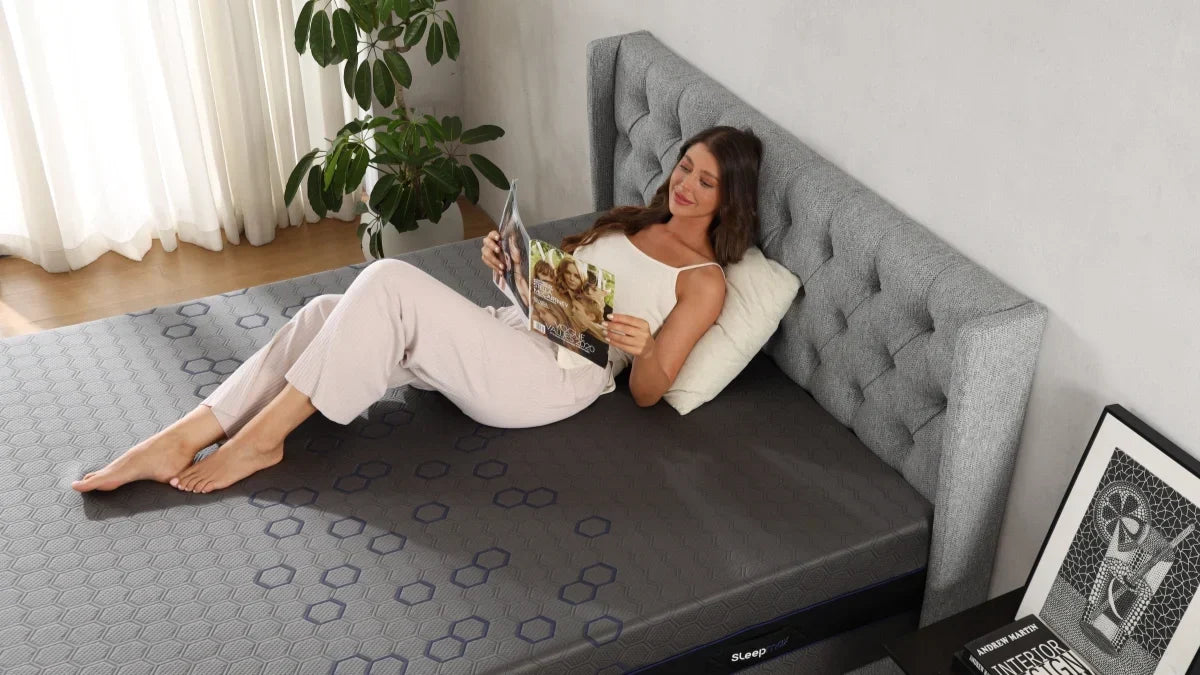
When shopping for a mattress, finding one that balances support and pressure relief is more difficult than you might imagine. Both are essential features of a comfortable mattress but are designed with different purposes.
In this article, we’ll walk you through the difference between mattress support vs pressure relief and why it is so hard to get both.
Mattress Support vs. Pressure Relief: Differences
| Mattress Support | Pressure Relief | |
| Primary purpose | Helps prevent excessive sinking, maintain spinal alignment, and provide a stable sleeping surface | Helps distribute body weight and reduce concentrated pressure. |
| Common areas affected | Lower back, pelvis, spine | Shoulders, hips, knees, and other contact areas. |
| Too little can feel like | Excessive sinking or lack of stability | Pressure points, soreness, numbness, or discomfort. |
| Too much can feel like | Rigid or overly firm | Hard contact against sensitive areas. |
| Influenced by | Mattress construction, firmness, support core, body weight |
Comfort layers, material response, firmness, body shape, and sleep position
|
What Is Mattress Support
When people say that a mattress is "supportive," they usually mean that their body feels adequately held up rather than sinking uncontrollably into the mattress. A supportive mattress should provide enough resistance for heavier areas of the body, such as the pelvis, while allowing the surface to accommodate the natural shape of the body.

If you are wondering “what is the best support for a mattress”, the answer depends on several factors, including body weight, body shape, sleeping position, mattress firmness, design of the comfort layers, and underlying support core.
A mattress that feels supportive to a stomach sleeper may feel excessively firm to a side sleeper. Likewise, a mattress that feels comfortably cushioned to a lighter sleeper may allow a heavier sleeper to sink more deeply.
What Is Pressure Relief in a Mattress
Pressure relief refers to how effectively a mattress distributes the weight of your body rather than allowing that load to be pooled in a small number of areas.
Just consider what happens when you lie on a hard surface. Your body doesn't contact that surface evenly. Certain areas, such as shoulders, hips, and pelvis, protrude farther and therefore experience more concentrated contact.

A mattress with a suitable comfort layer can contour to these areas and expand the contact area between your body and the mattress. But pressure relief isn’t the same as maximum sinking.
A mattress that permits your body to sink deeply may feel comfortable at first since the surface lies closely against your body. However, excessive sinking can change the overall support experience and make it more difficult to maintain a comfortable sleeping position. That's why pressure relief and support should complement each other, not compete.
Why Is It So Hard to Get Both Mattress Support and Pressure Relief?
At first glance, mattress support and pressure relief may sound like two sides of the same goal. A mattress should support your body while also cushioning the areas that bear the most weight. In practice, however, improving one does not always improve the other.
A mattress that feels very firm may prevent your body from sinking too deeply, but it can also create higher pressure around the shoulders, hips, or other prominent areas. A very soft mattress may allow those areas to sink in more easily, but excessive sinkage can make it harder to maintain a comfortable sleeping posture.
This is why choosing a mattress is less about finding the "firmest" or "softest" option and more about finding the right balance between how your body is supported and how pressure is distributed across the sleep surface.
Support ≠ =firm
Firmness describes how a mattress feels when you lie on it. Support is more about how effectively the mattress keeps your body from sinking too far and helps maintain a reasonably neutral position.
In a randomized controlled trial published in The Lancet, researchers studied 313 adults with chronic nonspecific low back pain and compared firm mattresses with medium-firm mattresses. After 90 days, participants assigned to medium-firm mattresses had better outcomes for pain while lying in bed, pain on rising, and disability than those assigned to firm mattresses. [1]
This is not to say that everyone with a bad back should buy a medium-firm mattress. It demonstrates why “firmer is always better” is an oversimplification. A mattress can be firm enough to offer support but not so firm as to cause undue pressure at the shoulders, hips, or other points of contact.
Too firm can create pressure points
Imagine lying on a hard surface. Your body does not contact that surface evenly. Areas such as the shoulders, hips, and other bony prominences carry more of the load. You may notice this as soreness, numbness, or the feeling that you need to change positions frequently during the night.
Recent research published in the International Journal of Industrial Ergonomics also found that mattress firmness affected interface pressure differently depending on body region and sleeping posture. The study of 34 adults found that medium-soft firmness provided a balance between pressure distribution and perceived support, highlighting that mattress response cannot be reduced to a single "firm versus soft" rule. [2]
Too soft can compromise support
A softer surface can reduce pressure by allowing the shoulders and hips to sink into the mattress. But if the deeper support layers do not adequately resist that movement, heavier parts of the body may sink farther than the rest of the body.
For example, a mattress that is excessively soft may allow the pelvis to sink substantially while the surrounding areas remain higher. Depending on the sleeper and sleeping position, this can make it more difficult to maintain a comfortable spinal position.
This does not mean that soft mattresses are inherently bad. The important question is whether the mattress provides enough underlying support for the sleeper while still allowing enough surface conformity to reduce uncomfortable pressure.
Your sleeping position changes the equation
There is no universal level of support or pressure relief that works equally well for everyone because different sleeping positions distribute body weight differently.

Side sleepers generally place more concentrated pressure around the shoulders and hips. They often benefit from a surface that can conform to these areas without allowing excessive overall sink.
Back sleepers distribute their weight over a relatively larger surface area, but they still need enough support to prevent the midsection from sinking excessively.
Stomach sleepers typically need to pay closer attention to excessive sink around the abdomen and hips. A mattress that is too soft may allow the midsection to sink more than is comfortable.
Combination sleepers face another challenge because they move between positions during the night. A mattress that feels excellent in one position may feel less suitable when the sleeper turns onto their side or stomach.
What Are the Best Mattress Types for Pressure Relief and Support?
It depends on many factors like mattress materials, the sleeper’s body shape, weight distribution, sleeping position, and preferred feel. A 2015 systematic review of 24 controlled trials similarly found that mattress characteristics can influence sleep comfort, pain, and spinal alignment. The review found the strongest overall evidence around medium-firm and adjustable/self-adjusted surfaces rather than extremely soft or extremely firm mattresses. [3]
Memory foam mattress
Pros:
- Excellent contouring and pressure relief
- Can cushion shoulders and hips effectively
- Excellent motion isolation for couples
Cons:
- Some sleepers may feel like they are sinking too deeply
- Slower response can make changing positions more difficult
- Dense memory foam may retain more heat than more breathable constructions
Latex mattress
Pros:
- Good pressure distribution
- More responsive than memory foam
- Easier to change positions
- Durable and resilient
Cons:
- Usually provides less deep contouring than memory foam
- May not feel plush enough for sleepers who prefer a "hugging" sensation
- Can be more expensive than some foam options
- The feel varies considerably between Talalay and Dunlop latex constructions
Hybrid mattress
Pros:
- Can balance pressure relief and support
- Usually more responsive than all-foam mattresses
- Coil cores allow greater airflow
- Often provides stronger edge support
Cons:
- Performance varies significantly between models
- A firm hybrid with a thin comfort layer may not provide enough pressure relief
- A plush hybrid with thick soft foam may allow too much sink
- Can be heavier and more expensive than some all-foam mattresses
- Coil construction may introduce more bounce and motion transfer than memory foam

If you're looking for a mattress that combines cushioning with deeper support, the Sleepmax pressure relief hybrid mattress OmniFit is worth considering. It pairs pressure-relieving memory foam and gel-infused high-density foam with a Hive™ Honeycomb Matrix Spring system designed to provide adaptive, full-surface support.
Available in firm, medium, and plush options, this pressure relief hybrid mattress allows sleepers to choose a feel based on how much cushioning and support they prefer. It also comes with a 365-night trial, giving you plenty of time to evaluate how well the mattress balances pressure relief and support in your own sleep environment.
How to Tell Whether You Need More Support or More Pressure Relief
Here are some simple practical clues that can help you evaluate how the mattress interacts with your body.
| What you notice | What it may suggest |
| Shoulder or hip pressure | Not enough surface conforming |
| Feeling "stuck" in the mattress | Excessive sink |
| Hips sinking noticeably lower | Potentially insufficient underlying support |
| Frequent tossing and turning because of discomfort | Pressure distribution or overall comfort may be inadequate |
| Back discomfort after sleeping | Mattress may not suit your body or sleeping position, but other causes are possible |
| Mattress feels hard but still supportive | You may need more cushioning rather than more support |
The Bottom Line: Support and Pressure Relief Are Not Opposites
Pressure relief is about reducing excessive or concentrated loading where your body meets the mattress. Support is about providing enough resistance to keep your body from sinking excessively and to maintain a comfortable sleeping position.
- The best mattress for pressure relief ≠ the softest mattress
- The most supportive mattress ≠ the firmest one
And the right balance depends on your sleeping positions, body shape, weight distribution, comfort preferences, and the mattress’s overall construction. If you’re looking for the best mattress in a box online, take a few more nights to experience the mattress. An at-home sleep trial can be especially beneficial in that it allows you to test out the mattress in your normal sleeping environment rather than relying on a few minutes of testing in a showroom.
References
[1] https://www.thelancet.com/journals/lancet/article/PIIS0140-6736(03)14792-7/abstract
[2] https://www.sciencedirect.com/science/article/abs/pii/S016981412600048X
[3] https://www.sciencedirect.com/science/article/abs/pii/S2352721815001400
[2] https://www.sciencedirect.com/science/article/abs/pii/S016981412600048X
[3] https://www.sciencedirect.com/science/article/abs/pii/S2352721815001400

Leave a comment
This site is protected by hCaptcha and the hCaptcha Privacy Policy and Terms of Service apply.