


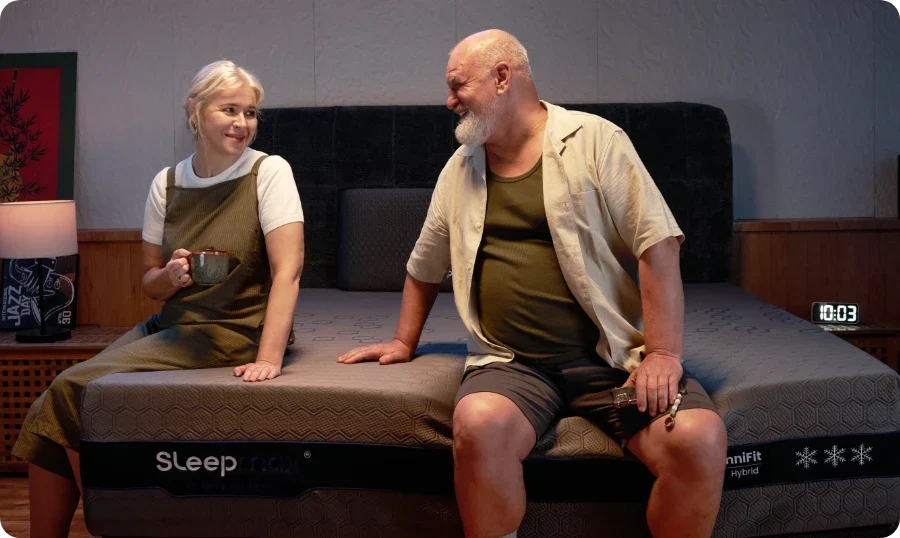
Choosing a mattress as a couple becomes difficult when each person asks the surface to do something different. A side sleeper may want more cushioning around the shoulder and hip, while a stomach sleeper may prefer a flatter, more supportive feel. A back sleeper can introduce another set of preferences involving contouring, lumbar support, and ease of movement.
The goal is not to find a universally “perfect” firmness. It is to identify the couple’s most important conflicts, decide which can be resolved by one shared surface, and recognize when separate comfort zones are the cleaner solution.
Start with Two Individual Sleep Profiles
Before comparing mattresses, each partner should write down a separate sleep profile. Do this independently so that one person’s preferences do not become the default.
Record:
- Primary and secondary sleep positions
- Areas that feel pressured or unsupported
- Whether turning over feels easy or difficult
- Sensitivity to a partner’s movement
- Preference for sleeping near or far from the edge
- Temperature complaints
- Preferred surface sensation, such as buoyant, conforming, plush, or firm
- Any meaningful difference between how the mattress feels at bedtime and how the body feels in the morning
Position matters, but it should not be treated as the only variable. Two side sleepers may disagree because they have different builds, shoulder shapes, mobility needs, or expectations of softness. Likewise, a back sleeper and stomach sleeper may agree on a stable surface but disagree about contouring.
A useful distinction is need versus preference. “My shoulder becomes uncomfortable on a hard surface” describes a functional problem. “I like a cloud-like first impression” describes a preference. Both matter, but functional problems deserve priority during testing.
Side, Back, and Stomach Sleeper Combination Matrix
The following matrix turns the side/back/stomach combination problem into a practical starting strategy. It is a screening tool, not a prescription: real comfort still depends on the sleepers and the complete mattress construction.

| Couple combination | Likely point of conflict | Shared-surface starting point | When to consider separate sides |
|---|---|---|---|
| Side + side | Different desired depth of cushioning or different sensitivity at shoulders and hips | A pressure-relieving surface with enough underlying stability for both sleepers | One partner consistently feels compressed while the other feels insufficiently cushioned |
| Side + back | Side sleeper may want deeper cushioning; back sleeper may dislike excessive sink | A balanced, responsive surface that cushions prominent pressure areas without feeling difficult to move on | The side sleeper still feels pressure after the back sleeper has reached a comfortable support level |
| Side + stomach | Strongest common firmness conflict: added cushioning may help the side sleeper but feel too deep to the stomach sleeper | A stable core with moderate surface cushioning; test alignment and pressure separately | Either partner must accept persistent discomfort to satisfy the other |
| Back + back | Usually more agreement on overall feel, but contouring and firmness preferences may differ | A stable surface with noticeable but controlled contouring | The partners have sharply different comfort preferences or body-response patterns |
| Back + stomach | Both may value stability, while the back sleeper may want more contouring | A supportive, easy-to-move-on surface with restrained cushioning | The stomach sleeper feels the center section settles too deeply or the back sleeper feels unsupported gaps |
| Stomach + stomach | Surface stability may be a shared priority; pillow choice and local cushioning can still differ | A flatter-feeling, stable surface that does not impede repositioning | The partners disagree strongly about firmness despite sharing a position |
| Combination sleeper + any position | A mattress optimized for one posture may hinder another; movement characteristics become more important | A responsive compromise that permits turning and performs acceptably in each regularly used posture | The combination sleeper rotates through positions that require incompatible comfort levels |
General industry guidance often frames side sleepers as needing more surface comfort, back sleepers as tolerating a broader comfort range, and stomach sleepers as needing greater care around support. That framing appears in a specialist mattress forum, but it should be treated as a starting heuristic rather than a personal diagnosis. The Mattress Underground
Decide Whether One Shared Feel Is Realistic
A shared mattress is most realistic when both partners’ acceptable comfort ranges overlap. They do not need identical preferences; they need a common range in which neither person experiences a clear problem.
Use a shared surface when
- Both partners can rest in their normal positions without obvious pressure or a sense of sinking too deeply.
- Their firmness preferences differ modestly rather than fundamentally.
- Motion transfer, edge use, or temperature is a larger concern than firmness disagreement.
- Small changes to pillows, sheets, or a topper could address the remaining difference without undermining the other partner.
A balanced combination of cushioning and support is a commonly recommended starting point for couples who use different sleep positions.
Consider separate comfort zones when
- One partner wants a distinctly soft surface and the other rejects noticeable sink.
- A side-and-stomach pairing cannot find an acceptable middle ground.
- One sleeper’s comfortable surface repeatedly creates a pressure or support complaint for the other.
- The partners want independently adjustable head or leg positions.
- Repeated shared-surface trials produce the same conflict.
Split designs and independently adjustable systems are possible approaches, but they introduce tradeoffs. Couples should inspect the center seam, usable sleeping area, sheet requirements, edge feel at the split, and whether the two sides remain level. Reddit shoppers frequently suggest split setups for strongly different preferences, but that is anecdotal consumer experience rather than controlled product evidence. Reddit discussion in r/BuyItForLife
Evaluate More Than Firmness
“Medium” or “firm” alone does not explain how a mattress will behave. Two models carrying the same label can differ in contour, responsiveness, motion behavior, and edge feel.
Pressure relief

Test whether the surface accommodates the side sleeper’s shoulder and hip without creating a concentrated pressure sensation. Do not assume that the softest option is automatically best: the whole surface still needs to feel stable enough for turning and for the partner’s position.
Support through the center of the body
Back and stomach sleepers should pay attention to how the pelvis and midsection settle relative to the rest of the body. The relevant question is not whether the bed feels hard. It is whether the sleeper can maintain a comfortable resting posture without feeling folded, bowed, or forced to brace.
Motion isolation
A position mismatch often comes with different movement patterns. A combination sleeper may turn repeatedly while a settled side sleeper remains in one posture. Test motion directly: have one partner change positions, get out of bed, and sit on the edge while the other observes what reaches their side.
A Reddit thread about partner disturbance illustrates the underlying buyer problem—a restless sleeper’s movement can become a recurring issue for a light-sleeping partner—but it does not establish that any particular material will solve it. Reddit discussion in r/Mattress
Responsiveness and ease of movement
Deep contouring may feel comfortable while still making turns laborious for some sleepers. Each partner should roll between their actual positions and sit up from the center of the bed. This is especially important when one person has limited mobility or changes positions frequently.
Edge usability
Couples use more of the mattress width than solo sleepers. Lie near the edge in a normal sleep position rather than judging it only by sitting. If the perimeter feels unstable, the practical sleeping area may feel smaller even when the listed dimensions are adequate.
Temperature experience
Ask whether either partner regularly feels too warm, not merely whether a product is marketed as cooling. Bedding, room conditions, protectors, and how closely a surface conforms can all affect the experience. Evaluate the complete setup instead of assigning temperature performance to one material name.
Use a Couple-Specific Mattress Test
A quick showroom impression rewards initial softness, not overnight suitability. Build a repeatable test around both partners’ normal behavior.
Test every regularly used position
Each person should lie in a primary position long enough to notice pressure, support, and the effort required to move. Combination sleepers should test every position they use regularly rather than choosing the posture that feels best for the first minute.
Run a movement test
One partner remains still while the other:
- Rolls from one side to the other
- Changes from back to side
- Gets out of bed
- Returns to bed
- Sits and stands from the edge
Then switch roles. This reveals whether the same mattress behaves differently for the lighter sleeper, heavier mover, or more sensitive partner without requiring a laboratory-style claim.
Check the center and perimeter
Both partners should occupy their normal sides at the same time. Test cuddling near the center, sleeping apart, and lying near each outside edge. A split setup should also be tested directly along its center boundary.
Record separate verdicts
Each partner can grade pressure comfort, support, movement, edge confidence, and temperature as acceptable, uncertain, or unacceptable. Compare notes afterward. This reduces the chance that one enthusiastic first impression hides the other person’s concern.
Solve Small Differences with the Rest of the Sleep System
Not every disagreement requires a different mattress. Pillows can materially change how a sleep posture feels because head and neck positioning interacts with the rest of the body. Each partner can use a different pillow without changing the shared surface.
Bedding can also be individualized. Separate blankets may help when partners disagree about warmth or when one person repeatedly pulls the covers. A topper is a more consequential change because it affects the entire shared surface unless it is sized for only one side. Before adding one, ask whether it could help one sleeper while making support, movement, or temperature worse for the other.
For couples interested in a hybrid positioned by the brand for adaptive pressure relief and motion isolation, the SLEEPMAX OmniFit Hybrid Mattress is a relevant model to compare. Treat those as brand positioning, not proof that the mattress will fit every side/back/stomach pairing. Shoppers can also review the broader SLEEPMAX range and its comparison, size, warranty, and trial information before deciding.
Know When the Compromise Is Failing
A compromise is unsuccessful when the same complaint persists after the adjustment period allowed by the seller, or when one partner routinely leaves the bed to sleep elsewhere. Warning signs may include recurring pressure at prominent areas, difficulty changing positions, a persistent sense of inadequate support, or substantially better sleep on another suitable surface.
Visible sagging, declining sleep quality, a mismatch between the mattress and current sleep position, and consistently sleeping better on other beds are among the consumer-facing warning signs identified by one furniture retailer. These signs do not diagnose a health condition, but they can prompt a closer inspection of the sleep setup.
Persistent pain, numbness, weakness, or another health concern should not be self-diagnosed as a mattress problem. A mattress can change comfort, but it cannot establish the cause of a symptom.
Frequently Asked Questions
What mattress firmness is best for a side sleeper and a back sleeper?
There is no dependable universal firmness label for that pairing. Start with a balanced surface that gives the side sleeper enough shoulder and hip accommodation while allowing the back sleeper to rest comfortably and move without excessive sink. Judge the actual model, not the label alone.
What is the hardest position combination to accommodate?
Side-and-stomach pairings commonly present a pronounced conflict because the side sleeper may seek more cushioning while the stomach sleeper may prefer a flatter, more stable feel. If neither partner has an acceptable overlap, separate comfort zones deserve consideration.
Is a hybrid automatically better for couples?
No. “Hybrid” identifies a broad construction category, not a guaranteed comfort or motion result. Compare the complete design and test pressure relief, support, movement, edge usability, and temperature for both partners.
Can a topper fix different firmness preferences?
It may help when both partners want a similar change. A full-width topper changes both sides, so it can solve one person’s complaint while creating another. Strongly opposed preferences may require a side-specific or split approach.
Should couples choose a split king?
A split configuration can make sense when independent comfort or adjustable positioning outweighs concern about the center divide. Test the seam, edges, bedding arrangement, and synchronization of both sides before committing.
How should combination sleepers shop?
They should test every position used regularly and pay particular attention to ease of movement. A surface that feels excellent in one posture but obstructive or uncomfortable in another is not a complete solution.

Leave a comment
This site is protected by hCaptcha and the hCaptcha Privacy Policy and Terms of Service apply.