


Walk into any Mattress Firm—or hell, just browse Amazon for five minutes—and you'll hit a wall of numbers. $299. $1,499. $3,200. $8,000 for some organic latex nightmare. What the hell is actually going on here?
I've spent way too long digging into this industry, and here's what I've learned: mattress pricing isn't some mysterious science. It's marketing wrapped in foam wrapped in more foam.
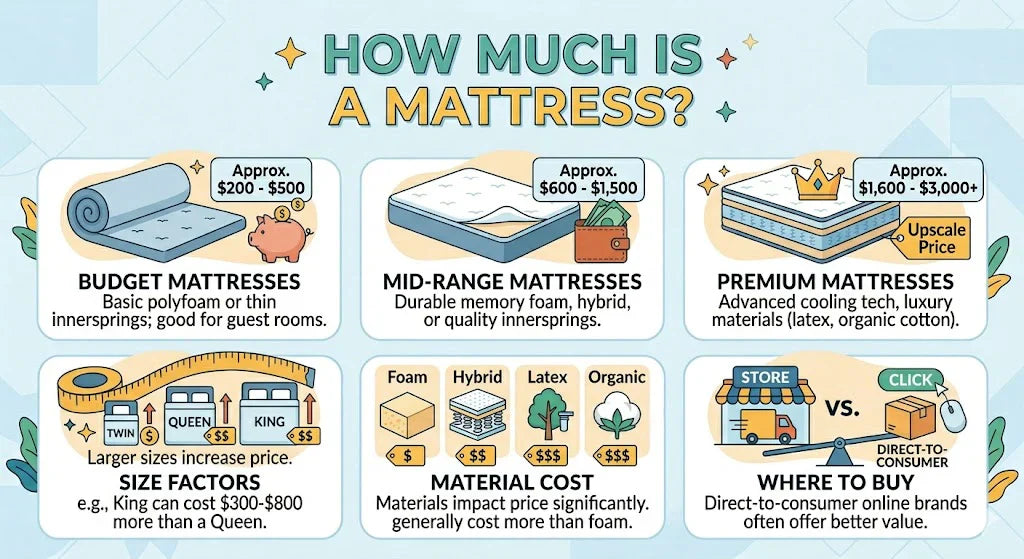
The Price Ranges Nobody Explains Clearly
Let's cut through the bullshit.
Budget tier: $200-$600
Here's the thing—most mattresses under $400 are basically disposable furniture. Yeah, they'll work for a year or two. But walk into a hotel room sometime and notice how the mattress feels like sleeping on a cardboard box wrapped in a thin blanket. That's budget tier.
Innerspring mattresses dominate this range. They're not bad if you're on a strict budget or furnishing a guest room you'll use twice a year. But for everyday use? Your back's gonna have opinions. In online shopping, you can find many mattresses on Amazon for under $200.
The foam density in these things? Usually around 1.2-1.5 lbs/ft³ in the base layer. Which sounds technical, but translate that to English: it'll start sagging faster than you'd like.
Mid-range: $600-$1,500
Here's where things get interesting. Most people end up shopping in this zone, and honestly? It's where you get the most value.
Memory foam mattresses start showing up seriously here. All-foam beds, foam-and-coil hybrids—you name it. The Casper Original, for instance, typically runs around $1,095 for a queen. Tempur-Pedic's "entry-level" line? We're talking $1,299-$1,799. Sleepmax hybrid mattress offers the most affordable mattresses in this price range. The specially designed hexagonal honeycomb coil spring offers good support, and the high-density foam provides comfort.
What's different about this tier? The foam actually has some substance. Density climbs to 2.5-4 lbs/ft³ in the comfort layers. That means it's not gonna turn into a hammock after eighteen months.
Oddly enough, this is also where Saatva operates—they're not cheap, starting around $999 for a queen mattress, but they build their coils with American steel and use real latex rather than synthetic approximations.
Luxury: $1,500-$3,000
Now we're talking. Tempur-Pedic's core lineup lives here ($1,799-$3,499 queen), alongside Saatva's thicker models and brands like Stearns Foster that have been doing this for generations.
What do you actually get? Thicker comfort layers—sometimes 4-6 inches of material instead of 2-3. Better edge support so you don't feel like you're rolling off a cliff. Longer warranties (often 15-25 years instead of 10).
The hybrids in this range use pocketed coils instead of Bonnell springs. Each coil moves independently, which means your partner's midnight bathroom trip won't launch you out of bed. Tested this theory on a Saatva Classic recently—pretty damn impressive motion isolation for a coil-based mattress.
Ultra-premium: $3,000+
Somewhere along the way, mattress companies discovered that rich people will pay basically anything for a good night's sleep.
100% natural latex mattresses from brands like Plutex or OrganicPedic? Easily $3,500-$6,000. Tempur-Pedic's Tempur-Adapt series? You're looking at $4,000-$7,000, depending on size and features.
The thing is—and this is gonna sound controversial—you don't necessarily sleep better on a $5,000 mattress than a $1,500 one. More money buys you premium materials, fancy branding, and that "I made it" feeling. Whether your spine actually cares? Less clear.
Why Does the Same Mattress Cost $500 at One Store and $1,800 at Another?
Oh, this one's fun. The mattress industry has some of the wildest retail markup I've ever seen.
Factory cost for a queen memory foam mattress? We're talking $150-$300 for materials and labor combined. By the time it hits a retail showroom, that $400 mattress becomes $1,200. The markup can hit 300-400%.
But here's the real kicker—and this one actually surprised me when I first learned it—many major brands sell identical mattresses under different names at different retailers. Same foam, same coils, different pillow-top ticking and a different price tag. Casper sells direct-to-consumer. Tempur-Pedic dominates retail floors. Same concept, vastly different shopping experience.
I once looked at a mattress in a Sleep Number store that could've passed for a cousin of a Casper model. Similar specs, similar construction. But because it had that "adjustable air" branding and lived in a fancy showroom, it cost twice as much. The sales guy was very helpful, very confident in explaining why this was worth $3,000. The foam inside? Probably similar stuff you can get online for half the price.
When you buy online—especially brands like Purple, Leesa, or Nectar—you're cutting out the middleman. That $1,500 mattress in the store might be $800 online. Is the mattress better? Not necessarily. But your wallet definitely notices the difference.
What Actually Drives the Price?
Let's break this down so you know where your money's actually going.
Foam density is huge
Density is measured in pounds per cubic foot (lbs/ft³). Higher numbers mean denser, more durable foam.
Memory foam at 2 lbs/ft³? Cheap. Probably won't hold up past year two. 4 lbs/ft³? That's the good stuff—expect 10+ years of service. Some Tempur-Pedic models use 5+ lbs/ft³, which is basically memory foam on steroids.
Thing is, most manufacturers don't advertise density numbers. You have to dig into the specs or ask directly. Here's a hint: if the company won't tell you the density, they're probably hiding something uncomfortable.
Coil count isn't what you think
Brands love bragging about coil counts. "2,000 micro-coils! 4,000 nano-coils!" Sounds impressive, right?
Here's the uncomfortable truth: anything over 800 coils in a queen size is basically theater. Independent testing shows minimal difference in pressure relief above that threshold. Those extra "micro-coils" compress completely under body weight—they exist to pad the spec sheet, not your sleep.
Focus on coil type instead. Pocketed coils (individually wrapped) outperform Bonnell coils for motion isolation. Continuous coils are durable but transmit movement. And gauge matters more than count—thicker wire (lower gauge number) means firmer, longer-lasting support.
The "cooling" tax
Gel-infused memory foam, copper-infused fabrics, phase-change materials, open-cell construction... mattress companies have invented approximately seventeen ways to charge you extra for "not sleeping hot."
Some of these actually work. Open-cell foam does breathe better than traditional memory foam. Gel infusions provide temporary temperature relief. But here's what they won't tell you: that initial cooling effect from gel typically fades within 30-90 days of use. The technology degrades.
You're paying $200-$400 premium for a benefit that diminishes. Just something to think about before dropping extra cash on "cooling" models.
Certifications cost money (and create marketing)
CertiPUR-US certification means the foam meets certain emissions and durability standards. Fine. But here's what it doesn't mean: this mattress is healthy, organic, or chemical-free. CertiPUR-US tests for specific compounds—not everything. It's basically a "we didn't break the law" badge.
The thing is, this certification was created by the foam industry itself back in 2008. That's like the tobacco industry creating a "reduced harm" badge. Technically accurate? Maybe. Independently verified? Eh, there's a conflict of interest baked in.
Organic certifications (GOTS, GOLS) are stricter, requiring actual third-party testing and traceable supply chains. But they add 30-50% to production costs. Is that organic latex worth an extra $1,500? Depends how much you trust marketing labels—and how sensitive you actually are to the trace chemicals that CertiPUR-US allows.
For most people, CertiPUR-US is fine. Don't stress about going full organic unless you have specific health concerns or genuinely want to support sustainable manufacturing. The sleep quality difference? Practically zero.
What Should You Actually Pay?
Alright, let's get practical.
For most people? Budget around $800-$1,500 for a queen mattress that will last 8-12 years. That's roughly $8-15 per month over the mattress's lifespan. Less than your streaming subscriptions combined.
If you're a side sleeper needing pressure relief, lean toward memory foam or a hybrid with thick comfort layers. Back sleepers can often get away with firmer, cheaper options. Stomach sleepers? Honestly, most mattresses work fine—you want something on the firmer side to keep your hips from sinking.
Heavy sleepers (over 250 lbs) should budget higher. The extra weight accelerates wear on comfort layers. Look for high-density foams (4+ lbs/ft³) and hybrid designs with robust coil systems. It'll cost more upfront but save you from buying again in three years.
Couples with different sleep preferences? Split mattresses exist for a reason. Don't force both of you onto a "medium" mattress that satisfies nobody. Some brands like Sleep Number lean into this hard—each side adjusts independently. Worth considering if you and your partner fight about mattress firmness like it's a geopolitical conflict.
Also: don't underestimate the trial period. Most online brands offer 90-365 nights to decide. Use them. Sleep on the thing for real. If it hurts your hip after a month, that's a problem that won't get better.
The Bottom Line
Mattress shopping feels overwhelming because companies want it that way. More features, more confusion, more reasons to upgrade to the next tier.
But here's what actually matters:
Don't fall for the "more expensive = better sleep" trap. Test mattresses when possible. Read independent reviews, not brand websites. And remember: that $4,000 Tempur-Pedic feels amazing in the showroom because you've been standing in a mattress showroom for forty-five minutes. At home, after six months, you probably won't notice the difference between that and a well-chosen $1,200 mattress.
Your sleep matters. Your wallet matters too. Spend smart, not just big.

Leave a comment
This site is protected by hCaptcha and the hCaptcha Privacy Policy and Terms of Service apply.