


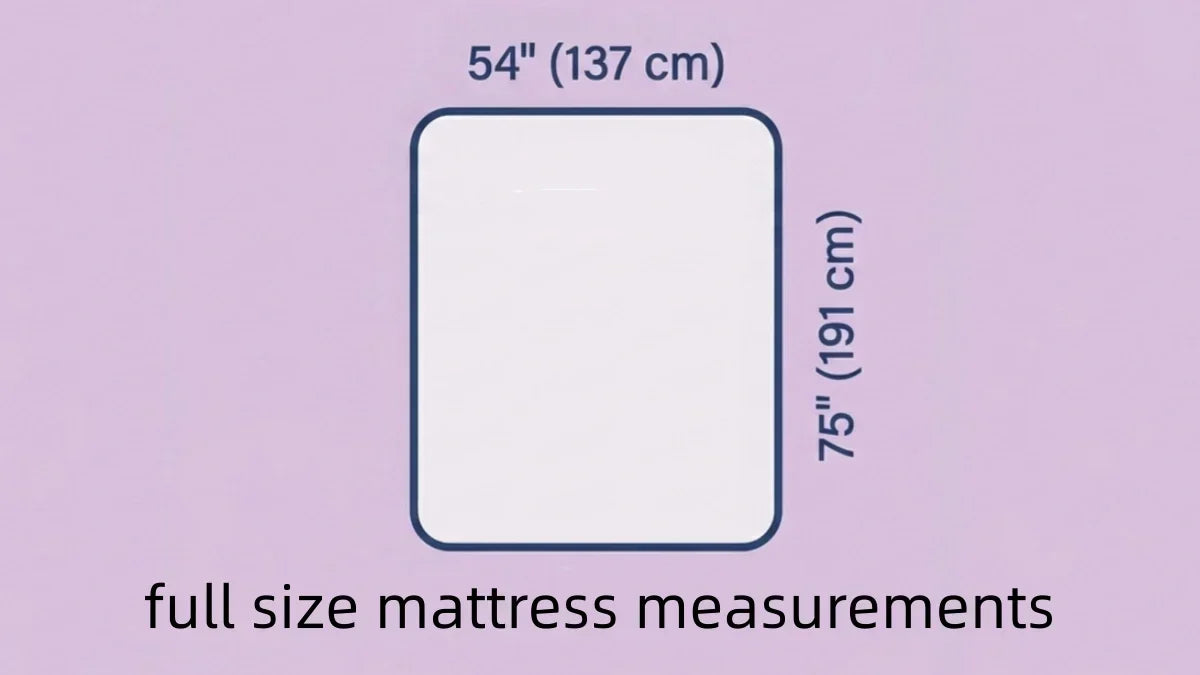
Okay, real talk—when I started helping friends and family shop for mattresses a few years back, I quickly realized most people don't actually know what "Full Size" means. They'd show up at the store, point at a bed, and ask "is this big enough for two people?" And honestly? The answer depends on way more than just the dimensions printed on the tag.
Let me break it down for you, because I've seen people make expensive mistakes (moves, returns, buying twice) all because they didn't understand what 54 by 75 inches actually looks like in real life.
What Exactly Is a Full Size Mattress?
Here's the deal—a full size mattress comes in at 54 inches wide by 75 inches long. That's roughly 4.5 feet by 6.25 feet, if you're the type who thinks in feet instead of inches like some kind of normal person.
Thing is, when mattress brands market these, you'll often see them called "Double" too. Yeah, it's the same thing. No clue why the industry decided one size needed two names, but here we are. Probably some marketing genius's idea of variety or something.
The surface area comes out to about 4,050 square inches. For reference, that's roughly 70% of what a Queen gives you. So if you're trying to picture it, imagine a Queen, then shave off about a third. Still not quite clicking? Let me put it another way—you'll fit a Full Size sheet just fine on most dorm room beds, but forget about those generous Queen-sized comforters you've got at home.
Full Size vs. The Other Guys: The Size Comparison Nobody Asked For But Everyone Needs

I remember the first time I helped my sister shop for her first apartment. She'd been eyeing this gorgeous bedroom set, convinced she needed a King because "bigger is better, right?" Wrong. Her room was maybe 10 by 10, and a King would've eaten the whole space. She ended up with a Full, and honestly? It's perfect for her.
Here's how the Full stacks up against the competition:
Twin: 38" x 75" Twin's the smallest commonly available size. Think college dorm rooms, kids' bedrooms, narrow guest rooms. A Full is about 42% wider than a Twin. If you're sharing a Twin with a partner... bless your heart, honestly. That's basically two adults sardined together.
Full/Double: 54" x 75" That's our guy. About 16 inches wider than a Twin. Still only 75 inches long though—same as Twin. Which brings me to my next point...
Queen: 60" x 80" Queen adds 6 inches of width and a full 5 inches of length. Sounds small when I put it that way, but honestly those extra 5 inches of length make a huge difference if you're over 5'10". I'm 6'1", and I've definitely had my feet hang off a Full mattress more times than I'd like to admit. ($647 on average for a Queen, by the way—about $200 more than your typical Full.)
King: 76" x 80" California King: 72" x 84" Look, these are for people with serious bedroom square footage and zero budget concerns. A King gives you 76 inches of width—22 inches more than a Full. That's like adding a whole extra person to your sleeping space, metaphorically speaking.
Who Should Actually Buy a Full Size Mattress?
Here's where things get interesting, because I've watched way too many people either undersell themselves or oversell their space needs.
Solo sleepers who want room to spread out
If you're flying solo but you toss and turn like you're fighting invisible ninjas all night, a Full gives you space without going overboard. I've seen plenty of single folks squeeze into Twins and complain about feeling cramped. Don't do that to yourself. You're worth 54 inches.
Couples on a budget or in smaller spaces
Alright, here's the uncomfortable truth nobody in mattress sales wants to tell you: a Full is tight for two adults. Like, really tight. You've got about 27 inches of personal space per person, which is basically shoulder-to-shoulder territory. But if your bedroom literally can't fit a Queen (and some apartments genuinely can't), or if you're trying to keep costs down, a Full works. Barely. With some compromise. My wife and I had a Full for our first year of marriage in a 450-square-foot apartment, and we made it work, but there were definitely some elbows-in-the-ribs moments.
Young kids transitioning from a toddler bed
Full works great for older kids and teenagers who need more growing room. Way better than constantly upgrading through Twin, Twin XL, then Full. One purchase, done.
Guest rooms
Here's a pro tip I learned after setting up way too many guest rooms: Full is perfect for the spare bedroom that gets used maybe twice a year. You're not dropping King money on a room nobody sleeps in. Smart, right?
How Much Space Do You Actually Need?
This one's funny because people are terrible at spatial awareness in stores. They see the mattress dimensions, then get home and wonder why their bedroom feels smaller.
Here's my rule of thumb—and I've moved enough furniture to have a solid opinion on this—you want at least 24 inches of walking space on at least one side of the bed. That means for a Full (54 inches wide), you're looking at a minimum clear width of about 8 feet for the room to feel comfortable. The length side needs at least 36 inches for foot traffic and getting dressed without feeling claustrophobic.
So realistically? A room needs to be at least 10 by 12 feet to comfortably fit a Full Size bed with nightstands and still move around. Smaller than that and you're navigating furniture like it's an obstacle course every morning.
But look, I get it. Space is expensive, especially if you're in a city. I've seen studios where people somehow make it work with a Full in a 200-square-foot space. It can be done. You'll just sacrifice some walking room and possibly some sanity.
Full Size Sheets and Bedding: The Things That Confuse Everyone
You wouldn't believe how many people come to me frustrated because they bought "Double" sheets and they didn't fit. Newsflash: "Double" sheets might actually be made for a Full... or they might not. Manufacturing labeling is all over the place, honestly.
Here's what you need to know:
Real Talk on Brands and Pricing
I've tested my fair share of mattresses over the years, and here's the honest rundown on Full Size pricing:
Budget options ($250-$500)
Sealy's Posturepedic line often hits this range. You're looking at mostly innerspring construction, basic foams, nothing fancy. They'll do the job, but don't expect cloud-like comfort. Durability is middle-of-the-road—maybe 5-7 years if you're lucky.
Serta's Simmons... I mean, Serta (I always mix those up) has some options here too. Similar story: functional, not luxurious.
Mid-range ($500-$1,000)
This is where things get interesting. Casper's Wave Hybrid comes in around $895 for a Full, and honestly the motion isolation is solid if you've got a restless partner. Purple's Original is in this neighborhood too—about $795. That grid technology is legit different, for better or worse depending on your sleep style.
Tuft & Needle, Allswell, Saatva... lots of competition here. The good news is you'll get better materials (higher-density foams, better coil systems) without breaking the bank.
Premium ($1,000-$2,000)
Tempur-Pedic's entry-level models hover around $1,299 for a Full. Look, I'm not going to pretend—I slept on a Tempurpedic once at a friend's place and it felt like sleeping on a supportive cloud. But is it worth double what Casper charges? Controversial opinion: maybe not for everyone.
Helix, WinkBed, Brooklyn Bedding... lots of customizable options here. If you've got specific sleep needs (back pain, hot sleeping, partner disturbance), this range gives you enough technology to actually address those issues.
My Honest Take After Years of Watching People Buy Mattresses
Bottom line? A Full Size mattress is a solid choice if:
It's probably not ideal if:
Thing is, there's no universal "right" answer. Your sleep, your space, your budget—all unique to you. I've seen people thrive on Twins and hate Kings. Context is everything.


