


There's a foam mattress on Amazon right now that costs $189 for a queen. Another one—listed by a different seller, different brand name, different packaging—costs $899. The latex comfort layer in both? Same thickness. Same supplier. Sometimes the same factory in Guangdong.
That's not just nonsense. It's how the mattress market actually works. We pay difference prices for same level product.
And it's the single biggest reason mattress pricing feels like complete chaos the first time you look into it.
A Market That No Longer Plays by the Old Rules
Ten years ago, buying a mattress meant walking into a showroom and hoping the salesperson was in a good mood. Prices were opaque — deliberately so. A mattress that cost $300 to manufacture would routinely sell for $2,400 to $3,000 once every layer of distributor markup, retail overhead, and commissioned sales had been factored in. The ISPA has documented retail markups in the 200–900% range across traditional brick-and-mortar channels going back decades.
Then two things happened.
First, the DTC boom: brands like Casper, Purple, and Nectar built direct online businesses that stripped out the retailer entirely. Mattresses got compressed into boxes, shipped to your door, and sold for 30–50% less than comparable showroom models. The math was simple — no rent, no commissioned floor staff, no inventory sitting in climate-controlled warehouses waiting to be test-napped.
Second — and this is the part most mattress blogs gloss over — Amazon changed the game at the budget end. Not through AmazonBasics (though that exists too), but through a flood of private-label sellers sourcing directly from Chinese OEM factories and competing almost entirely on price. So, the prices of mattress on Amazon are much low than mianstream mattress brands.
The result? By 2025, online mattress sales captured 56.4% of the total US market — up from 27% in 2016. Amazon alone accounted for roughly 19% of all mattresses sold online, per industry surveys. That's a massive channel, and it operates on completely different economic logic than either traditional retail or premium DTC.
Why Amazon Mattresses Sell for Half the Price
Walk through Amazon's mattress category and you'll notice something strange. There are brand names you've never heard of — Vesgantti, Zinus, Linenspa, Lucid — selling 10-inch gel memory foam queens for $200 to $400. The specs look identical to mattresses from DTC brands charging $800 to $1,200.
Are they the same? Sometimes. Sometimes not. The reality is more specific.
Most of these private-label Amazon sellers source from the same Tier 1 and Tier 2 OEM factories in China that produce for established US and European brands. The factory in Dongguan that makes a well-known DTC brand's cooling foam layer might run a separate production line for a private-label Amazon seller using a slightly different foam formulation — 1.5 lb/ft³ density instead of 1.8, a thinner quilted cover, fewer certification audits.
The price difference comes from three places:
- No marketing budget to speak of. These brands don't run Super Bowl ads or sponsor podcasts.
- Lower foam density. They hit the price point by spec'ing materials that will last 3–5 years, not 8–10.
- Amazon's marketplace dynamic. When 30 sellers list similar-looking mattresses in the same category, price becomes the primary differentiator. Margins get compressed to single digits.
I've reviewed spec sheets from OEM factories serving both DTC brands and Amazon private-label sellers. The foam-layer diagrams are often within 10% of each other. What separates a $300 Amazon mattress from a $900 online brand mattress isn't always materials — it's consistency. The $900 brand has a compliance team that audits production batches. The $300 seller usually doesn't. The main difference of famous brand and small brand is not the technical solution that used in product, is the product quality control. This is precisely why famous brands command a premium.
This doesn't mean the cheap mattress is a scam. It means you're trading durability guarantees for upfront savings. More on that in a moment.
What Each Mattress Type Actually Costs — And Why
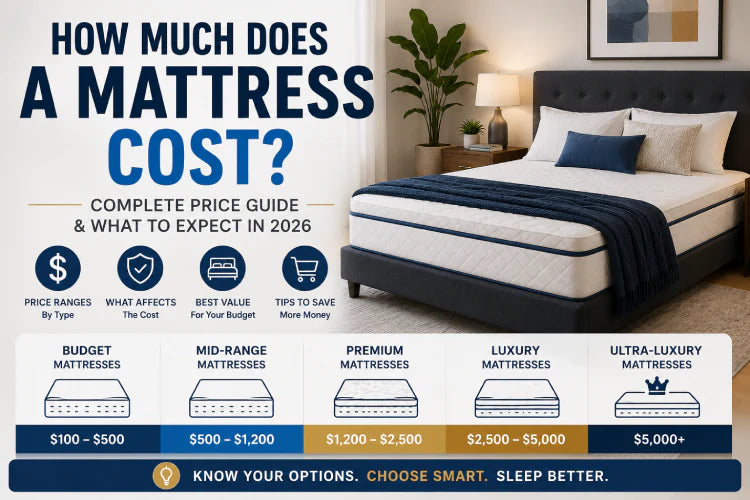
Let's get the price brackets on the table first, because they frame everything else.
Innerspring mattresses: 500–1,200 (queen). The coil unit — usually continuous coils or individually pocketed — is the dominant cost driver here. Open-coil designs (Bonnel springs) sit at the bottom of the range. Pocketed coils with 800+ count push toward the top. Comfort layers tend to be thinner than hybrids, which keeps innerspring prices below hybrid territory.
Memory foam mattresses: 250–1,200+ (queen). This is where Amazon sellers dominate the low end. At 250–400, you're almost certainly getting foam density under 2.0 lb/ft³. That's fine for a guest room or a temporary setup. For daily use over 5+ years, you want 3.0+ lb/ft³ density in the key comfort layers — and that pushes the price into the $600–$1,000 range where DTC brands compete. The 2023 market data shows foam mattresses (including memory foam) accounting for 45.9% of global revenue, which makes sense — nothing else delivers pressure relief at these price points.
Latex mattresses: 1,000–2,500+ (queen). The material math here is different. Natural latex rubber costs roughly 3–5× what polyurethane foam costs per cubic foot. Manufacturing is slower — Dunlop takes hours per layer, Talalay even longer. A genuine GOLS-certified organic latex mattress at $1,500 is a ctually a reasonable deal. At 900? Something is either synthetic-blended or the cert doesn't apply to every layer. Worth checking.
Hybrid mattresses: 1,000–3,000+ (queen). The fastest-growing segment, now commanding roughly 62% of US mattress revenue above the 1,000 mark, per Furniture Today data. You′re paying for two distinct systems—a pocketed coil support core and a multi−layer foam or latex comfort stack. Awell−built hybrid at $1,500 is usually worth the premium over a $900 all-foam model if you sleep warm or shift positions through the night.
The Online-Only Advantage Is Real — But It's Shrinking
For years the advice was simple: buy online, save money. That's still broadly true. DTC brands and online retailers operate at margins that traditional furniture stores can't match because the cost structure is fundamentally different. No per-square-foot mall rent. No commissioned floor staff. No floor models that get rotated out every 18 months.
But the gap is narrowing, and not in the way most people expect.
Traditional retailers have started launching their own digitally-native sub-brands and acquiring DTC startups. Tempur Sealy dropped $4.75 billion on Dreams (the UK's largest bed retailer) in 2023 specifically to accelerate omnichannel capability. The ISPA's bedding market quarterly now tracks "omnichannel share" as a distinct category because pure-play online and pure-play retail are both fading in relevance.
What this means for pricing: the $1,200 mattress you see in a showroom today is more likely than it was five years ago to be price-matched to the brand's website. Showrooms are becoming experience centers, not price traps. Some of them, anyway.
When Cheaper Costs More
Here's where I want to pump the brakes on the "always buy online" narrative — because the math can flip on you.
A $300 Amazon mattress with 1.5 lb/ft³ foam density will lose roughly 15–25% of its support properties within two to three years of nightly use. You'll start waking up with that vague lower-back tightness that builds slowly enough to feel like "just getting older." Two to three years after that, you'll be shopping again.
A $900 mattress with 3.0+ lb/ft³ HR foam in the support layers will maintain its compression resistance for seven to ten years.
The per-year math: 300 over 3 years=100/year, and you go through the buying process twice in a decade. 900 over 8 years=113/year, one purchase, one round of off-gassing, one adjustment period. The cheap mattress isn't actually cheaper. It just has a smaller number on the first receipt.
This isn't an argument against budget mattresses. If your timeline is short — you're furnishing a temporary rental, a college apartment, a guest room that gets used twice a year — buy the $250 option and don't overthink it. The frame matters more than the mattress in those scenarios anyway.
Five Numbers Worth Memorizing Before You Shop
These aren't predictions. They're the data points I come back to every time I look at a mattress spec sheet:
700–1,200. The price range where a queen mattress reaches the quality threshold worth buying for long-term daily use. Below $700, you′re almost certainly trading durability for price. Above1,200, you're paying for brand positioning, niche materials, or genuinely better engineering — and you need to know which one it is.
56.4%. The share of US mattresses sold online in 2025. It was 27% in 2016. The trajectory is clear — market analysts project 65.9% by 2029 — but the important number is the flattening rate of change. The easy online growth happened between 2018 and 2023. What's happening now is more interesting: the distinction between "online" and "offline" is dissolving as retailers and DTC brands both build out both channels.
10 years. The minimum warranty worth accepting. A 5-year warranty on a mattress signals that the manufacturer doesn't expect it to last past year five. I don't care how good the reviews are — if they won't stand behind it for a decade, that tells you something about the foam density they used.
30–45 minutes. How long most "cooling" gel foams actually provide a temperature benefit before reaching body-heat equilibrium. The gel beads absorb heat during the initial contact period, but once the foam matrix reaches skin temperature, the cooling effect stops. If you sleep hot all night — not just while falling asleep — coil-based airflow or genuine graphite-infused foam matters far more than gel marketing.
200–900%. Traditional retail markup range, per ISPA data. This number alone explains why online pricing transformed the industry. You're not necessarily getting "lower quality" when you buy a $1,000 mattress online instead of a 2,500 one in a showroom. You're just not paying for the showroom.
So What Should You Actually Spend?
For most adults buying a primary mattress, $700 to $1,200 for a queen still hits the sweet spot. That range buys you foam densities in the 2.5–3.5 lb/ft³ range from an online brand with a 100-night trial and a 10-year warranty. It won't get you organic latex or individually wrapped micro-coils in the comfort layer — but it gets you a mattress that will hold up for the better part of a decade.
If you share the bed with a partner, push toward $1,000–$1,500. Motion isolation and edge support matter more when there's another person six inches away, and both cost real money in materials.
If you sleep exclusively on your side and have chronic shoulder or hip pressure points, the budget floor rises. Memory foam in the 3.5+ lb/ft³ range or a Talalay latex comfort layer will serve you better than budget foam — and both push into the $1,200–$1,800 range.
Buying online still wins on price in nearly every bracket. But price isn't the only variable. Check the actual foam-density numbers (when brands disclose them — and the ones that don't are telling you something), verify the warranty length, and time your purchase around Memorial Day or Black Friday. A 30% discount on the right mattress is worth waiting two months for.

Leave a comment
This site is protected by hCaptcha and the hCaptcha Privacy Policy and Terms of Service apply.