


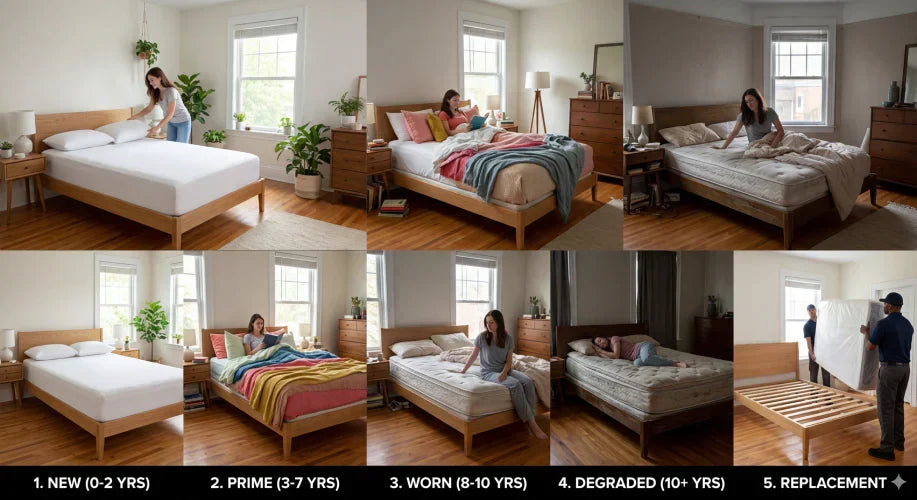
The time duration for which a mattress lasts can be a concern for some. The best answer to the question could be about 7-15 years of which 7 years is the ideal duration. However, this period is not set for all types of mattresses. Factors affecting this are the type of mattress, the quality of materials used, and how well it is maintained. In this guide, we will analyze all the factors which are relevant to the life of a mattress. We will also discuss the signs of your need to renew it as well as respond to your most asked questions about the old mattresses.

How Many Years Various Types Will Be of Use?
The kind of mattress you have is the first and biggest factor. It is the main reason that your mattress will last for that much time. Surprisingly, premium materials will most likely last the longest. Here is a quick math about the average mattress lifespan of most types of mattresses that you can find in 2026.
The Sleep Foundation believes fabric and construct are the direct factors that guide how long they last.
|
Mattress Type |
Average Lifespan |
Key Durability Characteristic |
|
Innerspring |
5–7 years |
Coils can stretch and sag over time. |
|
Memory Foam |
7–10 years |
Lifespan mainly depends on foam density. |
|
Latex |
10–15+ years |
Natural latex is highly durable and resistant to sagging. |
|
Hybrid |
7–10 years |
Durability depends on both coils and foam components. |
9 Factors that Influence Your Mattress Lifespan
On top of this, the mattress model, the rest of the mattress features will decide how long it works properly. Get to know these features and you will be able to benefit most from the current bed. Furthermore, they can help you to choose a better one next time.
Mattress Kind and Grade
As the table implies, the mattress type is the biggest predictor of mattress life. A mattress made from top-notch materials will be around for a much longer time. These are natural latex or high-density foams. They beat mattresses made with low-density foam and simple coils. The most vital factor in a mattress life span is the grade of materials.
Foam and Coil Composition
Your mattress's inner parts may be of importance. For instance, for foam mattresses, a higher foam density means the foam is more resilient. It is able to keep a good state for a longer time. For innerspring or hybrid mattresses, the type of coil, gauge, and count are key. Lower gauge coils are thicker and stronger. The layer number of coils can also influence the support system. But it is the coil quality which contributes to a long mattress life.

Weight and Sleeping Position
Body weight also influences the condition of a mattress. More weight means that the mattress gets more stress. That can be a reason why a mattress wears out so fast. Additionally, your sleeping position is a contributing factor. The side one exerts a lot of pressure on the hips and shoulders. This can cause early wear in these areas.
Usage Period
This one is simple. The main bedroom bed is used every day. This one will be damaged much faster than a guest room mattress. Only a few times a year guest room mattresses are used for sleeping. The more you use a product, the quicker it will break down.
Mattress Care and Maintenance
Proper mattress care is key for making it last as long as possible. Using a high-quality waterproof mattress protector is the best thing you can do. It will cover your mattress from spills, sweat, body oils, and allergens. Rotating your mattress every 3-6 months also helps it to age evenly. You should rotate it from head to foot.
What Happens to a Mattress If You Keep It for A Long Time?
A mattress is not just an "old" thing. It's undergoing a relegation process. Understanding what happens inside your bed over many years makes it clear why replacement is so important. It makes sense to change it as it is important for your health and good sleep.
Physical Damage: From Good Support to Sagging
Over long usage, the materials in your mattress wear out. Foams lose elasticity. This means they can no longer spring back to their original shape. The end result is permanent body impressions and reduced pressure relief. The metal coils in innerspring and hybrid beds lose their tension. This will sag and is responsible for the misaligned spine and backaches. The comfort layers become lumpy and uneven. That is the reason you cannot find a suitable position.
Hygiene Problems: The Invisible Build-up
What we can not see is often more troubling. Throughout its life, a mattress gathers a lot of organic matter. This means sweat, body oils, and millions of dead skin cells. Each night you shed these. This creates an ideal environment for dust mites, bacteria, and even mold. Wellness experts explain that this build-up can really impact your health. This is more pronounced with allergies or asthma problems.
Is It Time? 7 Obvious Signs You Need to Get Rid of Your Mattress
How to recognize if your mattress in fact has reached its end? Your physical body and vision are the best guides. If you track several of these, then take a decision to start shopping.
● Noticeable Sagging, Lumps, or Body Impresses. This is the most noticeable sign. Look at the mattress without any bedding. Do you see a clear dip where you sleep? Does the surface look lumpy and uneven? The support structure has failed.
● You Wake Up with Aches and Pains. Do you feel stiff in your back, neck, or hips every morning? Does the pain seem to fade as you move around during the day? That's a classic sign. Your mattress is no longer giving proper support and alignment.
● It's Noisy. An old innerspring or hybrid mattress often becomes noisy. Does it creak, groan, or ping every time you move? The coils are worn out and can no longer support you quietly.
● Your Allergies Are Worse. Do you find yourself waking up congested or with itchy eyes? Your old mattress could be the cause. It can become a major home for dust mites. These are a common allergy trigger.
● You Are Aware of Every Motion. Are you now surprised to find yourself waking up every time your partner flips to a different position? The mattress has lost its capacity to absorb motion. The parts which once isolated movement are now worn out.
● You Sleep Better Elsewhere. This is the basic parameter, right? Do you have a fabulous sleep at a hotel or a friend's place? Do you then return to a restless night in your own bed? Your mattress is most likely the problem.
● Just Plain Old. Time is always a factor, even when there are no visible signs. Is your mattress over 8-10 years old? Presumably, the materials are worn-out. This will make you think about it. The bed is likely not what it was once. This is especially true for those sleepers that need more support.
Common Concerns Regarding Your Old Mattress
Here are some of the most frequent challenges faced by people who have posed their queries regarding their near expiration mattress. Don’t forget to check their answers.
Can I fix a sagging mattress?
Unfortunately, you cannot really "repair" a sagging mattress. Sagging occurs when foam or coils are permanently destroyed. You can, however, apply temporary fixes to extend its lifespan a little. A mattress topper that is supportive enough can equalize the surface. Use one that is 2-3 inches thick. You might also want to check your foundation or box spring. A broken base can lead to a good mattress to sag. These are temporary solutions, not a permanent fix.
Is it possible for an old mattress to make people sick?
Of course, it is possible for an old mattress to make some people ill. At least they can make pre-existing conditions worse. Over the years, it builds dust mites, their waste, dead skin cells, mold, and mildew. For people with allergies or asthma, sleeping on this can trigger symptoms such as nasal congestion, sneezing, itchy eyes, and breathing difficulties.
Why does a mattress get heavier with time?
This theory is hard to fathom but it is a fact. Over the course of a decade, a mattress can get nearly double its weight. The extra weight comes from everything that the mattress absorbs, including gallons of sweat, pounds of dead skin cells, and millions of dust mites. This cumulative biological material significantly adds to the weight.
Does a mattress warranty mirror its actual lifespan?
Not really. A mattress warranty only pertains to certain manufacturing defects. Sagging, for instance, that goes beyond a certain depth, like 1.5 inches, is not covered. It does not include the regular loss of comfort and support. This falls under normal wear and tear. A 20-year warranty does not mean that you will be able to sleep on it comfortably for 20 years.
How often should I rotate my mattress?
You should rotate the mattress every three to six months to have it worn evenly and to extend its life of comfort. The rotation should be head to foot by 180 degrees. Most of the new mattresses are one-sided and cannot be flipped over. Always consult your manufacturer's care instructions for that specific model.
Conclusion: Putting Money into Your Sleep Equals Health Benefits
A mattress can live for an average of seven to ten years. The main point is that your body should rest well. Waking up sore or sleeping poorly are the best signs. These show that your bed is no longer doing its job. A new mattress is more than just an expense; it increases your quality of life, your sleep, and your health for 2026 and beyond.


Leave a comment
This site is protected by hCaptcha and the hCaptcha Privacy Policy and Terms of Service apply.