



If you weigh over 230 lbs (about 104 kg), finding the right mattress isn’t just about comfort—it’s about protecting your spine, getting restorative sleep, and making a smart long-term investment. Standard mattress recommendations are calibrated for average-weight sleepers, which means a bed that feels “medium-firm” to a 150-lb person can compress like a cloud under a heavier frame, leaving you sinking, sweating, and waking up with back pain.
In this guide, we break down everything you need to know to find the best mattress for heavy people—covering support, firmness, thickness, materials, and the features that genuinely matter when you carry more weight.
Why Standard Mattresses Often Fall Short for Heavier Sleepers

Most mattresses are engineered and tested with an average sleeper weight of 130–180 lbs in mind. When someone significantly heavier lies down, a few things happen that standard designs simply aren’t built for:
Deeper compression: Foam layers compress faster and more completely, eliminating the “cradling” effect and creating a feeling of sleeping in a hole.
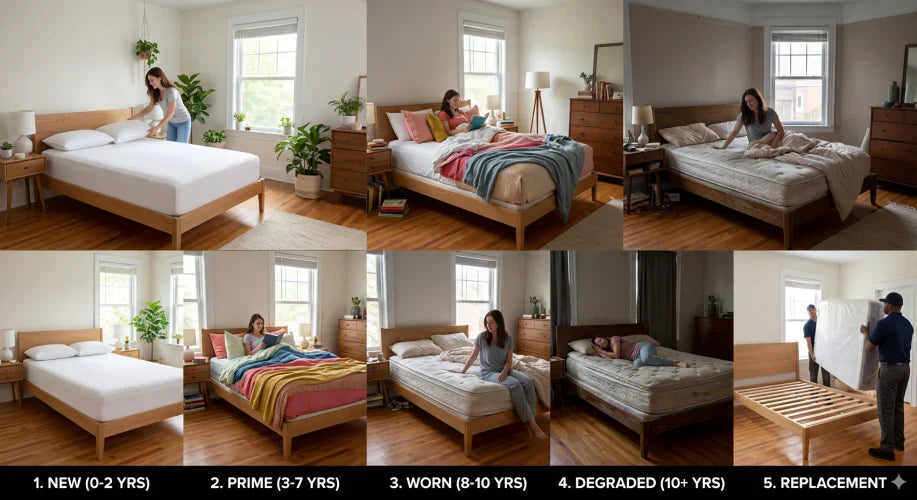
Premature sagging: A mattress rated to last 8–10 years for an average sleeper may show body impressions within 2–3 years under heavier loads.
Poor spinal alignment: Without deep, consistent support, the hips and lumbar area sink out of alignment, contributing to chronic back pain.
Heat buildup: Greater body mass produces more heat, and sinking deeper into foam reduces airflow around the body.
Edge collapse: Sitting on or near the edge puts concentrated pressure that cheaper edge systems cannot handle.
The good news? There are mattresses specifically engineered—or well-suited—to meet these challenges. You just need to know what to look for.
6 Key Factors to Look for in a Mattress for Heavy People
1. Firmness Level: Go Firmer Than You Think
Firmness ratings are relative to body weight. A mattress rated 6/10 (medium) by the manufacturer is tested on sleepers around 150 lbs. For a 250-lb sleeper, that same mattress will compress to something closer to a 4 or 5 out of 10—far too soft for adequate support.
Practical guide based on weight and sleep position:
|
Weight |
Sleep Position |
Recommended Firmness |
|
230–300 lbs |
Side sleeper |
Medium-Firm to Firm (6.5–7.5/10) |
|
230–300 lbs |
Back sleeper |
Firm (7–8/10) |
|
230–300 lbs |
Stomach sleeper |
Firm to Extra-Firm (8/10) |
|
300+ lbs |
Any position |
Firm to Extra-Firm (8–9/10) |
2. Thickness: At Least 12 Inches, Ideally 13–14 Inches
Mattress thickness matters more for heavier sleepers than anyone else. A 10-inch mattress may be perfectly adequate for a 150-lb sleeper but will “bottom out” under significantly more weight—meaning you feel the rigid support core beneath the comfort layers.
Minimum: 12 inches for sleepers over 230 lbs.
Recommended: 13–14 inches for sleepers over 275 lbs or couples where both partners are heavier.
3. Coil / Support System: Choose Individually Wrapped Coils
The support core is the engine of a mattress. For heavy sleepers, individually wrapped (pocketed) coils are the gold standard:
Resilience over time: Steel coils spring back after each night’s use, unlike foam which undergoes permanent compression.
Zoned support: Many hybrid mattresses use firmer coils in the center third (lumbar and hip zone), providing targeted support exactly where heavier sleepers need it most.
Airflow: The open structure between coils allows heat to dissipate, keeping you cooler than an all-foam mattress.
Edge support: Reinforced perimeter coils or high-density foam encasement dramatically improve edge stability for larger sleepers.
4. Foam Density: High-Density Is Non-Negotiable
Not all foam is created equal. Density (measured in pounds per cubic foot, lb/ft³) is the single most important predictor of foam durability under heavy weight.
Support base foam: ≥1.8 lb/ft? Anything lower will compress permanently within a few years.
Comfort layer foam: ≥4.0 lb/ft?
Memory foam: ≥5.0 lb/ft?(high-density). Standard 3 lb/ft?memory foam will degrade quickly.
Pro tip: Most mattress brands don’t advertise foam density in marketing materials. Contact customer service or look for it in the full product spec sheet before purchasing.
5. Mattress Type: Hybrid Is Usually the Best Choice
Hybrid (Best Overall): Deep coil support + pressure-relieving comfort layers + better cooling + strong edges. The go-to recommendation for most heavy sleepers.
Latex (Best for Durability): Natural latex is remarkably resilient—it doesn’t develop body impressions the way foam does. It’s responsive, cool, and lasts 10+ years under heavy use.
High-Density All-Foam (Proceed with Caution): Only viable if foam density specs confirm 5.0+ lb/ft?throughout. Most budget all-foam mattresses are not suitable for heavy sleepers.
Innerspring (Not Recommended): Thin comfort layers and interconnected coils offer minimal pressure relief and poor edge support.
6. Edge Support: More Important Than You Might Think
For heavier individuals, strong edge support isn’t a luxury—it’s a practical necessity. Weak edges create two real problems:
Reduced usable sleep surface: If the perimeter collapses under pressure, you’re effectively sleeping on a narrower mattress.
Safety hazard when getting in and out of bed: Edge collapse while sitting up can cause falls, especially concerning for anyone with mobility issues.
Sleep Position Matters: Matching Your Mattress to How You Sleep
Back sleepers: Firm support that keeps the spine neutral from head to tailbone. A mattress with zoned lumbar support is ideal—firmer in the middle third to prevent hip sinkage.
Side sleepers: Need slightly more give at the shoulders and hips to prevent pressure points, but still require a firm enough base to keep the spine aligned. Medium-firm hybrid works well.
Stomach sleepers: Require the firmest option. Soft mattresses cause the abdomen to sink, creating extreme lumbar extension. Extra-firm or firm hybrid is essential.
Combination sleepers: Firm hybrid with good responsiveness so the mattress adjusts quickly as you change positions during the night.
Common Mistakes Heavy Sleepers Make When Buying a Mattress
Buying based on online reviews alone: Most mattress reviews are written by average-weight testers. A mattress praised for its “perfect balance” may feel like a cloud collapsing under 280 lbs.
Choosing a plush pillow-top: The extra-thick top comfort layer that feels luxurious in the showroom will compact quickly under heavier body weight and create body impressions within months.
Ignoring the foundation: Even the best mattress for heavy people will sag prematurely on a weak or slatted bed frame with wide gaps. Use a solid platform base or a slatted frame with slats no more than 3 inches apart.
Prioritizing price above all else: A budget mattress that wears out in 3 years costs more over a decade than a quality mattress lasting 8–10 years. Heavy sleepers should view a mattress as a long-term investment.
Skipping the trial period: Most reputable online mattress brands offer 100-night (or longer) sleep trials. Use the full trial—your body needs 2–4 weeks to properly assess a new mattress.
Pro Tips to Make Your Mattress Last Longer
Rotate regularly: Rotate head-to-foot every 2–3 months to distribute wear evenly.
Use a quality foundation: A solid platform base or box spring rated for your combined weight is essential. Replace any foundation that’s visibly sagging.
Use a mattress protector: A waterproof, breathable protector guards against moisture and body oils that accelerate foam breakdown.
Check weight capacity: For couples, add both partner weights and check the mattress’ stated weight capacity. Many standard mattresses max out at 500 lbs combined; heavy-duty models often go to 1,000 lbs+.
Consider an adjustable base: Elevating the head or legs redistributes body weight across the mattress surface and can alleviate lower back pressure.
Summary: What the Best Mattress for Heavy People Looks Like
To recap, the ideal mattress for a heavy sleeper checks these boxes:
Hybrid construction with individually wrapped coils
Firmness of 7–8/10 (or higher for stomach sleepers and those over 300 lbs)
Thickness of at least 12–14 inches
High-density foam layers (4.0+ lb/ft³ comfort foam, 1.8+ base foam)
Reinforced edge support on all sides
Good heat dissipation (coil airflow, latex, or cooling foam layers)
Generous weight capacity rating (500+ lbs for single; 1,000+ for couples)
Final Thoughts
Sleeping well is not a luxury—it’s a foundation of health, energy, and wellbeing. For heavier individuals, the stakes are even higher: a poorly matched mattress doesn’t just cause discomfort, it can contribute to back pain, disrupted sleep, and accelerated wear that costs more over time.
When shopping for the best mattress for heavy people, resist the pull of bargain prices and trendy designs. Focus on the fundamentals: construction, density, support, and durability. A well-chosen mattress built for your body weight will reward you with years of deep, restorative sleep—and that’s an investment worth making.


Leave a comment
This site is protected by hCaptcha and the hCaptcha Privacy Policy and Terms of Service apply.