


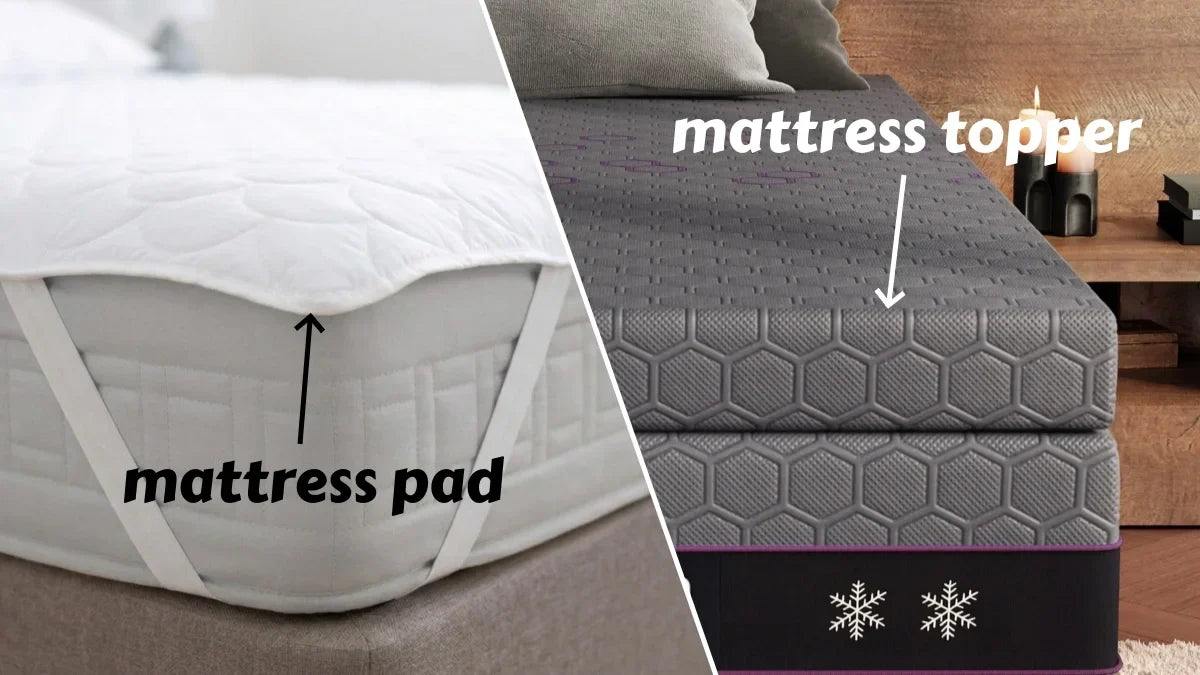
The practical difference between a cooling mattress topper and a cooling mattress pad is the job each one is designed to do. A topper is the stronger choice when you want to change how the bed feels. A pad is usually better when the mattress already feels comfortable, and you want a lighter, easier-to-manage surface layer.
That distinction matters because “cooling” does not describe one standardized construction. Cooling toppers may use latex, wool, gel memory foam, or other materials intended to move heat away from the sleeper, according to the Sleep Foundation. A pad may instead rely on a cool-touch cover, breathable fill, moisture management, or a more active temperature-control system. The product name alone does not tell you how it handles heat.
Before buying either one, decide whether your real problem is excess sink, an uncomfortable sleep surface, trapped heat, dampness, bedding that fits poorly, or an overly warm room. The right answer may be a topper, a pad, or neither.
Mattress Topper vs Mattress Pad at a Glance
| Decision point | Cooling mattress topper | Cooling mattress pad |
|---|---|---|
| Primary job | Noticeably alter cushioning or surface feel | Add a lighter comfort and bedding layer |
| Typical profile | Deeper and more substantial | Thinner and less intrusive |
| Effect on firmness | Can materially soften or otherwise change the surface | Usually changes the feel less |
| Thermal behavior | Depends heavily on material, depth, airflow, and how far the sleeper sinks | Often exposes the sleeper more directly to the cover, but may have limited capacity to manage ongoing heat |
| Sheet fit | More likely to require deeper fitted-sheet pockets | Less likely to create a major fit problem, though total bed depth still matters |
| Cleaning | Often requires spot cleaning or separate cover care | More likely to fit into a normal bedding-care routine, subject to its label |
| Best fit | An uncomfortable mattress that is still structurally serviceable | A comfortable mattress that needs a modest surface adjustment |
| Main risk | Solving comfort while adding insulation or excessive sink | Expecting a thin layer to correct a major comfort or support problem |
Choose by the Job You Need the New Layer to Perform
Choose a topper when comfort needs a meaningful change
A topper belongs on the shortlist when your mattress feels too firm, creates uncomfortable pressure at the surface, or needs a more substantial comfort layer. Its added material can change how deeply you settle into the bed and how the surface conforms around you.
That does not mean every topper makes a mattress softer in the same way. Foam, latex, wool, and other constructions respond differently. Evaluate the specific material, firmness, resilience, and cover instead of treating “topper” as a single feel category.
A topper also cannot repair a mattress with a structural problem. If the bed has visible depressions, a failing edge, broken components, or an unsuitable support base, adding material above it may disguise the symptoms without correcting the cause.

Shoppers who want a plush comfort adjustment can review the SLEEPMAX Apex Plush Mattress Topper. Compare its disclosed dimensions, materials, care requirements, and intended feel with your own mattress and bedding before deciding.
Choose a pad when the mattress already feels right
A pad makes more sense when you want to preserve the underlying mattress feel. It can provide a light buffer between the sleeper and the mattress, and certain designs may add protection or a different surface textile without introducing a new comfort layer.

This is often the cleaner choice for a bed that is comfortable but feels warm at first contact, needs a washable bedding layer, or would become too soft with a thick topper. However, a passive pad should not be assumed to remove heat continuously. Some products may feel cool initially but become warmer later, which is why you should distinguish a cool-touch sensation from sustained temperature management.
Thickness Affects More Than Comfort
Thickness is not merely a specification to maximize. It changes the height of the sleep surface, the amount of cushioning between you and the mattress, how much material can surround the body, and whether your fitted sheet can stay attached.
A deeper topper is more likely to produce a noticeable comfort change. It can also make climbing into bed feel different, interfere with a carefully chosen pillow height, or cause a fitted sheet to pull loose. A pad usually has a smaller effect on bed height, but its skirt and elastic still must accommodate the mattress beneath it.
Do not compare nominal thickness in isolation. Ask how much the layer compresses under load and whether the listed measurement includes a lofty cover. Two products with apparently similar profiles can behave differently once someone lies on them.
The available research also points to a tradeoff between cushioning and thermal response: thinner pads offer less support but cool down faster, while thicker pads tend to be more supportive and less cooling. Treat that as a category-level buying consideration rather than a promise about every model. The Spruce
Understand What “Cooling” Actually Means
Cooling performance can come from several different mechanisms. Buyers should identify the mechanism before comparing marketing labels.
Cool-touch surfaces
A cover may feel cool when your skin first contacts it. That initial sensation can be pleasant when getting into bed, but it does not mean the surface will remain cool after prolonged contact. Ask whether the claim concerns the first touch, heat transfer over time, moisture handling, or an active control system.
Airflow and reduced heat accumulation
Open or springy structures may allow more air movement than dense, deeply conforming layers. The complete stack matters: topper or pad, protector, fitted sheet, sleeper, mattress, and foundation all interact. A breathable top layer cannot guarantee a cool bed if another layer restricts airflow or if the sleeper sinks deeply into insulating material.
Moisture management
A fabric can feel more comfortable by moving perspiration away from the skin or drying efficiently. That is not the same as lowering temperature, but it may reduce the clammy feeling associated with sleeping hot. Look for precise fiber content and care directions rather than relying on an undefined “breathable” claim.
Check Fitted-Sheet Clearance Before Ordering
Sheet fit is one of the most overlooked differences in the cooling mattress topper vs cooling mattress pad decision. Measure the assembled bed rather than relying on the mattress label.
Use this process:
- Install every layer that will remain on the bed, including the topper or pad and any protector.
- Measure vertically from the bottom edge of the mattress to the highest point of the assembled sleep surface.
- Compare that total with the fitted sheet’s stated pocket depth.
- Leave practical allowance for the sheet to wrap beneath the mattress rather than stopping at its edge.
- Check whether the fitted sheet’s elastic and corner construction can accommodate the stack.
A topper can create a second fit issue: shifting. Determine whether it uses straps, a grippy underside, a fitted enclosure, or no retention feature. Verify that the retention method fits your mattress depth and does not interfere with an adjustable base, if applicable.
Compare Washability at the Component Level
“Washable” can mean the entire item is machine washable, only the cover is washable, or the product tolerates limited cleaning under specific conditions. Read the care label before purchase and confirm that your washer and dryer can handle the item’s size.

Pads often have an advantage when frequent laundering is important because they are generally less bulky. A substantial topper may have a removable cover while its core requires spot cleaning. That can be manageable, but it makes a separate protector more valuable.
Before choosing, ask:
- Is the whole product washable, or only its cover?
- Are commercial or oversized machines required?
- Can it be tumble-dried, and under what settings?
- Are bleach, softener, or dry cleaning prohibited?
- Does laundering affect the return or warranty terms?
- Can a replacement cover be purchased separately?
When Neither Option Will Solve a Hot Mattress
A topper or pad is unlikely to be a complete solution when the heat problem originates elsewhere in the sleep environment.
Neither may be sufficient when:
- The room itself remains uncomfortably warm.
- Heavy or poorly ventilated bedding holds heat above the sleeper.
- A waterproof or otherwise low-airflow layer dominates the feel of the bed.
- The mattress is deep-sinking.
- The mattress has a structural or comfort failure that calls for replacement rather than another layer.
- A health issue, medication, or unexplained change in nighttime temperature is involved.
Start with a layer audit. Temporarily simplify the bedding, review thermostat and humidity conditions, and identify when the discomfort begins. Immediate warmth at first contact suggests a different issue from waking hot after prolonged sleep. Dampness points toward moisture management, while discomfort caused by deep sink may require a change in surface feel or mattress construction.
If symptoms are new, severe, persistent, or otherwise concerning, discuss them with an appropriate healthcare professional. Bedding can change the sleep environment; it should not be treated as a medical solution.
Full Buyer Guide: How to Compare Products Responsibly
Decision criteria
Use the following criteria in order. Starting with “cooling” marketing language tends to obscure the more important fit questions.
Primary job: Decide whether you need a meaningful comfort change, a light surface layer, mattress protection, moisture handling, or active temperature adjustment.
Current mattress condition: Inspect for depressions, damaged edges, uneven support, and incompatibility with the foundation. A topper is not a structural repair.
Cooling mechanism: Require the seller to explain whether the product relies on cool-touch fabric, passive heat transfer, airflow, moisture management, phase-responsive material, or active circulation.
Total bed depth: Add the mattress, topper or pad, and protector before checking fitted-sheet compatibility.
Layer order: Confirm where the protector and fitted sheet belong. This matters because adding layers above a cool-touch surface may change how directly you feel it.
Care burden: Determine exactly which components can be washed and whether they fit your laundry equipment.
Policies: Read the return, trial, and warranty terms for the exact accessory. Do not assume a mattress policy automatically covers a topper, pad, or bedding item. SLEEPMAX’s brand profile includes a 365-night mattress trial, but buyers should verify the policy that applies to the specific item they are considering through SLEEPMAX.
Questions to send the seller
For a retail purchase, these work like a compact request for quotation and clarification:
- What is the topper/pad made of?
- What cooling mechanism does the product use?
- Does the cooling claim describe initial touch or performance over extended use?
- What assembled bed depth should the fitted sheet accommodate?
- Is the complete item machine washable, or only a removable cover?
- Does it work on an adjustable base?
- What are the item-specific return, trial, exchange, and warranty conditions?
- Are opened or laundered products eligible for return?
Record the answers in writing, especially when fit or return eligibility determines whether the purchase is viable.
Final pre-purchase checklist
- [ ] I know whether I need a comfort change or only a light surface layer.
- [ ] I have inspected the mattress for structural problems.
- [ ] I understand the specific cooling mechanism.
- [ ] I have measured the complete bed stack.
- [ ] My fitted sheet has enough usable pocket depth.
- [ ] I know the correct order for the topper or pad, protector, and sheet.
- [ ] I have read the care label or written care instructions.
- [ ] My laundry equipment can handle every washable component.
- [ ] I have reviewed the exact return and warranty policy for this item.
- [ ] I have considered whether the room, bedding, or mattress is the real heat source.
The Practical Verdict
Choose a cooling topper when the bed’s surface comfort needs a substantial adjustment, and you are prepared to manage added height, sheet fit, and more involved cleaning. Choose a cooling pad when the mattress already feels good, and your priority is a lighter, more washable surface.
If your main complaint is persistent heat rather than comfort, investigate the mechanism before choosing either category. A thick layer can change pressure relief without resolving heat accumulation, while a thin cool-touch pad may provide an appealing first sensation without managing warmth throughout the night. Measure the assembled bed, audit every layer, and buy for the specific job, not the label.
FAQ
Can I put a cooling pad over a mattress topper?
Yes, if the combined construction is permitted by both manufacturers and the pad fits the total depth. Check whether the added pad changes the topper’s intended feel, retention, or cooling surface, and make sure the fitted sheet can wrap securely around the complete stack.
Does a cooling topper need a fitted sheet?
Normally, yes. A fitted sheet provides the direct sleep surface and helps keep the stack orderly. Confirm the manufacturer’s recommended layer order and measure the total depth first.
Will a cooling topper fix a mattress that sleeps hot?
It may change the surface environment, but the outcome depends on its materials, construction, sink, bedding layers, and room conditions. It will not correct every source of nighttime heat, and it cannot repair a structurally failing mattress.
Which option is easier to wash?
A pad is generally the more manageable category because it is less bulky, but the care label controls. Some toppers have washable covers even when their cores cannot be machine washed.


