


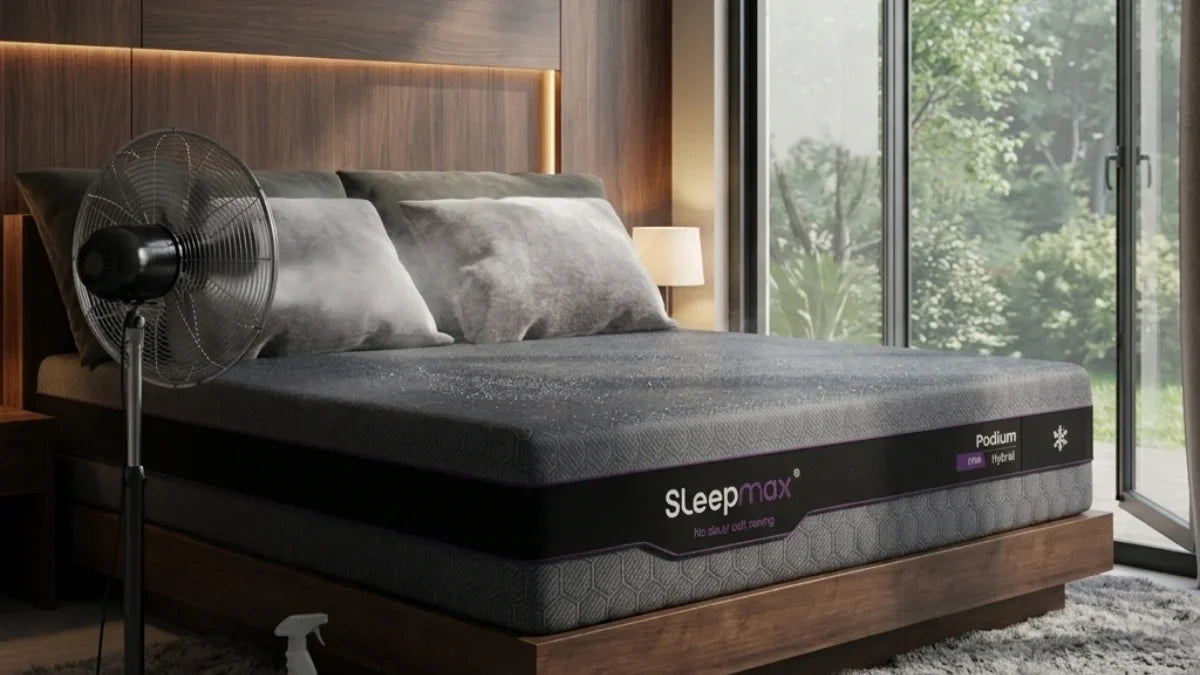
We’ve all been there: waking up sweaty during the night, like 4 am. You kick off the blanket, wait a few minutes until you feel cold, pull it back up, and repeat the agonizing cycle all night.
You decide to switch to a cooling mattress. But with so much marketing hype surrounding "ice-tech" covers, how do you separate genuine science from sales pitches?
Comparing Popular Cooling Mattress Materials
| Material | How It Helps With Heat | What It Feels Like | Best For |
| Natural Latex | Its breathable structure and ventilation can help air move through the material | Responsive and less “hugging” | Hot sleepers who prefer a bouncy feel |
| Open-Cell Memory Foam | More open-cell structures can improve airflow | Contouring without feeling as closed-in as dense foam | Hot sleepers who still want memory foam |
| Gel-Infused Memory Foam | Gel can help absorb and redistribute some heat within the foam | Familiar memory foam feel with potentially less initial heat | Memory foam lovers |
| Phase Change Materials (PCM) | Absorbs and stores heat as the material changes phase | Often creates a cooler surface feel | Sleepers who feel hot when first getting into bed |
| Cooling Fibers & Fabrics | Airflow, moisture management, or heat transfer depending on the material and weave | Helps keep the surface cooler and drier | Hot sleepers who sweat or feel heat at the surface |
1. Natural Latex
Natural latex is one of the more breathable mattress materials, making it a popular choice among hot sleepers. Its open structure and, in many mattresses, additional ventilation holes allow air to move through the material.
Unlike memory foam, latex has a more responsive feel and does not contour as closely around the body. That can leave more space around the sleeper and reduce the enclosed, heat-trapping feeling some people experience with dense foam.
If you like a mattress that feels responsive rather than deeply contouring, natural latex is worth considering.
2. Open-Cell Memory Foam
If you like the pressure relief of memory foam but tend to sleep hot, open-cell memory foam is one variation to look for.
Its more open structure can improve airflow compared with denser foam, allowing heat and air to move through the comfort layer more easily. However, open-cell foam is still foam, so it should not automatically be considered “cooling” on its own.
You can keep the contouring feel of memory foam while potentially reducing some of the stuffiness associated with denser foam.
3. Gel-Infused Memory Foam
Gel-infused memory foam adds gel particles or beads to the memory foam to improve heat management.

Gel can help absorb and spread some of your body heat, which may slow down heat buildup at the sleep surface. However, its cooling effect depends heavily on the foam and overall mattress construction, so gel alone does not guarantee a cool night's sleep.
So if you already like memory foam, gel infusion can be one feature to look for, but don't evaluate a mattress based on the word “gel” alone.
4. Phase Change Materials (PCM)
Phase Change Materials work differently from breathable foams. Instead of primarily relying on airflow, PCM is designed to absorb excess heat when your body warms the mattress surface. As the PCM reaches its transition temperature, it changes from solid to liquid and stores that heat. When the surrounding temperature drops, it changes back to a solid and releases the stored heat, helping moderate temperature changes.
In mattress applications, PCM is often incorporated into the comfort layer. As the surface warms, the material can absorb some of that heat and help moderate temperature changes near the body.
For hot sleepers, PCM can be particularly appealing if you tend to notice heat as soon as you get into bed. However, it is still only one part of a mattress's cooling system.
5. Cooling Fibers and Fabrics
The mattress cover is the first layer in contact with your body, so its material can affect how cool and dry the sleep surface feels. Common cooling and standard bedding materials include cotton, linen, TENCEL™ (lyocell), rayon, bamboo-derived viscose, nylon, polyester, polypropylene, polyethylene, and moisture-wicking fibers like COOLMAX®. [ScienceDirect]
The weave matters, too. For hot sleepers, look for a lightweight, breathable construction that allows air and moisture to move through the fabric rather than a heavy, tightly woven cover. [Taylor & Francis]
Which Cooling Mattress Material Is Best for Hot Sleepers?
There isn't one cooling material that works best for everyone.
If you want natural breathability and a responsive feel, latex may be a good fit. If you love memory foam, open-cell or gel-infused foam can be worth considering. If you mainly struggle with surface heat when you first get into bed, PCM may be more relevant. And if sweat and moisture are your bigger concerns, pay attention to the mattress cover as well.
Most importantly, don't judge a mattress by one material alone. A mattress with breathable materials can still sleep warm if the overall construction traps heat, while a mattress that combines breathable foam, a cooling cover, and an airflow-friendly support system may perform better as a whole.
Common Myths About Cooling Mattresses
Before investing in a new bed, clear away these common misconceptions:
Myth 1: A cooling mattress feels like an ice pack all night.
Reality: Passive cooling materials regulate temperature; they don't freeze it. Their goal is to keep you at a neutral, stable temperature (~30°C–32°C at skin level) so you don't sweat.
Myth 2: Cooling gel solves all memory foam heat issues.
Reality: Gel alone cannot overcome poor mattress airflow. If the underlying foam layers are dense and unventilated, the gel will eventually warm up to your body temperature.
Myth 3: Any mattress pad or protector is fine.
Reality: Putting a thick, non-breathable polyester mattress protector over a high-tech cooling mattress acts as a thermal barrier, blocking the cooling properties from reaching your skin.
Key Features to Look For in a Cooling Mattress
A cooling mattress is not defined by one material or a single “cooling” feature. The overall construction matters, especially how well the mattress can release heat, manage moisture, and avoid excessive heat buildup.
A Breathable Mattress Cover
The cover is the first layer between your body and the mattress, so it can affect how warm or cool the surface feels. Look for breathable, moisture-managing fabrics such as cotton, lyocell, or other cooling fabrics and a good weave rather than focusing only on a “cool-to-the-touch” claim.
Good Airflow Through the Mattress
Airflow is important for moving heat away from the sleep surface. Hybrid mattresses with pocketed coils can leave open space within the support system, allowing air to move through the mattress more easily than a dense foam core.
Ventilated Comfort Layers
Don't stop at the cover and support core. The comfort layers also affect how much heat stays close to your body. Open-cell or ventilated foam and perforated latex can provide more pathways for air movement than dense, less-ventilated foam.
Temperature-Regulating Materials
Materials such as PCM, gel-infused foam, and other cooling infusions can be useful additions. However, they work differently and shouldn't be treated as interchangeable, so check what the material is actually designed to do rather than choosing a mattress simply because it has a “cooling” label.
Don't Ignore How Deep You Sink
A mattress can have breathable materials and still feel warm if you sink deeply into the comfort layers. More contouring can increase the amount of mattress surrounding your body and reduce airflow around the sleep surface, so hot sleepers may want to consider how deeply the mattress allows them to sink as well.
Consider the Whole Construction
The best cooling setup is usually not one impressive material but several features working together. A breathable cover, ventilated comfort layers, an airflow-friendly support core, and appropriate temperature-regulating materials can each address a different part of the heat problem.
Real-World Example: Sleepmax Pressure Relief Hybrid Mattress
Sleepmax pressure relief hybrid mattress combines several cooling-focused features in one hybrid construction, including:
- HyFresh™ cover
- gel-infused high-density foam
- Honeycomb individually wrapped pocketed coils
This combination is designed to provide cooling-focused comfort without relying on a single material.
FAQ
Do cooling mattresses work all night, or do they warm up?
Passive cooling materials like standard gel foam eventually reach thermal equilibrium with your body after 3 to 4 hours. However, systems that combine open-cell foam with hybrid coil bases or Phase Change Materials (PCM) maintain active heat transfer throughout the entire night.
What is the best mattress material if I suffer from severe night sweats?
A hybrid mattress utilizing ventilated natural latex or open-cell/gel-infused memory foam paired with a Tencel or PCM cover offers the best performance. The coil system evacuates moisture vapor, while the wicking cover prevents dampness against your skin.
Can a cooling mattress topper fix a hot bed?
A cooling topper can provide temporary surface relief, but it cannot fix an underlying mattress that traps heat. If your mattress base consists of dense, closed-cell foam, heat will eventually build up and radiate back through the topper.


