


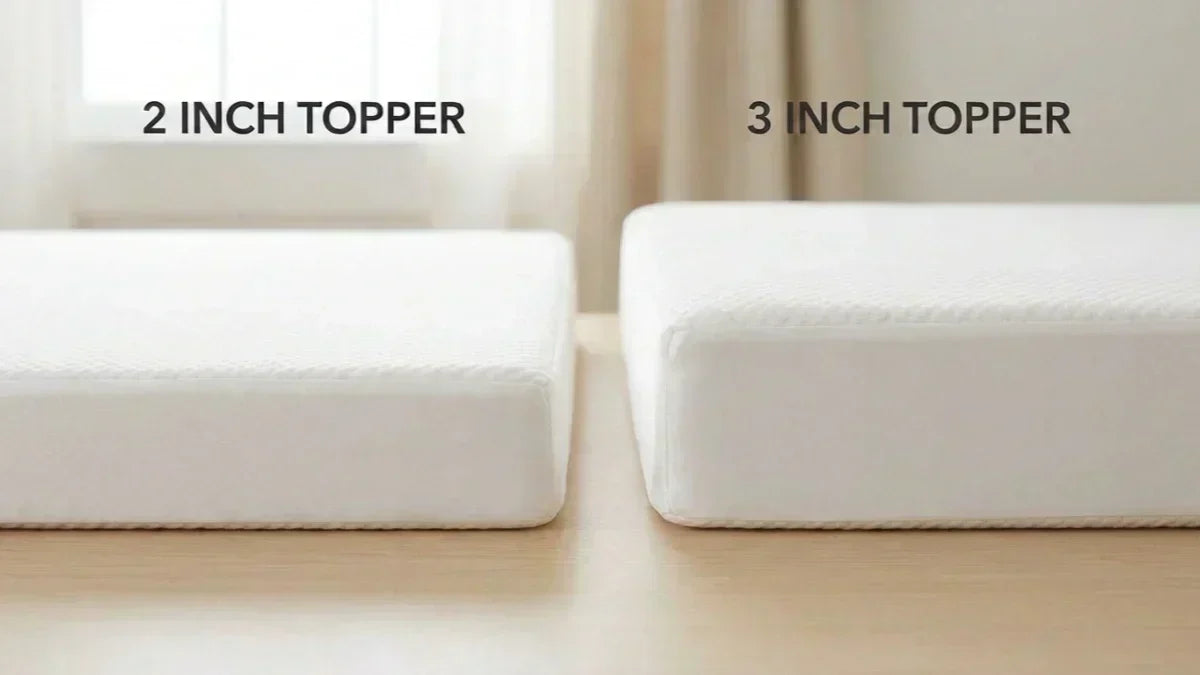
For a hot side sleeper, the choice between a 2-inch and 3-inch mattress topper is not simply “more cushioning versus less.” Thickness changes how far your shoulder and hip can settle, how much of the mattress you still feel, how easily you can turn over, and how closely the topper surrounds your body.
The practical starting point is this:
- Choose 2 inches when the mattress is basically supportive and needs a modest comfort correction, especially if you dislike deep sink or frequently change positions.
- Choose 3 inches when a firm mattress leaves your shoulder or hip under-cushioned and you need the topper to make a more substantial change.
- Do not choose thickness alone. Material, firmness, resilience, cover construction, and the mattress underneath can make two toppers of equal thickness feel very different.
Quick Decision Table
| Your situation | Better starting point | Why |
|---|---|---|
| Mattress feels slightly too firm, but support feels stable | 2 inches | Makes a smaller comfort adjustment and preserves more of the mattress feel |
| Shoulder presses into a firm surface before the torso feels settled | 3 inches | Provides more depth for side-sleeping contouring |
| You turn frequently or alternate between side and back sleeping | 2 inches | Usually represents the lower-risk mobility choice |
| Mattress is distinctly firm, and both shoulder and hip need more room | 3 inches | Changes the comfort surface more substantially |
| You sleep hot and are uncertain about a slow-response foam | 2 inches, or test both | Less depth may reduce envelopment, but construction matters more than the number alone |
| Mattress is sagging or has a persistent body impression | Neither | A topper may soften the surface but cannot repair an unstable support system |
These are selection heuristics, not universal performance guarantees. Treat them as a way to choose what to test first.
Why Side Sleepers Notice Topper Thickness
Side sleeping concentrates contact at the shoulder and hip. A topper has to let those areas settle without allowing the midsection to lose a stable relationship with the mattress.
A thin comfort change may be enough if the underlying mattress already contours reasonably well. If the mattress is firm, however, you can compress a shallow topper and encounter the firmer surface beneath it. A 3-inch layer gives the body more material through which to contour.
The Six-Factor Thickness Decision Framework
1. Body weight
Observe what happens when you lie on your side:
- Little visible compression: If your shoulder remains elevated and the surface feels hard, added depth may help.
- Moderate compression with stable support: A 2-inch topper may be sufficient when the mattress underneath is still contributing useful contouring.
- Near-complete compression: If you quickly pass through the topper and feel the firm mattress, consider 3 inches or a different topper firmness.
- Excessive immersion: If your hip settles far below your waist or turning feels laborious, additional thickness may worsen the problem.
Body shape matters alongside total weight. Broad shoulders, a pronounced hip profile, and how weight is distributed can change the depth needed. The useful question is not “What do I weigh?” by itself, but “How deeply do my shoulder and hip compress this particular material?”
2. Mattress firmness: decide how much correction is necessary
A topper works as part of a sleep system. The same 2-inch model can feel subtle over a plush mattress and abruptly bottom out over a very firm one.
- If the mattress is comfortable on your back but slightly harsh on your side, start with 2 inches.
- If side sleeping produces immediate, localized shoulder or hip discomfort on an otherwise flat and supportive mattress, 3 inches is the stronger candidate.
- If the mattress already feels soft through the torso, do not add thickness reflexively. A thinner, more responsive topper or no topper may preserve better control.
- If the mattress has softened unevenly, inspect the foundation and mattress condition before shopping.
Consumer Reports notes that adding a 3-inch foam or feather topper can make a mattress that feels too firm softer and more comfortable (Consumer Reports). That supports 3 inches as a meaningful firmness correction, but it does not establish that every material or sleeper will respond identically.
3. Shoulder and hip pressure: identify the limiting contact point
Do not evaluate the bed only by whether it feels “soft.” Determine which body area stops settling first.

If the shoulder feels blocked while the hip is comfortable, the topper may need more depth or a more conforming surface. If the hip drops deeply while the shoulder still feels crowded, simply adding thickness may not solve the mismatch; material response and firmness deserve closer attention.
Run a short side-lying check in your normal sleep posture:
- Settle fully rather than judging from the first touch.
- Notice whether the shoulder can descend without being forced.
- Check whether the hip feels cushioned rather than staying on the surface.
- Notice whether the waist feels reasonably supported.
- Roll to the other side and assess the effort required.
Persistent pain, numbness, or symptoms that continue away from bed warrant discussion with a qualified healthcare professional. A topper is a comfort product, not a diagnosis or treatment.
4. Sink depth
Useful contouring lets the shoulder and hip enter the comfort layer while the rest of the body remains easy to reposition. Excessive sink feels different: the body becomes surrounded, the hip may feel markedly lower, or you may need momentum to turn.
For buyers who dislike a “stuck” sensation, 2 inches is the safer first test unless the mattress is so firm that the topper is being compressed through.
5. Mobility
Thickness can affect movement because it changes how far the body must rise out of the comfort layer. This matters for combination sleepers, people who turn often, and anyone who already finds low or enveloping beds inconvenient.
During the test, check whether you can:
- Roll from one side to the other without pushing forcefully against the bed.
- Move from side sleeping to sitting without feeling caught in the surface.
- Use the edge without the topper shifting or folding.
- Maintain a comfortable sleeping position without repeatedly readjusting.
If a 3-inch sample relieves the shoulder but makes every turn difficult, the answer may be a more resilient material or firmer feel, not necessarily accepting poor mobility as the price of pressure relief.
6. Heat retention
Thickness does not provide a complete cooling forecast. A 3-inch topper can surround more of the body if its material allows deep sink, but a 2-inch dense or poorly ventilated design may still feel warm. The cover, protector, fitted sheet, room conditions, and mattress beneath all influence the experience.
For a hot sleeper, compare:
- How deeply the torso is enclosed by the topper.
- Whether the material recovers quickly when you move.
- Whether the cover can be removed and washed.
- Whether the product discloses its core material and cover composition.
- Whether your protector and sheets add a less breathable layer above it.
- Whether the fitted sheet is deep enough without compressing the topper tightly.
Treat undefined words such as “cooling” as prompts for questions, not proof of performance. Ask what physical feature the claim refers to: cover fabric, airflow channels, or a phase-change treatment.
2-Inch vs 3-Inch Topper by Sleeper Profile
Choose 2 inches if you want refinement
A 2-inch topper is the more conservative choice when you already like the mattress’s support and want to soften its first-contact feel. Its main failure mode is insufficient depth. If your shoulder compresses the topper completely and reaches the mattress, a softer 2-inch model may not be the answer; it could bottom out even more readily.
Choose 3 inches if you need a larger comfort change
A 3-inch topper is the more logical starting point when a supportive but firm mattress does not give the shoulder and hip enough room. Its main risks are excessive sink, harder repositioning, greater total bed height, and more envelopment than a hot sleeper wants. Those risks depend heavily on material and firmness, so compare specifications rather than buying by thickness alone.
When neither thickness is the right fix
Skip the topper purchase when the mattress sags, tilts, has a deep body impression, or feels unstable through its support layers. Adding cushioning can change surface feel, but it does not rebuild the mattress underneath.
Also pause if the problem is limited to pillow height, an overly warm protector, or sheets that no longer fit. Changing the topper would add cost and another variable without addressing the likely cause.
Full Buyer Guide: How to Compare Toppers Before Ordering
Decision criteria
Evaluate each candidate on the same fields:
| Criterion | What to record | Why it matters |
|---|---|---|
| Thickness | Finished topper depth | Defines the available contouring range |
| Core material | Latex, memory foam, fiber, or another disclosed construction | Materials differ in response, sink, and handling |
| Firmness description | Exact option and seller terminology | Thickness cannot compensate predictably for unknown firmness |
| Response | Slow-conforming or quick-rebounding | Influences mobility and perceived envelopment |
| Cover | Materials, removable status, and care method | Affects surface feel and maintenance |
| Return terms | Trial conditions, fees, and return method | A home test is more useful than marketing language |
| Warranty scope | Covered defects, exclusions, and claim process | Clarifies post-purchase recourse |
| Final bed height | Mattress plus topper and protector | Determines sheet fit and ease of entry |
Questions to ask the seller or include in an RFQ
- What material is used in the core?
- Does the 2-inch version use the same material and firmness as the 3-inch version?
- Is the cover removable, and what are its care instructions?
- How is the topper kept from shifting on the mattress?
- Who pays return shipping, and is pickup available for bulky returns?
- Does using a protector, adjustable base, or heated bedding affect coverage?
A Practical Recommendation for Hot Side Sleepers
Start with 2 inches when your mattress is supportive and only somewhat too firm, or when heat and freedom of movement are equal priorities with cushioning. Move toward 3 inches when your shoulder or hip clearly runs out of cushioning on a firm, stable mattress.
If possible, compare both thicknesses in the same material and firmness. That isolates depth from other variables. A softer 2-inch foam and a firmer 3-inch latex topper are not clean thickness comparisons.
Shoppers considering the SLEEPMAX Apex Plush Mattress Topper should verify its current construction, thickness, care, cooling features, and return terms on the product page rather than assuming category-level guidance describes that specific model. The broader SLEEPMAX range is positioned around cooling, pressure relief, motion isolation, and recovery, but the right topper still depends on the mattress and sleeper beneath it.
FAQ
Is a 3-inch mattress topper always better for side sleepers?
No. It offers more contouring depth, but it can also create more sink and envelopment. Side sleepers who already have a moderately conforming mattress or who move frequently may prefer 2 inches.
Can a 2-inch topper relieve shoulder pressure?
It can be a reasonable starting point when the mattress needs only a modest comfort change. If the shoulder compresses through the topper and encounters the firm mattress, more depth or a different material may be needed.
Which thickness sleeps cooler?
Thickness alone cannot answer that reliably. A thinner topper may reduce envelopment, but material response, cover construction, protector, sheets, and room conditions also matter.
Should a heavier side sleeper automatically buy 3 inches?
No. Greater compression can make added depth useful, but body shape, topper firmness, material response, and mattress firmness must be considered together. The supplied evidence does not support a universal body-weight cutoff.
Will a topper fix a sagging mattress?
No. A topper can alter surface cushioning but should not be treated as a structural repair. Inspect the mattress and foundation before adding another comfort layer.
What is the simplest final test?
Choose the option that cushions the shoulder and hip without making the hip feel uncontrolled, turning laborious, or the sleep surface uncomfortably enveloping.


