


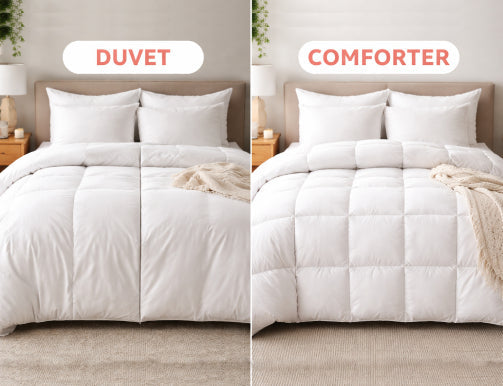
When it comes to creating a comfortable, inviting bed, your choice of bedding matters more than you think. One of the most common questions we hear from shoppers is: Should I choose a duvet or a comforter?
While they may look similar at first glance—especially when neatly arranged on a showroom bed—duvets and comforters serve distinctly different purposes. The right choice for you depends on your lifestyle, sleep habits, budget, and how much you value flexibility versus simplicity.
Let's break it all down so you can make an informed decision.
What Is a Duvet?
A duvet is a soft, fluffy insert designed to be used with a removable duvet cover. Think of it as a pillow-and-pillowcase system, but for your entire bed. The insert provides the warmth, while the cover serves as both protection and decoration. This two-piece design originated in Europe and has become synonymous with luxury hotel bedding worldwide.
Duvets are especially popular in Scandinavia, France, and high-end hospitality brands because they offer unmatched flexibility, effortless cleaning, and that signature "hotel cloud" sleep experience.
Why do people love duvets
Easy to clean – Simply remove and wash the duvet cover instead of laundering the entire insert. Most duvet covers can be tossed in a standard home washing machine (check for size compatibility with your washer). This makes weekly or bi-weekly washing completely practical.
Style flexibility – Change your bedroom look instantly by swapping covers. One month you can have crisp white hotel vibes; the next, a bold geometric print or soft linen in earth tones. This is particularly appealing for renters or anyone who loves refreshing their space without buying new bedding.
Customizable warmth – Choose different inserts for summer and winter. Rather than adding or removing layers, you simply swap to a lighter (4.5-7.5 tog) or heavier (10.5-15 tog) insert. This extend the life of your bedding investment.
Things to consider
Putting a duvet into its cover can take a little practice. The infamous "burrito roll" or "shake-down" methods exist because it's genuinely tricky at first. But once you master it (usually within the first few attempts), it becomes second nature.
You'll need both an insert and a cover. This is technically a two-part purchase, though many retailers sell matching sets. Budget-conscious shoppers should know: a quality duvet insert typically costs $80-$300, while premium options from brands like Pacific Coast or Downlite can reach $400+.
Understanding Duvet Fill Materials
The fill inside your duvet determines its warmth, weight, feel, and price point. Here's what you need to know:
White Down (Goose Down) — Premium goose down clusters offer exceptional warmth-to-weight ratio and can last 15-20 years. Higher fill power (500-900+) means larger, fluffier clusters with better insulation. Prices: $150-$600+ for queen size.
Duck Down — More affordable with excellent insulation. May have slight natural odor. Fill power typically 400-600. Good entry point: $80-$200 queen.
Down-Feather Blend — Mix of down clusters and feathers (50/50 or 30/70). More affordable ($60-$150 queen) but heavier and less lofty. Feathers may occasionally poke through fabric.
Synthetic/Microfiber Fill — Polyester fibers engineered to mimic down's loft. Hypoallergenic, machine-washable, and affordable ($50-$150 queen). Modern fills like PrimaLoft perform well, lasting 5-8 years. Ideal for allergy sufferers or budget shoppers.
Duvet Cover Materials
Cotton Percale: Crisp, breathable, ideal for hot sleepers. Gets softer with washing. Brooklinen and Parachute offer luxury options at 400+ thread counts.
Cotton Sateen: Silky smooth with subtle sheen. Warmer than percale, wrinkle-resistant. Brooklinen's Luxe Sateen is a popular choice.
Linen: Natural, textured, highly breathable. Temperature-regulating and improves with age. $150-$400 for queen, but lasts 20+ years.
Microfiber: Budget-friendly, wrinkle-resistant, but less breathable. Good for guest rooms.
Understanding Tog Ratings: The European Warmth Standard
If you've shopped for bedding internationally, you've likely encountered "tog" ratings. This British Standard system measures thermal resistance:
| Tog Range | Best For | Season |
|---|---|---|
| 1.5-4.5 tog | Hot sleepers, summer | Summer/Early Fall |
| 7.0-9.0 tog | Moderate warmth | Spring/Autumn |
| 10.5-13.5 tog | Cold climates, cold sleepers | Winter |
| 14.0-15.0 tog | Extra cold rooms, layering | Deep Winter |
Pro tip: If you run hot, start with a 4.5 tog for summer and 9.0-10.5 tog for winter. In climate-controlled environments (68-72°F), a medium 7.0-9.0 tog often works year-round.
How to Put On a Duvet Cover: The Burrito Method
Frustrated by wrestling with corners? Here's the technique professionals use:
- Lay your duvet cover flat, inside-out, with the opening at the foot of the bed
- Place the duvet insert on top, matching corners
- Starting from the head, roll both the duvet and cover together toward the foot
- Reach through the cover opening and grab the far corner
- Unroll back toward the head, turning the cover right-side-out as you go
- Shake to distribute fill evenly
Practice makes perfect—expect to need 3-4 attempts before you flow through it smoothly.
Duvet Lifespan: When to Replace
A quality duvet should last:
- Premium down (800+ fill power) : 15-20 years
- Quality down (500-700 fill power) : 10-15 years
- Down blend: 7-10 years
- Synthetic fill: 5-8 years
Signs it's time to replace: Visible clumping that doesn't redistribute, loss of loft after shaking, cold spots, or visible feather escape through fabric.
What Is a Comforter?
A comforter is an all-in-one blanket with both the outer fabric and inner filling permanently stitched together. It's designed to be placed directly on the bed—no cover required. The fill is evenly distributed and secured through quilting, creating a consistent appearance and warmth level.
Comforters are popular in American households for their simplicity and convenience. They're typically sold in coordinating bedding sets that include matching pillow shams and sometimes sheets, making bedroom styling straightforward.
Why do people love comforters
Ready to use – No extra layers or assembly. Simply take it out of the packaging and lay it on your bed. This immediate gratification appeals to busy households and those who prefer plug-and-play solutions.
Clean, uniform look – Often sold as part of a matching bedding set. Brands like Threshold, UGG, and Nautica offer coordinated collections that take the guesswork out of matching. The uniform appearance is particularly popular in spaces where bedding is visible (studio apartments, minimalist designs).
Low-effort bedding solution – Once you've chosen your set, there's no ongoing cover-swapping or seasonal insert swapping. Your comforter is your comforter, year-round.
Things to consider
Washing can be more difficult due to size and thickness. A queen-size comforter can weigh 8-12 pounds when saturated. Home washing machines often struggle, leading to unbalanced spin cycles or incomplete cleaning. Many manufacturers recommend professional laundering or large-capacity commercial machines.
Less flexible if you like changing your bedroom style often. Unlike duvets where you buy new covers, comforters are a bigger commitment. Changing your bedroom aesthetic means purchasing an entirely new comforter.
Comforter Fill Materials
While comforters share some fill types with duvets, construction and fill density often differ:
Down Alternative (Polyester) — Most common U.S. comforter fill. Modern engineered fibers provide decent warmth without allergy concerns. $50-$200 queen, 5-8 year lifespan.
Cotton Fill — Natural, breathable, improves with age. Premium options use long-staple cotton. Boll & Branch offers certified organic versions. $100-$400 queen.
Wool Fill — Excellent temperature regulation. Heavier but highly durable. $200-$500 queen.
Real Down — Premium down clusters with denser fill than duvet inserts. $200-$800+ from Pacific Coast Feather Company or Eastern Silks.
Comforter Construction
Baffle Box Construction — Internal fabric walls create three-dimensional boxes allowing fill to fully expand. Maximizes loft, prevents cold spots. Premium construction from GhostBed and Parachute.
Sewn-Through (Quilted) — Top and bottom layers stitched together. More affordable but can create cold spots at stitching lines. Common in mid-range comforters.
Channel Stitch — Parallel channels run lengthwise or crosswise. Fill can shift within channels. Often found in traditional or decorative comforters.
Comforter Sets: What's Included
Typical sets include: comforter (always), pillow shams (1-2), decorative pillows (2-4), sheet set (bed-in-a-bag), and sometimes bed skirt. Budget sets (Target, Amazon Basics) start at $60-$100. Mid-range ($150-$300): Madison Park, Urban Habitat. Premium ($400-$800+): Restoration Hardware, Sferra, Frette.
Washing Your Comforter
Home Machine: Only if 4.5+ cubic feet capacity, synthetic fill, and label permits. Cold water, mild detergent, extra rinse cycle, low heat dry with dryer balls. Budget 3-4 hours.
Commercial Laundromat: Industrial washers (45+ lb) cost $4-$8 per load. Better for down and natural fills.
Professional Laundering: $30-$80 per comforter. Recommended for down or complex construction. 5-7 day turnaround.
Dry Cleaning: Only if labeled. Chemical solvents may degrade synthetics over time. $40-$100.
Comforter Lifespan
- Down alternative: 5-8 years
- Cotton fill: 10-15 years
- Wool fill: 15-20 years
- Premium down: 10-15 years (professional cleaning every 2-3 years)
Duvet vs Comforter: Key Differences at a Glance
| Feature | Duvet | Comforter |
|---|---|---|
| Structure | Insert + removable cover | One-piece design |
| Cleaning | Cover is easy to wash at home | Entire unit often needs professional cleaning |
| Style Options | Highly customizable—swap covers anytime | Fixed design; replacement needed for new look |
| Warmth Control | Change inserts by season (4.5-13.5 tog) | One warmth level year-round |
| Ease of Use | Cover setup with short learning curve | Ready to use immediately |
| Fill Options | Full range: down, blends, synthetics, wool | Primarily synthetics and down alternatives |
| Initial Cost | $130-$500+ (insert + cover) | $60-$800+ |
| Long-term Cost | Lower—replace cover only for style changes | Higher—full replacement for new aesthetic |
| Temperature Regulation | Excellent—fabric choice affects breathability | Varies; sewn-through may create cold spots |
| Lifespan (Premium) | 15-20 years (down insert) | 10-15 years (down) |
| Hotel Preference | European luxury hotels (95%+) | American mid-range hotels |
| Best For | Flexibility seekers, renters, allergen concerns | Simplicity lovers, coordinated room looks |
Which One Should You Choose?
The answer depends on your specific situation. Let's walk through the decision factors:
Choose a duvet if you:
Like switching up your bedroom style — With a duvet, refreshing your bedroom costs $50-$200 for a new cover rather than $150+ for an entirely new comforter. Renters and design enthusiasts benefit most.
Want easier cleaning and better hygiene — Washing a duvet cover weekly is practical and recommended for allergen control. The insert itself needs washing only 1-2 times per year (or never for down, if using a cover).
Prefer adjusting warmth seasonally — Owning two inserts (light + heavy) gives you four warmth combinations when paired with or without a blanket. This adaptability beats adding/removing layers.
Live in a climate with extreme seasonal temperature swings — Regions with hot summers and cold winters (Northeast, Midwest, Mountain states) benefit from swapping 4.5 tog summer inserts for 13.5 tog winter inserts.
Share a bed with different temperature preferences — Some brands like Buffy and Slumberjack offer dual-zone duvets with different fills on each side.
Have allergies — A quality duvet cover (especially with encased corners) creates a barrier against dust mites. Many down alternatives are specifically marketed as hypoallergenic.
Choose a comforter if you:
Want a simple, no-fuss bedding setup — No technique to master, no matching to worry about. Take it out, spread it on, done.
Prefer a consistent look year-round — Your bedroom maintains one aesthetic without seasonal swapping. Ideal for minimalists or those who've found their perfect color scheme.
Don't want to deal with covers — Some people simply don't enjoy the extra step of covering their insert. That's okay—this is a valid preference.
Buy on a tight immediate budget — Entry-level comforters ($60-$100 for queen sets) cost less upfront than quality duvet + cover combinations.
Live in a climate-controlled environment — If your bedroom stays a consistent 68-72°F year-round, one warmth level may suffice.
Shop at physical stores — Comforters are easier to evaluate in person—you can see the color accuracy, feel the weight, and assess construction immediately.
The Convertible Solution: Comforter + Duvet Cover
Here's a hybrid approach many shoppers overlook: Use a comforter as a duvet insert.
This works if you:
- Buy a comforter without a cover (or one with a removable cover)
- Purchase a duvet cover one size up to accommodate the bulk
- Enjoy the simplicity of choosing one product with the flexibility of style changes
Some brands like Buffy and Tuft & Needle explicitly market comforters that work as inserts. This approach gives you the best of both worlds: the fill distribution expertise of comforter construction with the style flexibility of a duvet system.
Real-World Price Comparison
Budget Tier (Under $150 for Queen)
- Duvet: Budget microfiber insert ($40-60) + cover ($50-80) = $90-140
- Comforter: Amazon Basics, Mainstays, Threshold Basic = $60-100
Mid-Range ($150-$350 for Queen)
- Duvet: Down-blend or quality microfiber insert ($100-150) + cotton cover ($80-150) = $180-300
- Comforter: Threshold (Target), Brooklyn Loom, Nautica = $150-250
Premium ($350-$700 for Queen)
- Duvet: Quality down insert ($200-400) + linen/sateen cover ($150-250) = $350-650
- Comforter: UGG, Eastern Silks, Brooklinen Down = $350-600
Luxury ($700+ for Queen)
- Duvet: Premium down (800+ fill power, $400-600) + designer cover ($200-400) = $600-1000
- Comforter: Frette, Sferra, Restoration Hardware = $800-2000+
Sleepmax Tip: Your Bedding Should Match Your Lifestyle
If you value flexibility, cleanliness, and hotel-inspired sleep, a duvet system adapts to you—wash weekly, swap styles seasonally, customize warmth precisely.
If you prefer simplicity and instant comfort, invest in a quality comforter with baffle-box construction that lasts 10+ years.
Bedding Layering Recommendations
- Mattress protector ($30-80) — Essential for extending mattress life and allergen protection.
- Fitted sheet ($50-150) — Percale for hot sleepers, sateen for warmth.
- Flat sheet or light blanket ($30-80) — Temperature control and keeps your main bedding cleaner.
- Duvet insert + cover OR Comforter — Your main warmth layer.
- Decorative throw — Aesthetics and extra warmth when needed.
For couples with different temperature preferences: Consider twin XL comforters joined with snaps (Scandinavian style) or dual-tog duvet systems.
No matter which you choose—duvet or comforter—the most important thing is how it makes you feel: comfortable, relaxed, and ready for deep rest. Your bed is where you spend one-third of your life. Invest accordingly.

Leave a comment
This site is protected by hCaptcha and the hCaptcha Privacy Policy and Terms of Service apply.