


Just imagine: You walk into a mattress showroom and see a price tag on a bed that, in some parts of the country, would be enough to buy a three-bedroom house. This isn’t a typo, nor has an extra zero been added. It really is a mattress that costs six figures—sometimes even seven figures.
This may sound a bit absurd. But the ultra-luxury mattress market is very real, and—driven by royalty and celebrities, and thanks to a wealth of stunning traditional craftsmanship—it has been quietly thriving for over a century. So, what exactly goes into a mattress that costs more than a Ferrari? Let’s find out.
The Floating Bed That Defies Gravity — Literally

When discussing the most expensive mattress of all time, we have to start with the magnetic levitation bed designed by Dutch architect Janjaap Ruijssenaars. It retails for as much as $1.53 million.
The bed doesn’t touch the floor. It floats — suspended midair by an interplay of powerful permanent magnets. No electricity required. No wires. Just physics doing something that feels like magic. The design was reportedly inspired by the monolith from 2001: A Space Odyssey, and the whole thing is fashioned from durable magnetic materials that repel magnets embedded beneath the floor.
Is it comfortable to sleep on? To be honest, aside from the very few who can afford it, probably no one knows. Most of the world’s most expensive mattresses don’t float in the air. They rely on a more traditional craftsmanship: materials that sound like they came from a Victorian-era tailor shop, and hundreds of hours of labor for each bed.
Hästens and the $400,000 Mattress

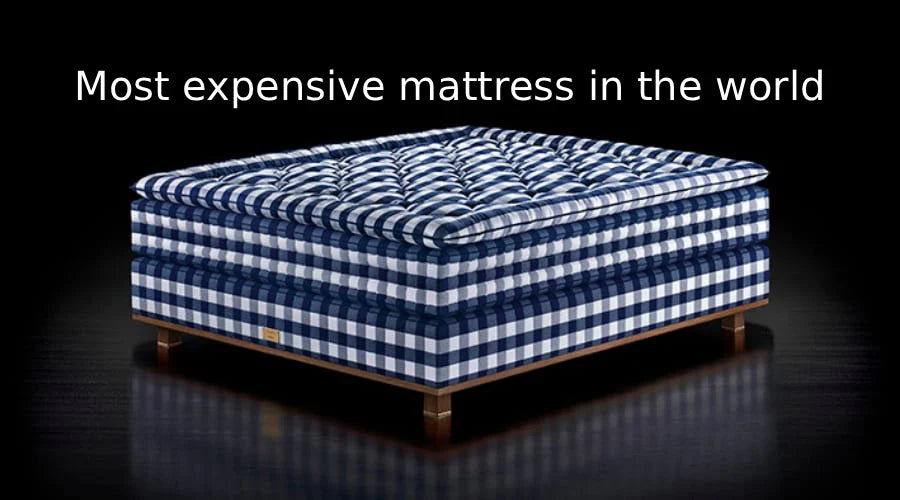
Hästens—a Swedish brand that has been in existence since 1852—currently holds the title for the most expensive traditional mattress in production. Its Grand Vividus mattress, designed in collaboration with luxury interior architect Ferris Rafauli, retails for as much as $400,000. What do you get for that kind of money? Horsehair. Lots of horsehair.
Each “Grand Vividus” mattress is handcrafted by artisans in Köping, Sweden, a process that takes over 600 hours. Its list of materials reads like a pre-Industrial Revolution inventory: cotton, linen, wool, and horsehair—specifically, horsehair that has been washed, twisted, and layered to create a surface that is naturally breathable and offers a level of supportive resilience that synthetic foam simply cannot replicate.
Horsehair is the “secret weapon” of ultra-luxury mattresses. Each strand of horsehair is hollow, which means that when you toss and turn in your sleep, air circulates through the horsehair inside the mattress. It effectively absorbs moisture and wicks away sweat, and its resistance to compression far exceeds that of foam materials. In addition, the horsehair processing is extremely labor-intensive, which is one of the reasons these mattresses are so expensive.
For those who find $400,000 a bit too steep, Hästens has also launched the Vividus—the “slightly less luxurious” sibling of the Grand Vividus—at a relatively more affordable price of $145,000. It still requires 320 hours of handcrafted work, uses 210 kilograms of natural materials, and features a layered horsehair structure designed to conform to the sleeper’s body contours.
Reportedly, Drake sleeps on a Hästens mattress. Whether this counts as an endorsement depends on your taste in music.
The British Contenders: Vispring and Savoir

Traveling across the North Sea to the United Kingdom, you’ll discover two brands that have been quietly crafting the world’s finest mattresses for over a century.
Vispring—founded in 1901—produces the “Diamond Majesty” mattress, with the king-size model retailing for approximately $74,600. The core structure of this mattress consists of three layers of hand-nested, burlap-covered springs, each wrapped in its own individual cotton sleeve. The fillings are equally ingenious: British wool, loose horsehair, Shetland wool blended with cashmere and silk, bamboo fiber, and royal alpaca wool. You can customize the spring firmness to your preference—soft, medium, firm, or extra-firm—but the price is non-negotiable.
Vispring’s slightly more affordable “Masterpiece Superb” series (priced at approximately $40,000) features 4,080 springs made from virgin vanadium steel. This spring system is actually custom-calibrated to your body type, which means that if you and your partner have different body types, the sleeping experience on either side of the same bed may be completely different.
Then there’s Savoir—a brand founded in 1905 that originally crafted bedding for London’s Savoy Hotel. Its No. 1 model starts at around $67,000, but if fully customized, the price can easily exceed $250,000. Each mattress takes more than 80 hours to craft, using hand-combed horsehair, Mongolian cashmere, and Suffolk silk. What sets Savoir apart is its highly personalized customization service: they tailor each mattress to your exact body measurements, sleeping position, and firmness preferences. You can even choose the fabric color, tufting pattern, and embroidery design.
It is said that Winston Churchill once used a Savoir bed. Whether this influenced his decision-making remains unknown.
What Makes These Mattresses So Expensive?
Strip away the brand prestige and heritage marketing, and you’re left with three factors that genuinely drive cost skyward:
First, there are the raw materials. Horsehair isn’t cheap—it must be sorted, washed, disinfected, curled, and layered by hand. A single mattress may require horsehair from dozens of horses’ tails. Cashmere comes from goats in Mongolia and the Himalayas. Silk is hand-harvested from silkworm cocoons. Alpaca wool must be sheared, washed, and graded. Vanadium steel springs—which are far more resistant to deformation than ordinary steel—are also much more expensive to manufacture.
Second are labor costs. These are not assembly-line products. It takes over 600 hours to craft a “Grand Vividus” mattress, while a “Vividus” requires 320 hours. Even Savoir’s “entry-level” mattress demands 80 hours of skilled handcrafting. This equates to several weeks of labor by master craftsmen—who individually tuft, stitch, layer, and finish each mattress.
Third is customization. When you purchase a $40,000 mattress from Vispring, a specialist takes your body measurements, calculates the ideal spring tension based on your weight distribution, and custom-builds the mattress to those specifications. This bespoke production model cannot be scaled up—and never will be.
There is also a fourth factor, though it is more difficult to quantify: scarcity. Many of these brands produce less in a year than half of what a typical mattress factory produces in a single day. Savoir strictly limits its production. Hästens operates only one factory, located in Köping. Scarcity is part of their pricing model—and for their target customers, that is precisely what makes them so appealing.
Do You Actually Sleep Better on a $100,000 Mattress?
Here’s where things get interesting — and where I’d be dishonest if I pretended the answer is an unqualified “yes.”
The materials used in these mattresses do offer tangible benefits. Horsehair is genuinely more breathable than memory foam. Natural latex and wool regulate temperature better than polyurethane. Hand-tufted construction distributes weight more evenly than glue-based assembly. And a pocket-spring system calibrated to your body will, objectively, provide better spinal alignment than a one-size-fits-all alternative.
Research backs up parts of this. A study in the Journal of Chiropractic Medicine found that medium-firm mattresses with proper lumbar support significantly reduced back pain and improved sleep quality compared to softer, less supportive alternatives. Another study, published in the journal Sleep, found that sleeping on a new, high-quality mattress reduced stress and improved sleep efficiency.
But here’s the thing: you can get a genuinely excellent mattress — with pocket springs, natural latex, breathable wool, and proper lumbar support — for $2,000 to $5,000. Brands like Saatva, Avocado, and Naturepedic’s Halcyon line hit almost all the same functional notes as a Vispring or Hästens at a fraction of the cost.
The $400,000 Grand Vividus isn’t 80 times better than a $5,000 Saatva. That’s not how luxury goods work. The difference between “excellent” and “the best” often costs disproportionately more than the difference between “average” and “excellent.” You’re paying for craftsmanship, heritage, materials rarity, and the experience of owning something that almost nobody else has.
What you’re not paying for is proportionally better sleep. If your current mattress is a sagging $300 foam brick from a big-box store, upgrading to a $2,000 hybrid mattress will transform your nights. Upgrading from that $2,000 mattress to a $40,000 Vispring? The improvement will be real — but marginal. The law of diminishing returns hits hard around the $5,000 mark.
What Every Mattress Shopper Can Learn from the Ultra-Rich
Even if you’ll never drop six figures on a bed, the luxury mattress market actually teaches a few useful things about what matters in a mattress — and what doesn’t.
Natural materials aren’t just marketing. The breathability of horsehair and wool, the temperature regulation of cotton and linen, the elasticity of natural latex — these aren’t invented benefits. They’re physical properties. When you’re shopping for a mattress in any price range, look for natural fiber content in the comfort layers. Even a modest percentage of wool or cotton in the top quilting makes a measurable difference in how hot or cold you sleep.
Pocket springs are worth the upgrade. Every single mattress on the luxury list uses individually wrapped pocket coils. That’s not an accident. Pocket springs move independently, which means your partner’s movements don’t ripple across to your side. They also conform to your body’s curves more precisely than interconnected springs or all-foam constructions.
Customization matters more than price. The high-end brands build mattresses for individual bodies. You probably can’t afford a fully bespoke mattress, but you can look for brands that offer multiple firmness options, split-comfort designs (different firmness on each side), or adjustable bases. Spending $3,000 on a mattress that’s wrong for your body is worse than spending $1,500 on one that’s right.
Longevity is the real value proposition. An ultra-luxury mattress is designed to last 25 to 50 years — sometimes longer, with proper care and occasional re-tufting. The average consumer mattress lasts about 7 to 10 years before it starts to degrade noticeably. A $40,000 Vispring that lasts 40 years costs $1,000 per year. A $2,000 mattress replaced every 8 years costs $250 per year. The Vispring isn’t cheaper, but the gap isn’t as wide as the sticker prices suggest. If you’re buying a mattress, ask about the warranty and, more importantly, what the company expects the actual usable life to be. A 25-year warranty on a mattress that’ll be sagging in year 8 isn’t worth the paper it’s printed on.
The Bottom Line
The world’s most expensive mattresses are truly extraordinary objects. They are made from materials that have been used in bedding for centuries and are meticulously crafted by artisans who have undergone years of training—artisans who must hone their skills for many years before being permitted to make a mattress on their own. They represent a form of artisanal craftsmanship that has all but disappeared in other industries.
Are they “worth the price”? That depends entirely on what “worth the price” means to you. If you are financially well-off and value owning the most exquisitely crafted versions of everyday items—much like the motivation behind purchasing hand-stitched leather goods or a tailor-made suit—then yes, a $50,000 Vispring mattress or a $250,000 Savoir mattress does indeed hold a unique value.
But if “value for money” means a corresponding improvement in sleep quality, then the answer is no—it doesn’t add up. It’s no exaggeration to say that for just 5% of the cost, you can reap 90% of the sleep benefits.
The real lesson to be learned from this world’s most expensive mattress isn’t that you should buy one. Rather, it’s that a mattress is worth investing in—and “investment” here should be defined according to your budget. Spend a little more than you planned. Prioritize natural materials and pocketed springs. Be sure to test it out before buying, or look for brands that offer a generous trial period. Replace it before it starts to sag noticeably.

Leave a comment
This site is protected by hCaptcha and the hCaptcha Privacy Policy and Terms of Service apply.