


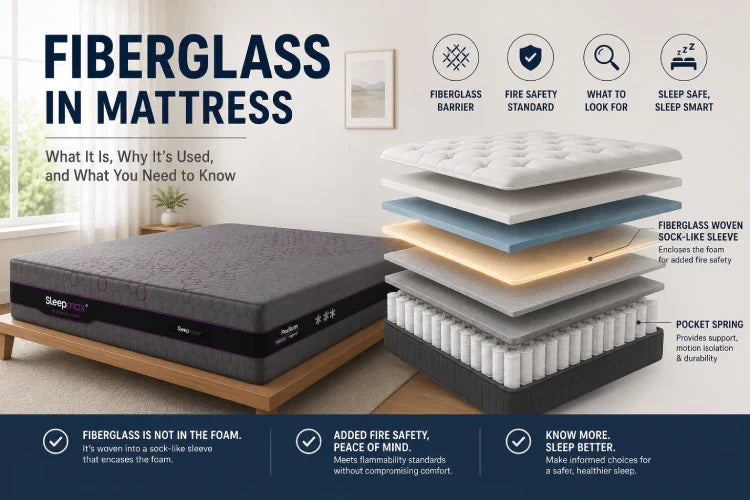
There is a controversy about the material in mattresses that many mattress buyers may not note. Fiberglass is used in mattresses for flame-retardant materials. It is safe in most cases.
The problem arises when those tiny glass fibers escape. A torn cover, a washed mattress sock, or simply an unzipped zipper can release microscopic shards into your bedroom air. Once airborne, they settle on furniture, carpet, clothing, and even inside HVAC ducts. The result is skin rashes that feel like invisible splinters, red and scratchy eyes, and throat irritation that mimics a lingering cold.

What Is Fiberglass?
Fiberglass — sometimes labeled as "glass fiber," "glass wool," or "man-made vitreous fiber" (MMVF). It is a fiber-reinforced plastic using glass fiber. It is typically manufactured in the form of chopped-strand mat or glass cloth.
Fiberglass has various applications in industry as it's lightweight and highly strong. Aircraft, boats, automobiles, hot tubs, water tanks, roofing, pipes, cladding, and even orthopedic casts also contain fiberglass.
In the mattress world, fiberglass plays a specific role: fire protection. It is typically woven into a thin sock-like fabric that wraps around the foam core, sitting just beneath the inner mattress cover. Memory foam and hybrid mattresses are the most common carriers because their foam layers are highly combustible and require a robust flame barrier to pass federal testing.
Due to the potential hazards of glass fiber, both OSHA and NIOSH regulate it. OSHA has set the legal limit for fiberglass exposure in the workplace as 15 mg/m3 total and 5 mg/m3 in respiratory exposure over an 8-hour workday.
Why Is Fiberglass Used in Mattresses?
The Federal Flammability Mandate
Since July 1, 2007, every mattress sold in the United States must comply with 16 CFR Part 1633, the Consumer Product Safety Commission's open-flame mattress flammability standard. The regulation requires each mattress to incorporate a fire barrier that significantly slows the spread of flame. Testing involves placing lit cigarettes and open-flame burners on the mattress surface and measuring char length, which must not exceed defined thresholds.
The standard does not mandate any particular material. Manufacturers can choose organic wool, Kevlar, rayon, silica, or fiberglass — as long as the finished mattress passes the test. Thanks to its advantages in three areas, fiberglass has become the most popular flame-retardant material used in mattresses.
Lightweight: Fiberglass adds almost no extra weight to the mattress, making shipping and handling easier.
Affordable: It keeps manufacturing costs low, which translates to lower retail prices for consumers.
Chemical-free (when sealed): Unlike chemical flame retardants such as PBDEs or organophosphate esters, fiberglass does not release volatile compounds as long as it remains inside the mattress cover.
The protective layer, made of fiberglass, can stretch and conform along with the foam as the mattress is compressed. This advantage has made it more popular among “mattress-in-a-box” products sold online.
Health Risks of Fiberglass Exposure
Fiberglass is classified as a mechanical irritant, not a toxin or allergen. It causes problems wherever it physically lands — on skin, in eyes, or in the upper airway. The International Agency for Research on Cancer (IARC) places ordinary glass wool in Group 3, meaning there is insufficient evidence to classify it as carcinogenic. This is distinctly different from asbestos, which is a Group 1 known carcinogen. The irritation fiberglass causes is real and genuinely unpleasant, even though the cancer fears are not supported by current science.
Skin and Eye Irritation
When fiberglass fibers land on skin, they act like microscopic splinters. They embed in the outer layer of the epidermis, triggering itching, stinging sensations, and sometimes small papules or follicular rashes. Thinner-skinned areas — the inner wrists, elbows, and along the torso — tend to be the most affected. Floating fiberglass particles also irritate the surface of the eyes, producing a gritty, sand-in-the-eye sensation along with redness and tearing. One mattress owner described the experience: "He pulls shards of fiberglass out of his skin. They are literally cutting him in his sleep."
Respiratory Discomfort
Airborne fiberglass fibers settle first in the upper airway — the nose, mouth, and throat. Symptoms include sore throat, dry cough, and hoarseness, often mistaken for the onset of a cold. In people with pre-existing asthma or bronchitis, the fibers can aggravate those conditions. Importantly, the fiber diameters found in mattress socks (5-10 microns, with aerodynamic diameters of 30-50 microns) are far too large to reach the alveoli. This means fiberglass from mattresses does not deposit deep in the lungs the way asbestos fibers do.
The Diagnostic Pattern
One of the most telling signs of fiberglass contamination is a symptom cycle: discomfort that improves when you leave home and returns when you come back. This pattern is classic for indoor environmental exposure and can help distinguish fiberglass irritation from a genuine respiratory infection. If fibers are accidentally swallowed — which can happen when they contaminate food or drink in an affected bedroom — they can irritate the stomach lining and cause mild gastrointestinal discomfort.
How Fiberglass Leaks From a Mattress
A sealed fiberglass sock is inert and harmless. To prevent the fiberglass leak, the mattress engineer wrapped the fiberglass filaments in a sheath made from flame-retardant acrylic or another material. Tests have shown that this core-spun fiberglass can withstand ten years of wear and tear.
Problems begin the moment the containment is breached:
Unzipping the mattress cover: The single most frequent cause. Many mattresses have zippered outer covers that look removable, but the zipper exists only for manufacturing convenience. Opening it exposes the fiberglass sock directly.
Fabric tears and punctures: Sharp objects, pet claws, or rough handling can puncture the inner cover.
Washing the mattress cover: Laundering a fiberglass-containing cover in a home washing machine disperses fibers throughout the wash cycle.
Long-term wear and pet damage: Over years of use, the inner cover may develop micro-tears, and pets that scratch or chew at the surface can break through protective layers.
Once fibers escape, they spread through a home via three mechanisms:
Clothing transfer: Fibers embed in fabric and travel from room to room. Research shows roughly 47% of particles on clothing re-suspend into the air within an hour of light walking.
HVAC circulation: Fibers drawn into air returns redistribute to every room connected to the same system.
Surface reservoirs: Carpet and upholstered furniture act as deep storage sites. Every footstep or bed-making motion re-launches settled fibers — a "settle-and-resuspend" cycle that can persist for months.
How to Identify Fiberglass in Your Mattress
Check the Law Label
The simplest first step is to check the mattress label—the white label sewn onto the side or bottom of the mattress. See if the label lists “glass fiber,” “glass wool,” “glass filaments,” or “spun glass fiber.” Please note that some brands do not explicitly list glass fiber on the label even if it is present, and many brands use other terms to obscure its composition. The absence of the term “glass fiber” on the label does not mean the mattress is free of glass fiber.
Ask the Manufacturer Directly
Please contact the brand’s customer service and ask, “Does this mattress contain any form of fiberglass?” Brands that are transparent will give you a straightforward answer. Be wary of brands that beat around the bush or only mention “silica” without providing further explanation—“silica” and “spun glass fiber” may both be synonyms for fiberglass.
Consider Price and Origin
Statistics show that king-size mattresses priced under $600 are more likely to contain fiberglass. Products manufactured outside the United States are also more likely to contain fiberglass, as they are not always subject to the same material disclosure regulations.
Look for Visual Clues
If fiberglass begins to ooze out, you may see translucent, shiny, plastic-like fibers on the surface of the mattress or on the bedding around it. Do not touch them. Immediately cover the mattress with a protective cover and consult a professional cleaning service; do not attempt to remove these fibers yourself.
Alternatives to Fiberglass: Safer Fire Barriers
Federal flammability standards can be met without fiberglass. Several alternative materials deliver equal or superior fire protection while posing no risk of fiber leakage. Here is a comparison of the most common options:
|
Alternative Material |
How It Works |
Used By |
Cost Level |
|
Organic Wool |
High keratin and moisture make it naturally flame-resistant; self-extinguishes when lit |
Birch, Avocado, Naturepedic, Saatva, Happsy |
Medium-High |
|
Kevlar (Aramid) |
Synthetic fiber with extraordinary thermal stability; resists heat up to 850°F |
Essentia, iSense |
High |
|
Fire-Retardant Rayon |
Semi-synthetic cellulose fiber that curls and chars under flame, slowing fire spread |
Bear, DLX, Helix, Saatva, 5 Little Monkeys |
Medium |
|
Hydrated Silica |
Common mineral that forms a compact char layer, restricting heat and smoke |
Avocado, Brentwood Home, Brooklyn Bedding, Nolah |
Medium |
|
Food-Grade Salt |
Acts as a natural flame suppressant within the mattress sock |
Tuft & Needle, Boring Mattress Co |
Low-Medium |
The takeaway: you do not need to sacrifice fire safety to avoid fiberglass. Organic wool, Kevlar, rayon, silica, and even food-grade salt all satisfy 16 CFR Part 1633. The difference is cost, and brands that invest in these alternatives tend to price their mattresses accordingly — but the premium is modest compared to the expense and stress of dealing with a fiberglass contamination event.
What to Do If Fiberglass Leaks From Your Mattress
If you discover that fiberglass has escaped from your mattress, your first instinct will be to clean — but that instinct can actually worsen the situation. The guiding principle for the first hour is do not add energy to the system. Here is what that means in practice:
Immediate Steps
Do not unzip or remove the mattress cover. If the cover is already open, close it gently without shaking or pulling.
Do not vacuum unless you have a certified, fully sealed True HEPA or ULPA vacuum. Standard vacuums and "HEPA-type" machines capture only 50-60% of fine particles and blast the rest back into the room through motor exhaust, often breaking them into even smaller fragments.
Turn off HVAC and fans in the affected room. Close the door to limit air circulation.
Keep children and pets away. Children are closest to the floor — the surface where most fibers settle — and are the most vulnerable to skin and respiratory irritation.
Use wet cleaning on hard surfaces only: damp microfiber cloths wiped from top to bottom capture fibers without re-suspending them. Dry sweeping or dusting will launch settled fibers back into the air.
Longer-Term Actions
Discard heavily contaminated textiles — bedding, clothing, and soft items that have been in direct contact with the affected mattress. Laundering them in a home machine spreads fibers into the laundry system.
Hire a professional cleaning service that specializes in hazardous particulate remediation. Fiberglass is classified as a hazardous material, and professional crews have the sealed HEPA equipment and containment protocols that homeowners do not.
Seek independent verification after cleanup. Just as asbestos and lead remediation require clearance testing by a party independent of the remediation contractor, fiberglass cleanup should be confirmed by a third-party inspection. You cannot visually verify that fibers are gone — they are invisible at the concentrations that matter.
How to Choose a Fiberglass-Free Mattress
Avoiding fiberglass does not require guesswork if you follow a systematic approach:
Read the full materials list: Before purchasing. Look specifically for the fire barrier disclosure. Brands that proudly state "no fiberglass" and name their alternative (wool, rayon, hydrated silica, etc.) are generally trustworthy.
Avoid brands that dodge the question: If a company's FAQ page mentions "silica" without context, if customer service gives you a non-answer, or if the label says "glass fiber" in any form, move on.
Prefer organic and natural-material mattresses: Latex, organic cotton, and wool-based mattresses almost never use fiberglass because their natural materials already provide substantial flame resistance.
Be cautious with budget memory foam: The price point that makes a $300 queen mattress attractive is often enabled by a fiberglass fire sock. If the price seems unusually low, ask about the fire barrier before assuming it is safe.
Check independent sources: Community-driven databases and investigative sites such as FiberglassFree.com maintain regularly updated brand lists. Be wary of large affiliate-review sites that may promote fiberglass-containing brands for commission revenue.
Conclusion
A lawsuit over fiberglass in mattresses once resulted in a multimillion-dollar settlement. However, this material is not a carcinogen, and it does its fire-safety job effectively when sealed inside the mattress. When used properly to encase the foam and prevent it from catching fire, it is highly unlikely to leak over the course of the mattress's lifespan. If your mattress is like SleepMax, where the fiberglass is enclosed in a sheath, then there's nothing to worry about.
Before buying a mattress, read the label carefully, consult the manufacturer, and verify the flame-retardant materials used. Taking a few minutes to do some research can save you months of frustration and spare you the worry that the air you breathe while sleeping might contain fibers invisible to the naked eye.


Leave a comment
This site is protected by hCaptcha and the hCaptcha Privacy Policy and Terms of Service apply.