


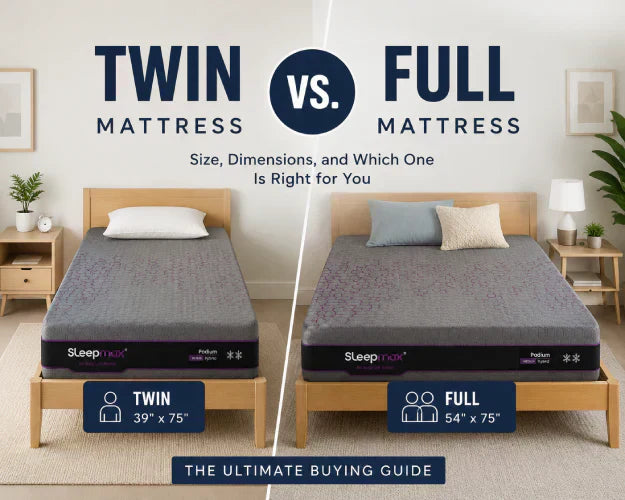
As a mattress store manager, I've spent a long time watching people stand in mattress stores with that glazed-over look, trying to figure out whether a twin or a full is better for their situation. Last month alone, I counted about 6 customers who grabbed the wrong size and ended up returning to the store to swap it out. So let me break this down for you in a way that actually sticks and is intuitive.
The twin vs full decision isn't just about "which one's bigger." It's about your space, your body, your budget, and honestly, how you actually live.
The Basic Dimensions (And Why Numbers Matter More Than You Think)
Let's start with the mattress sizes chart—but I promise it'll make sense in a second.
| Size | Dimensions | Surface Area | Cost per Square Inch* |
|---|---|---|---|
| Twin | 38" × 75" | 2,850 sq in | ~$0.28 - $0.42 |
| Twin XL | 38" × 80" | 3,040 sq in | ~$0.30 - $0.45 |
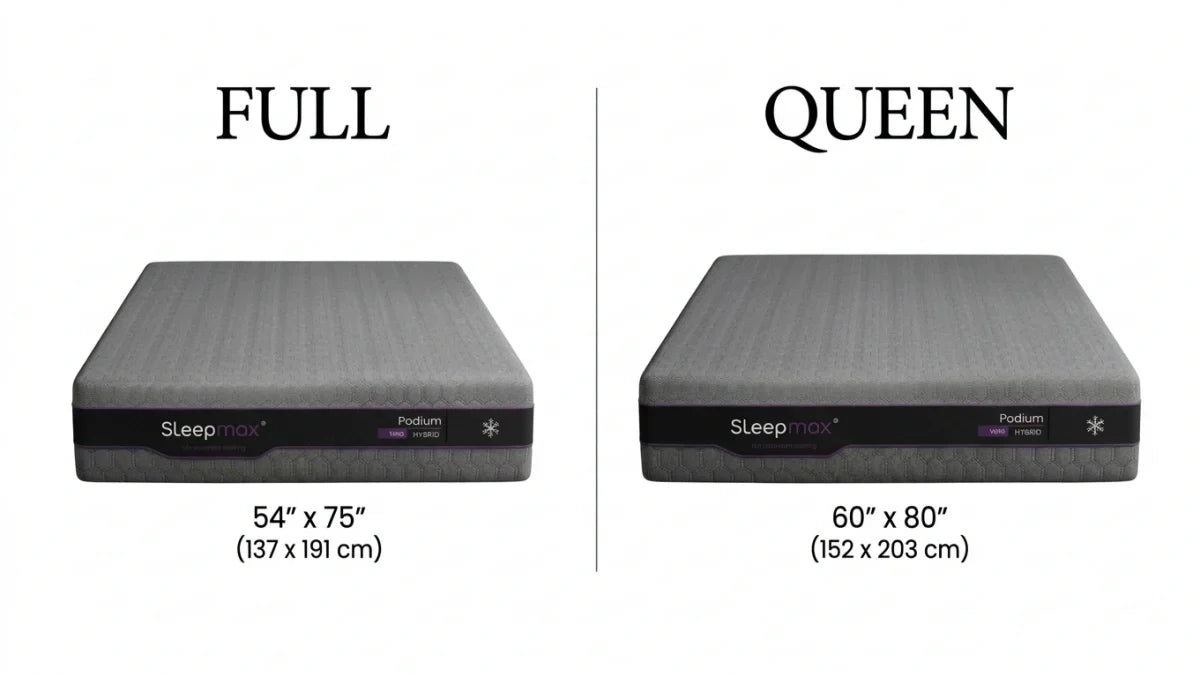
| Full | 53" × 75" | 3,975 sq in | ~$0.25 - $0.38 |
| Full XL | 53" × 80" | 4,240 sq in | ~$0.24 - $0.36 |
*Average prices based on mid-range memory foam and hybrid models from major brands.

Here's what gets me about these numbers. The full gives you about 39% more sleeping surface than the twin. But here's the thing most people miss: the cost per square inch is actually lower for full mattresses in most cases. You're technically getting a better deal per square foot if you go full. If you are living in a big room at a low cost, I recommend you choose a full mattress for comfortable sleep.
Compared to the standard versions, the XL versions of the Twin and Full mattresses are both 5 inches wider. For all of the mattress sizes and bed sizes, you can read this article-Mattress Sizes and Dimensions Guide (2026).
The Real Space Math
The thing is, raw dimensions don't tell the whole story. You should think about how these sizes actually fit in real rooms.
- 10 × 10 foot room: Twin leaves you with roughly 73 sq ft of floor space after the bed. Full? About 53 sq ft.
- 12 × 12 foot room: Twin leaves 96 sq ft of floor space. Full leaves 76 sq ft. Much more manageable.
I remember one couple came into the showroom to choose a Double Bed as they liked the "cozy" vibe. The two people are tall, 5'10" and 6'2". Bless their hearts. I had to gently explain that if they're both on the bed, the full gives each person about 26.5 inches of personal space. For context, most shoulder widths are around 18-24 inches. You do the math.
Who's Actually Sleeping Here? Matching Size to Body
This is where people really mess up. They think age is the determining factor. It's not—or at least, it's not the only thing.
For Kids and Younger Children
My sister's kid started at 4'9" at age 9 and hit 5'4" by 12. If your kid's already tall for their age, a full's actually the smarter call for longevity.
The twin wins if:
- Your kid's on the smaller side and you're tight on space
- You need to fit two beds in a small bedroom (bunk beds, anyone?)
- Budget's the main concern right now
The full makes more sense if:
- Your kid's showing signs of outgrowing other kids their age
- This is a guest room that'll host adults too
- You want one mattress that lasts through middle school minimum
For Teenagers and Young Adults
Now here's where things get interesting. If we're talking about a 5'8" teenager, a full's genuinely comfortable for solo sleeping. But if your kid's hitting 6 feet or taller—because apparently every teenage boy in America is 6'2" these days—you might wanna look at Twin XL or Full XL. The extra 5 inches in length saves you from foot-danglers.
I've seen so many dorm rooms with those cramped twin XL beds. Colleges love Twin XL because it fits standard dorm furniture. But I can't tell you how many students I've talked to who ended up wishing they'd fought for a full.
For Adults Flying Solo
Alright, single adults. This is your sweet spot, honestly.
A full mattress is genuinely designed for solo sleepers. At 53 inches wide, you've got room to spread out a bit. You get about 40% more room than a twin, which matters a lot when you're trying to actually sleep instead of doing sleep-tetris.
But look, if you're in a studio apartment in Brooklyn—I'm talking that beautiful cramped 450-square-foot hellscape—every inch counts. That IKEA bed frame you bought might not fit a full. Sometimes the twin's just the practical choice.
| Body Type | Twin | Full |
|---|---|---|
| Under 5'6", under 150 lbs | ✓ Perfect | Overkill |
| 5'6" - 6', 150-180 lbs | ✓ Short-term ok | ✓ Ideal |
| Over 6', any weight | ✗ Feet hang off | ✓ Minimum |
| Couples | ✗ No chance | Tight squeeze |
The Money Talk: What You're Actually Spending
Here's what most sites won't tell you straight.
Mattress Prices (2024 Data)
| Brand/Type | Twin | Full | Difference |
|---|---|---|---|
| Budget (Zinus, Linenspa) | $149-299 | $199-399 | ~$50-100 |
| Mid-range foam (Casper, T&N) | $695-895 | $895-1,195 | ~$200-300 |
| Mid-range hybrid (Purple, Saatva) | $1,295-1,895 | $1,695-2,595 | ~$400-700 |
| Premium (Tempur-Pedic) | $1,999-3,499 | $2,799-4,799 | ~$800-1,300 |
On average, you're looking at spending about $647 on a mid-range mattress, and the full will run you maybe $200-400 more. Over a decade, that extra $300 breaks down to less than a dollar a week.
Bedding and Accessories: The Hidden Costs
| Accessory | Twin | Full | Notes |
|---|---|---|---|
| Sheet sets | $25-80 | $35-120 | Full costs 30-40% more |
| Mattress protector | $30-60 | $45-90 | Scales with size |
| Duvet/comforter | $50-150 | $80-250 | Bigger = pricier |
| Pillows | $20-50 (×1) | $40-100 (×2) | Full looks weird solo |
No clue why bedding costs aren't in every comparison guide. You're not just buying a mattress—you're buying a whole ecosystem. Over the lifespan of the mattress, twin bedding might save you $300-500 total.
And don't even get me started on that cheap foam topper from Amazon. You know the one—maybe $89, reviews that all say "great value!" Here's my take: they work fine for maybe 18 months if you're lucky. Budget mattress plus budget bedding equals spending more money long-term.
Real Scenarios: Where Each Size Actually Makes Sense
College Dorm Room
You're moving into a cramped dorm. The room came with this weird IKEA bed frame that can only fit a twin XL. I've seen students try to cram full mattresses into these spaces—it's a disaster. In this case, twin XL isn't just practical, it's basically the only option.
Verdict: Twin or Twin XL only.
Studio Apartment
You're in your first real place. Maybe 500 square feet total, bedroom corner maybe 10×10. Here's the thing: a full in this space is tight but doable if you're strategic. Put the bed against the main wall, skip the nightstands. Can it be done? Yeah. Is it ideal? Eh.
If your studio's under 400 square feet, honestly, you might be better off with a twin.
Verdict: Twin works great; full if you're stubborn and space-conscious.
Guest Bedroom
My buddy built a beautiful guest room, about 8×10 feet. He put a full bed in there, thinking guests would appreciate the extra space. Here's the reality: most guests only live in one or two nights. They don't care that much, even his room feels cramped. But if you're regularly hosting couples? Full's the minimum.
Verdict: Full if hosting couples; twinXL daybed if solo guests only.
Kid's Room Transition
You're setting up your 7-year-old's "big kid room." Here's what I'd do: skip the twin entirely unless you're working with a seriously cramped space. Go straight to full. Here's why: your kid's gonna be in this bed until they're 16, 17, maybe 18. The twin's gonna feel cramped by age 12 at the latest, and now you're buying another mattress. Full today beats full tomorrow plus wasted twin money.
I remember helping my cousin move her daughter into a new place. That kid went from crib to twin at age 3, twin to full at age 11. Three mattress purchases in 16 years. Could've just started with the full.
Verdict: Full from the start if budget allows.
Daybed or Trundle Setup
Daybeds with trundles are popular for home offices, guest rooms, studios. The thing is, most daybed frames are designed around twin or full mattresses, and the trundle mechanism usually only works with one specific size.
If you're getting a daybed for occasional overnight guests, twin works perfectly. Two twins in trundles = four sleeping spots. But if you're using the daybed as your main bed, go full.
Verdict: Twin for flexible guest setup; full if daybed = your real bed.
The Growth Factor: When to Make the Switch
Upgrade from twin to full when:
- Your kid hits about 5'4" and keeps growing
- They're complaining the bed feels cramped (they're not wrong)
- They're approaching or past puberty
- You're buying a new mattress anyway (might as well size up)
Stick with twin if:
- You just bought the mattress 2 years ago
- Your kid's on the smaller side and not growing fast
- Space is genuinely limited
Here's what bugs me to no end: people who treat mattress sizing like it's permanent. You're allowed to upgrade. You're allowed to start small and go bigger.
Making Your Final Decision: The Real Talk
Go twin if:
- Your space genuinely can't fit a full (measure twice, people)
- This is temporary housing (dorm, sublet, short-term lease)
- You're on an extremely tight budget
- You're furnishing a bunk bed situation
Go full if:
- You're buying for yourself as a solo adult
- Your kid's approaching the teenage years
- The room can handle it (10×12 feet or larger ideally)
- You're thinking long-term
Honestly, if you're on the fence and can swing the extra $200-400, go full. Here's what I've found: people almost never regret getting the bigger bed. They do regret the smaller one when they're trying to sleep and feeling cramped.
FAQ: Real Questions, Real Answers
Is a twin bed big enough for two adults?
Short answer: no. Long answer: absolutely not. I've seen couples try to make it work and it's always uncomfortable. Each person gets about 19 inches of space—that's basically sleeping on an airplane.
Can a full mattress fit in a 10×10 room?
Technically yes, but it's gonna be snug. You'll have maybe 2.5-3 feet of walking space on the sides.
How much should I expect to spend on a quality mattress?
For something that'll last 8-10 years, you're looking at around $800-1,500 for twin and $1,000-1,800 for full. That cheap $199 mattress? Plan on replacing it in 3-4 years.
Bottom Line
Here's my take after all these years: the twin vs full decision depends on three things—your space, your body, and your timeline.
If you're short on space, measure carefully and pick accordingly. If you're a solo adult with any kind of room to spare, full's almost always the better call. And if you're furnishing a kid's room with long-term thinking, full is the smarter investment.
At the end of the day, you're gonna sleep on this thing every night for the next decade. Don't nickel-and-dime yourself into a decision you'll regret. Your back will thank you for going with the more comfortable option.
Now go get some sleep. You've got research to do.

Leave a comment
This site is protected by hCaptcha and the hCaptcha Privacy Policy and Terms of Service apply.