


I still remember the look on my buddy's face when he dragged that California king mattress up three flights of stairs to his downtown LA apartment, only to realize it was 4 inches too long for his bedroom. The carpet installer — this old guy who'd seen everything — just stood there, arms crossed, shaking his head. "Son," he said, "you should've measured twice before you bought once."

That was maybe six years ago now, and I've seen that exact same mistake happen way too many times since. When it comes to upgrading your sleep setup, choosing between a king mattress and a California king mattress can feel surprisingly tricky. Both promise that luxurious, sprawling space we all dream about, but they serve different needs — and picking the wrong one could mean cramped toes at the foot of the bed, a bedroom that feels stuffed to the gills, or accessories that simply won't fit.
Here's the deal: I've spent the better part of a decade writing about sleep products, testing everything from $200 foam mattresses to $4,000 luxury hybrids. And what I've found is that most people don't actually know the difference between these two sizes until they're standing in a showroom, completely overwhelmed. So let me break it all down for you — the dimensions, the history, the real pros and cons, and most importantly, how to figure out which one belongs in your bedroom.
What Are the Exact Dimensions of King vs. California King?
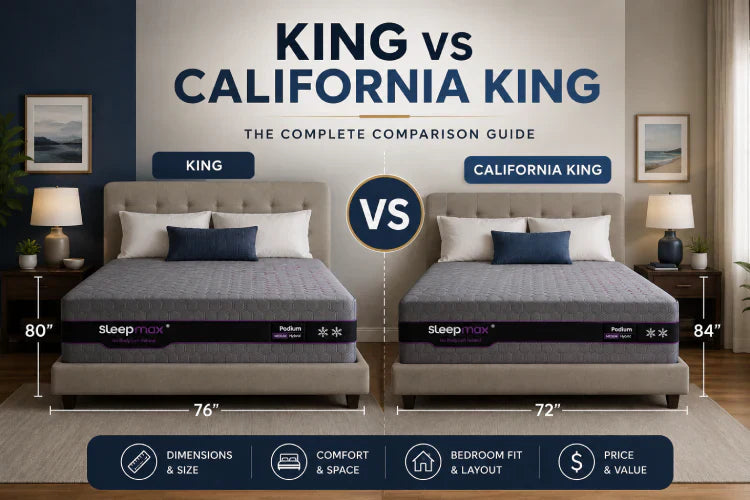
Here's the quick rundown: a standard king mattress comes in at 76 inches wide by 80 inches long (that's about 193 by 203 centimeters for my metric friends), giving you 6,080 square inches of sleeping real estate. The California king, on the other hand, measures 72 inches wide by 84 inches long — so 6,048 square inches total.
Quick memory trick that's never failed me: California is one of the longest states in the US, and the California king follows suit. It's narrower but longer. That visual has helped me remember it every single time, and I've probably explained this distinction to a couple hundred people at this point.
Thing is, the difference is only 4 inches on each dimension, which sounds negligible until you actually try to fit sheets, comforters, and that cheap foam topper you bought from Amazon three years ago. Then those 4 inches matter. A lot.
Why Is the California King Called That, Anyway?
This is where it gets interesting, and honestly, it's one of those facts I bring up at parties way too often.
The California king was born in the mid-20th century, back when Hollywood was exploding and LA was becoming this playground for celebrities and tastemakers. The story goes that the standard king — what we now call the Eastern King — just wasn't cutting it for the glammed-out clientele of Beverly Hills mansions. These folks wanted something that looked more proportional in those sprawling master bedrooms, something with a bit more length for those who wanted to stretch out in style.
So the Western King was born in California, hence the name. It became this status symbol associated with LA luxury living. You'll still hear both names used interchangeably today: Eastern King for the standard, Western King for the California king. Most people in the mattress industry know both terms, so if you walk into a store and ask for a Western King, they won't look at you like you've lost your mind.
How Do King and California King Compare to a Queen Mattress?
If you're coming from a Queen-size bed, here's what you're getting into. A Queen comes in at 60 by 80 inches, so 5,040 square inches total.
The standard King is 16 inches wider than a Queen but the same length. The California King, though, is 12 inches wider and 4 inches longer. So if you're a tall person who also wants more width, the Cal King technically gives you more total square inches than going up to a standard King. It's a weird trade-off, and I'll be honest — most people don't think about this until I point it out.
I remember testing mattresses in this cramped 450-square-foot studio apartment in Brooklyn last spring (don't ask why I was there, long story involving a friend of a friend), and the sales guy kept pushing King sizes. But honestly? A Queen would've fit that space way better, and it would've saved the couple probably $600-800 on average for a decent mattress.
Which Mattress Size Is Better for Different Sleep Positions?
Here's where things get personal, and honestly, this is the question I get asked the most.
If you're a side sleeper, the standard King's extra 4 inches of width is gonna be your friend. You're essentially getting an extra 2 inches on each side of the bed, which doesn't sound like much until you're curled up with a partner who hogs half the mattress. That little bit of breathing room can make a huge difference in how refreshed you feel in the morning.
But if you're a back sleeper or stomach sleeper — especially if you're tall — the California King's extra length is a game-changer. I'm talking 6'2" and 210 pounds here, and I've definitely had nights where my feet were dangling off the edge of a standard King. That's not a great feeling when you're trying to actually rest. The Cal King gives tall folks like myself room to stretch out completely without any toes hanging over the edge.
What gets me is how many people don't even consider their sleep position when mattress shopping. They just see "bigger = better" and grab the King. But if you're 5'6" and mostly sleep on your side, that extra width might not matter nearly as much as you'd think.
Can You Use the Same Bed Frame or Base for Both Sizes?
Short answer: no. And this is where people really mess up.
Both sizes require matching frames and bases — you can't swap them. A California king mattress on a standard king frame will be unstable and potentially dangerous. The mattress will overhang in weird ways, and that's just asking for trouble. I can't tell you how many times I've seen this happen, usually when someone inherited a bed frame and thought "close enough" would work. Spoiler: it's not.
Now here's the good news — both sizes work with pretty much any type of bed base you can imagine. Platform beds? Absolutely. Adjustable bases? Those are becoming super popular, and yes, both King and Cal King come in adjustable configurations. Box spring foundations? Those work too, though honestly, they're becoming less common as more people shift to platform setups or memory foam mattresses.
If you're going the adjustable base route — and look, for certain situations like couples with different sleep preferences or folks with back issues, these things are genuinely worth it — just make sure you're buying the right size. Most major manufacturers sell both versions, but you'll want to double-check the specs before checkout.
Oh, and one more thing that bugs me: make sure your bedroom doorways and hallways can actually accommodate the mattress you're buying. A mattress in a box is one thing, but if you're buying a traditional mattress and it won't fit through your hallway turn, you're gonna have a very bad day.
What's the Price Difference Between King and California King?
Here's what I tell people when they ask about pricing: on average, you're probably looking at around $647 for a decent quality mattress in either size, though prices obviously swing wildly depending on the brand and what materials you're dealing with.
The honest truth? In most cases, they're priced similarly. The cost difference is usually negligible — maybe $50-100 difference at most retailers. The bigger expense is gonna come from the brand you choose, whether you're going hybrid or all-foam, and what certifications (like CertiPUR-US) matter to you.
That said, I've seen some brands charge a premium for Cal King specifically, usually because they cut fewer of them and the manufacturing runs are smaller. If you see a big price discrepancy between the two sizes from the same brand, that might be why. But generally speaking, don't stress the size difference too much when it comes to your wallet.
One thing I'll note: sheets and bedding for California King tend to run slightly more expensive and harder to find in fun patterns. Standard King sheets? You've got a million options. Cal King sheets? Your choices narrow down pretty quick. Just something to keep in mind when you're budgeting.
What About Motion Isolation — Does Size Matter?
For all you couples out there sharing a bed, this one's for you.
Here's the thing: motion isolation is much more about the mattress material than the size. A memory foam mattress is gonna isolate motion way better than an innerspring, regardless of whether it's a King or Cal King. If you're someone who shares a bed and tends to toss and turn, material choice matters way more than dimensions.
That said, the larger surface area of either size does give you a bit more buffer zone between you and your partner. You're just inherently further apart on a King or Cal King than you would be on a Queen. It's not revolutionary science, but it's something.
If motion isolation is a top priority — and for light sleepers with restless partners, it absolutely should be — look for mattresses specifically marketed for that. Zoned pocket coils, high-density memory foam, and things like that. Don't just assume "bigger bed = better sleep" because that math doesn't always work out.
What Are the Oversized Alternatives to King and California King?
So you've decided neither King nor Cal King is quite doing it for you. Maybe you've got a massive bedroom, maybe you're just one of those people who needs obscene amounts of space. I feel you.
Here's what's out there beyond the standard options:
Wyoming King: 84 by 84 inches. Yeah, that's right — it's actually square. This thing is 16 inches wider than a standard King but the same length. Good option if you want width but don't necessarily need the extra length.
Texas King: 80 by 98 inches. Here's where it gets crazy. This thing is 22 inches wider and 18 inches longer than a standard King. If you've got the room and you want serious space, this is where you go. But fair warning — finding sheets and bedding for these specialty sizes is a pain, and you'll be custom-ordering a lot of stuff.
Alaskan King: 108 by 108 inches. This is the absolute monster of the mattress world. 9 feet by 9 feet. It's designed for families who co-sleep with kids, for taller folks who need serious length, or for anyone who just wants to be absurdly comfortable. The problem? Finding bedding is almost impossible without custom orders, frames are pricey, and forget about moving it without professional help.
Honestly, unless you've got a very specific need (and I mean very specific), I'd stick with the standard King or Cal King. The specialty sizes are cool in theory, but the practical realities of living with them — sourcing accessories, moving them, just daily logistics — become a real headache.
Which Mattress Size Is Right for Your Room?
Let me give you the quick breakdown based on room dimensions:
For a standard King, you're looking at a minimum bedroom of about 12 by 10 feet, with 13 by 13 feet being more ideal. Anything smaller and you're gonna feel cramped, especially once you add nightstands and dressers.
For a California King, the ideal setup is more like 12 by 12 feet minimum, or 12 by 14 feet if you really want to breathe. The longer, narrower profile actually works better in certain room layouts — like if your bedroom is oriented more vertically or you've got sloped ceilings in an older home.
Here's my honest advice: grab a tape measure, actually measure your space, and then add at least 2 feet of walking space around the bed. I've seen people buy these massive mattresses and then realize they can't even open their closet doors. That's no way to live.
Final Verdict: King or California King?
Bottom line, here's how to decide:
Go with a standard King if:
Go with a California King if:
Honestly, you really can't go wrong with either. They're both fantastic choices if you have the room and the budget. The key is knowing your specific situation — your height, your sleep position, your room dimensions, and your partner's preferences too.
Just do yourself a favor: measure twice, sleep once. And maybe don't be like my buddy with the LA apartment. Learn from his mistakes so you don't end up staring at a mattress that won't fit, wondering where it all went wrong.


Leave a comment
This site is protected by hCaptcha and the hCaptcha Privacy Policy and Terms of Service apply.