



When choosing a mattress for a Murphy bed, you’ll face constraints you’ve never had to consider when selecting a standard mattress. A mattress that performs well on a traditional bed frame may fail within a matter of weeks—or sometimes even days—if it’s folded vertically and stored in a cabinet for up to 16 hours a day. Thickness restrictions, weight limits, and a phenomenon known as “compression set”—which silently breaks down foam material from the inside out—are all factors that effectively determine whether a Murphy bed mattress will last beyond its first year.
Most buying guides repeat the same superficial advice—choose a thin one, choose a light one, and that’s it. There’s nothing wrong with this advice, but the reality is far more complex. This includes a clear divide within the industry itself over the question of whether foam mattresses should be used on wall beds.

The Three Hard Constraints
Every murphy bed mattress must satisfy three non-negotiable requirements:
Thickness. Standard wall beds with regular bed legs can accommodate mattresses no thicker than 10 inches. Models with extended bed legs can accommodate mattresses up to 12 inches thick. High-end or custom models can accommodate mattresses between 12 and 14 inches thick. Cabinet beds—compact beds that resemble wardrobes when closed—can accommodate mattresses up to 6 to 8 inches thick. For example, Murphy Bed Depot’s standard-depth Majestic Library Bed only accommodates 9-inch-thick mattresses; to use an 11-inch-thick mattress, you must upgrade to its “Deep” cabinet option.
Weight. Gas strut mechanisms, which typically have a total weight capacity (mattress plus bedding) of 250–300 pounds, are best suited for queen-size mattresses weighing between 60 and 75 pounds. Torsion spring systems have a maximum weight capacity of approximately 150–200 pounds and require lighter mattresses—typically weighing less than 65 pounds. Exceeding these limits not only makes the bed harder to lift but also causes the balancing system to require recalibration and accelerates wear on the piston seals. In spring systems, it also increases the risk of the bed slamming shut suddenly. Replacing a single piston costs $80–$300 and requires recalibration based on the weight of the new mattress.
Vertical storage compatibility. This is precisely where most standard mattresses reveal their shortcomings. When the mattress is stood upright, the pillow-top comfort layer wrinkles and shifts out of place. After several months of vertical storage, the individually wrapped pocket springs will shift downward under their own weight. Hybrid mattresses containing thick transition foam may develop permanent creases along the folding axis. For most of its lifespan, a Murphy bed mattress is positioned perpendicular to its intended orientation. This fact changes everything.
Which suitable: Foam vs. Spring
On this issue, opinions from industry organizations are conflicting.
Independent reviewers and mattress authorities—including “Mattress Miracle Canada,” “Sleep Junkie,” and “Murphy Bed Plans”—generally agree that all-foam mattresses are the best choice for Murphy beds. The reasons are as follows: foam is lighter, flexes easily with the mechanical structure, has no springs that can shift out of place, and returns to its original shape after being compressed.
However, the official website of Murphy Wall-Beds (a company founded by the heirs of William Lawrence Murphy), murphybeds.com, explicitly recommends spring mattresses and prohibits the use of all-foam, latex, and Tempur-Pedic-style viscoelastic mattresses. Their reasoning is that, due to their weight and internal structure, foam mattresses are not suitable for vertical storage. Murphy Bed Depot goes even further, explicitly excluding latex and hybrid mattresses from its warranty coverage.
How did this contradiction arise? Part of the answer lies in traditional engineering design. Early torsion spring mechanisms were designed around the weight distribution and stiffness of spring mattresses. Coil spring mattresses distribute the load evenly across the bed frame, and their steel framework maintains its structural geometry when in the upright position. Foam mattresses—especially early models with low-density polyurethane cores—could sag unevenly, thereby altering the frame’s pivot dynamics. Although modern high-density foam materials have largely resolved these issues, manufacturers’ restrictions based on past experience remain in warranty terms.
Sleepmax Advice: Be sure to confirm mattress compatibility with the specific MeiFei bed frame manufacturer before making a purchase. Using a mattress type explicitly prohibited by the bed frame manufacturer may void both the bed frame warranty and the mattress warranty—in which case neither party will provide warranty service.
Compression Set: The Silent Mattress Killer
When a foam mattress is stored vertically for several hours each day inside a closed wall bed, gravity compresses the material at the bottom edge of the mattress. Over time, the polymer cell walls deform under continuous loading, and some of this deformation may not fully recover. This is known as compression set, the most critical materials science concept determining the service life of wall bed mattresses.
ASTM D3574 Test D measures compression set as follows: a foam sample is compressed to 50% of its original thickness at 70°C for 22 hours, after which the permanent loss in thickness is measured. The calculation is simple: (original thickness minus recovered thickness) divided by the original thickness, with the result expressed as a percentage. High-quality foam has a compression set rate of 10% or less. High-performance foam used in demanding applications has a compression set rate of 5% or less.
CertiPUR-US, the most authoritative foam certification standard in North America, sets the upper limit for compression set at 15% under more stringent test conditions (compressed to 75% of its original thickness at 90°C for 22 hours). This threshold is acceptable for standard mattresses. However, in Murphy beds, where compressive stress is constant and directional rather than sporadic and dispersed, even foam that barely meets CertiPUR-US certification standards will develop visible sagging within one or two years.
In practice, this means that foam density is far more important than the type of foam. A queen-size memory foam mattress with a core density of 1.2–1.5 pounds per cubic foot, when used daily on a Murphy bed, is likely to develop permanent indentations and lose its support within 6–12 months. Under the same conditions, a mattress with a core density of 1.8–2.0 pounds per cubic foot typically retains its shape for 3–5 years. Mattresses with a core density exceeding 2.0 pounds per cubic foot can last more than 5 years.
The situation is somewhat different for latex. Natural latex has excellent elastic recovery—its compression set is typically less than 3%—making it technically well-suited for vertical storage. The issue lies in its weight. A king-size natural latex mattress typically weighs 80–100+ pounds, which can reach or even exceed the weight capacity limits of many piston-style lifting mechanisms. While synthetic latex blends are lighter, their recovery performance is less than ideal.
The Finger Gap Rule
One engineering detail that rarely appears in buyer's guides: a murphy bed mattress should maintain a ¼ to ½ inch gap between its edges and the cabinet interior walls. This clearance serves dual purposes. It prevents the mattress from rubbing against the cabinet during the fold cycle, which frays the ticking and abrades the cabinet finish. More importantly, it allows air to circulate around the mattress when the bed is closed—critical for moisture management.
Without that airflow, a mattress stored in a closed cabinet at room humidity above 55% can accumulate enough moisture in its foam layers to support mold growth within weeks. The recommended practice is to air out the mattress by leaving the bed open for several hours every 3–4 weeks, even when not in use. A breathable, waterproof mattress protector is not optional for murphy bed applications—it is essential infrastructure.
Cabinet Depth and the Size Puzzle
Murphy bed cabinet dimensions vary significantly by mattress size, and the depth dimension directly constrains mattress selection:
- Twin cabinets: 14–16 inches deep
- Full cabinets: 16–18 inches deep
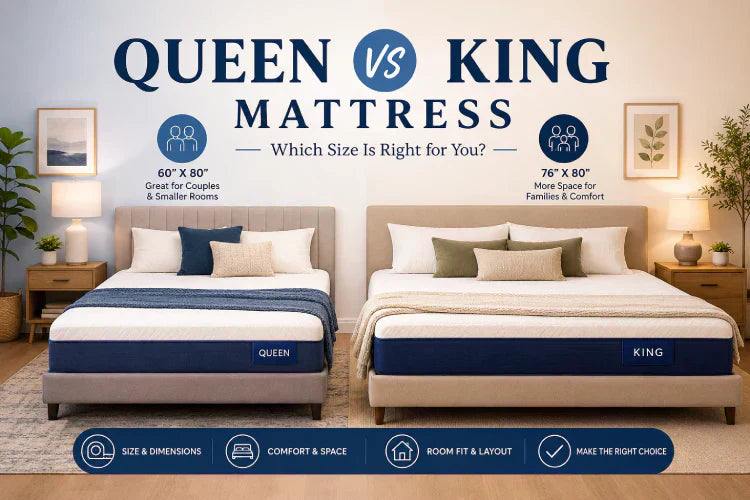
- Queen cabinets: 16–20 inches deep
- King cabinets: 20–24 inches deep
A queen murphy bed with a 16-inch cabinet depth might only accommodate a 9-inch mattress once the platform, frame members, and door are accounted for. The same bed in a 20-inch depth version opens room for a 12-inch mattress. This is why the same murphy bed model often lists different maximum mattress thicknesses depending on the cabinet depth option selected—and why comparing only mattress specifications without knowing the cabinet dimensions leads to expensive mismatches.
Weight Limits and Mechanism Lifespan
The weight ceiling of a murphy bed is not a static number. It is a product of the lift mechanism's design life. Gas pistons are typically rated for 10,000–25,000 operating cycles. At one cycle per day (one open, one close), a 10,000-cycle piston theoretically lasts about 27 years. But that rating assumes the piston operates within its designed load range. Running a piston at the top of its weight capacity—say, a 90-lb mattress against a mechanism rated for 95 lbs maximum—accelerates seal degradation and can cut effective lifespan to 60–70% of the rated cycles.
In practice, Tier 1 pistons (economy grade) last 8–12 years, Tier 2 (mid-range) 12–20 years, and Tier 3 (premium) 20–30 years. Torsion springs, which have no self-damping and require periodic re-tensioning, typically last 8–15 years. Choosing a lighter mattress within the mechanism's rated range is not just about preventing catastrophic failure on day one. It is about preserving mechanism life over the long term.
What About Warranty Coverage?
Most mattress warranties do not explicitly address murphy bed use. Many standard warranties include clauses that limit or exclude coverage when the mattress is used on a foundation other than a conventional box spring or flat platform—and a vertically stored, strap-secured platform with periodic folding motions is certainly "other." Some manufacturers, like Lori Beds with their proprietary Lori Mattress, engineer products specifically for murphy bed applications and warrant them accordingly. But placing a standard retail mattress into a murphy bed frame may silently void the warranty, even if the mattress physically fits and seems to perform well.
Checking the warranty fine print before purchase is not paranoia. It is due diligence. Look specifically for language about "approved foundations," "intended use," or "unsupported configurations." If the warranty is silent on murphy beds, get written confirmation from the manufacturer that vertical storage will not affect coverage.
Fire Safety Standards
All mattresses sold in the United States must comply with two federal flammability standards regardless of whether they are intended for murphy bed use. 16 CFR Part 1632 (the cigarette ignition test) requires that a mattress char no more than 2 inches from any ignition point. 16 CFR Part 1633 (the open flame test) limits peak heat release rate to 200 kW within 30 minutes and total heat release in the first 10 minutes to 15 megajoules. There is no separate or additional standard for murphy bed mattresses. The same rules apply, and no special certification is needed beyond the General Certificate of Compliance that accompanies any compliant mattress.
Quick Reference: What to Check Before You Buy
1. Maximum mattress thickness specified by your murphy bed manufacturer (not a generic number from the internet)
2. Maximum mattress weight for your specific mechanism type and size
3. Foam core density of 1.8 lb/ft³ or higher for daily-use murphy beds
4. Compression set rating of 10% or better (ASTM D3574), ideally 5% or below
5. No pillow-top or Euro-top layers that can shift during vertical storage
6. Compatibility confirmation in writing from both the bed frame and mattress manufacturers
7. Breathable waterproof protector included from day one
The murphy bed mattress market is small enough that there is no separate product category in most retailers' systems. But the engineering requirements are real, measurable, and expensive to ignore. A mattress chosen with thickness and weight alone in mind will survive the first fold. A mattress chosen with compression set, density, and mechanism compatibility in mind will survive the next thousand.

Leave a comment
This site is protected by hCaptcha and the hCaptcha Privacy Policy and Terms of Service apply.