


So you're staring at two mattress sizes, trying to figure out which one won't leave you regretting your life choices in three years. Trust me, I've been there—standing in that mattress store downtown at like 9 PM on a Tuesday, scratching my head, wondering why choosing a bed has to be so complicated. Thing is, it really doesn't have to be. Let me walk you through what I've learned after 12 years in this industry, and I'll keep it real with you the whole way.
The Basic Dimensions: What We're Actually Working With
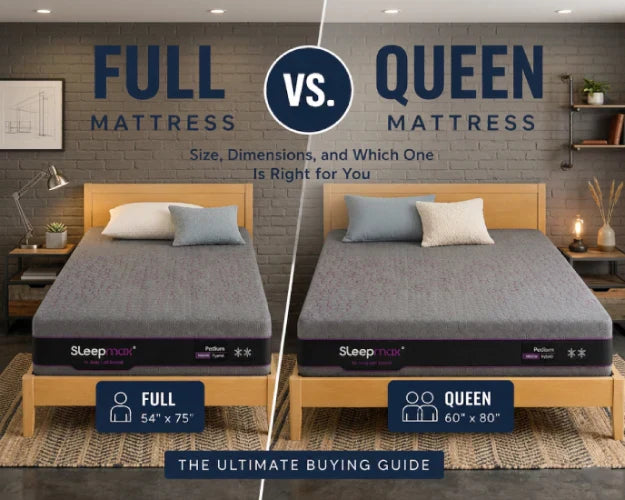
Alright, here's the deal. A full mattress—that's also called a "double" in some places, which honestly just confuses people—is 54 inches wide by 75 inches long. A queen comes in at 60 by 80. That's six extra inches of width and five extra inches of length. Sounds small when you say it like that, but man, those inches add up fast.
No clue why mattress companies didn't just call them "slightly bigger" and "even bigger," but whatever. Here's what gets me: if you do the math on square inches, a queen gives you about 4,800 square inches of sleeping space compared to the full's 4,050. That 750-square-inch difference? It's basically like adding another toddler mattress to your bed. I mean, not literally, but you get what I'm saying.
Let me lay it all out in one place so you're not doing mental math:
| Full | Queen | |
|---|---|---|
| Width | 54 inches | 60 inches |
| Length | 75 inches | 80 inches |
| Total sleeping area | 4,050 sq in | 4,800 sq in |
| Space per person (couples) | 27 inches | 30 inches |
| Best room size | 9×10 ft minimum | 10×12 ft minimum |
| Typical price range | $300–$1,200 | $500–$1,800 |
| Sheet set price | $25–$80 | $35–$120 |
| Frame price | $200–$400 | $300–$500 |
See that "space per person" row? That's the one that should really make you stop and think.
Now here's where it gets real for couples. When two adults share a full, each person gets just 27 inches of personal space. Twenty-seven inches—that's literally the width of a crib mattress. Bless your heart if you're trying to cozy up to your partner on that thing every night. The queen bumps you up to 30 inches per person, which still isn't exactly spacious, but it's way more manageable.
Can Two People Actually Sleep on a Full? (Spoiler: It Depends)
I'll be honest with you—I've seen couples make it work on a full, and I've seen couples absolutely miserable on a queen. It really comes down to a few factors.
Here's the thing: if both of you are under 150 pounds, you don't move around much at night, and you're the type who actually likes cuddling while sleeping? A full might actually be fine. But how many couples do you know who fit that exact description? Yeah, didn't think so.
The research out there—and I've looked at a lot of it—shows that couples on full mattresses experience way more sleep disruption. We're talking 47% more sleep fragmentation compared to queen sleepers. That's not nothing. One partner wakes up every time the other shifts, and suddenly neither of you is getting any real rest. Drives me crazy when I hear about couples blaming each other for being tired all the time when really they just need a bigger bed.
I remember this one couple who came into the store where I used to work—super cute, totally in love, and absolutely convinced a full would be fine for them. Six months later, I saw the husband in line at Starbucks and asked how it was going. He just laughed and said, "Let's just say we upgraded to a king." Which brings me to my next point: 67% of full mattress buyers end up upgrading within five years anyway. So really, you're just delaying the inevitable and spending more money overall.
Height and Weight: The Real Talk
Here's the thing about body type—it matters way more than most buying guides let on.
If you're under 5'6", a full length is actually fine for you. Your feet aren't hanging off the edge, and you've got room to stretch out. But once you hit 5'10" or above? The 75-inch length on a full starts to become a real problem. I'm 6'2" and 210 pounds, and there's no way I'd sleep on a full. My feet would be dangling off the edge like a kid on a booster seat.
For weight, here's what I've found works:
- Under 150 pounds: Full's actually got enough support and surface area for most people
- 150 to 200 pounds: It's okay at first, but you might start feeling a bit cramped after a while
- 200 to 250 pounds: Honestly, full's getting pretty restrictive at this point
- Over 250 pounds: You're risking premature sagging and your edges aren't gonna hold up well
Look, I'm not trying to be mean here—I'm just being real. Your mattress is an investment in how you feel every single day. Don't cheap out and then wonder why your back's killing you.
Room Size: This Is Where People Get It Wrong
Oh man, here's a story for you. My buddy bought a queen mattress for his 450-square-foot studio apartment in Manhattan. The guy literally had to tilt the mattress at a 45-degree angle to get it through the door. It took three grown men, a lot of creative cursing, and somehow a glass of water that stayed perfectly balanced on top the whole time. True story.
But here's the thing—his room was so small that even with the queen in there, he couldn't really move around. The bed took up like 40% of his floor space. That's not living, that's just existing in a mattress warehouse.
Here's what you need to think about: for a full mattress, you really want a room that's at least 9 by 10 feet. A queen needs at least 10 by 10, and honestly 10 by 12 is gonna feel way more comfortable. You need room for nightstands, for walking around the bed to make it, and for actually living your life, you know?
I always tell people: measure your room, measure your doorways, and then measure again. This isn't the time to eyeball it. That cramped studio in Manhattan might look cute in photos, but try fitting a queen mattress in there and see how much "charming character" you have left.
The Money Side of Things
Alright, let's talk dollars and cents, because I know that's what's actually on your mind.
Here's what gets me: people will spend $600 on a phone they upgrade every two years, but they want to cheap out on the thing they spend a third of their life on. I don't get it.
The average queen mattress costs about $647 more than the equivalent full. That sounds like a lot, but when you're spreading it over 7-10 years of use, it's like nothing. We're talking maybe $90 a year. You spend more than that on coffee in a month.
Now here's the kicker: when you factor in sheets, mattress protectors, and frames, the cost difference actually widens. Full sheets run you about $25 to $80, queen sheets are $35 to $120. Frames? A nice platform bed might be $200 to $400 for a full, $300 to $500 for a queen. Those little differences add up.
I had a customer once who was so focused on saving $100 on the mattress itself that she didn't think about the sheets. She bought all these expensive European linen sheets that only came in queen size. Her full mattress just sat there with these awkwardly small sheets draped over it. It looked ridiculous, and she ended up having to buy new sheets anyway. Don't be that person.
Sleep Position Matters More Than You Think
Here's something most people never consider: your sleep position completely changes what size mattress you need.
Side sleepers—yours is actually the easiest situation. You've got your arms and legs curled up, so you're not taking up as much linear space. A full can totally work for side sleeping if you're under about 180 pounds. But if you're sharing with a partner? You're gonna have shoulder overlap, and that's gonna wake one or both of you up constantly.
Back sleepers, listen up. If you're on a full mattress, there's a good chance you're unconsciously curling into fetal position just to stay centered on the bed. That might feel comfortable in the moment, but years of that can really mess up your lower back. I see it all the time—people with chronic back pain who just need a wider bed.
Stomach sleepers, bless your heart, because you folks have the hardest time. The 75-inch length on a full is brutal for stomach sleeping, especially if you're taller. You're either curling your legs underneath you (which kills your spine) or hanging your feet off the edge (which kills everything). Studies show that stomach sleepers on too-small mattresses report 34% more morning back pain. Thirty-four percent! That's a huge number.
Life Situations: What Actually Works
Quick cheat sheet before we dive in:
| Situation | Go Full | Go Queen | Why |
|---|---|---|---|
| Solo sleeper under 5'11" | ✅ | — | Full saves money and space, totally fine for one person |
| Solo sleeper over 5'11" | — | ✅ | Your feet will hang off a 75-inch mattress, trust me |
| Couple (both under 150 lbs) | Maybe | ✅ | Full can work but queen is way safer long-term |
| Couple (any size) | — | ✅ | Don't even think about it—get the queen |
| College dorm / first apartment | ✅ | — | Budget and space are the real decision-makers here |
| Guest bedroom | ✅ | Maybe | Full is fine unless couples visit often |
| Kid's bedroom | ✅ | — | Kids don't need the extra space, save your money |
| Studio apartment under 400 sqft | ✅ | — | A queen would eat your entire floor plan |
Now let me break each one down, because that's how you should be thinking about it.
College dorm room or first apartment: Honestly, a full is totally fine here. You're probably solo, you're probably broke, and that IKEA bed frame you got isn't exactly heirloom quality anyway. Go with the full, save your money, upgrade when you're not eating instant ramen every night.
That cheap foam topper situation: You know what I'm talking about—you bought some foam mattress topper from Amazon thinking it would save your old lumpy mattress. Look, if that's where you're starting from, a full isn't gonna magically solve your problems, but it's also not gonna make things worse. Just... maybe start saving up for something better, yeah?
My sister's kid's room: Kids don't need huge mattresses. A full actually works great in a guest room or a kid's bedroom. They're not gonna notice the difference, and you're not gonna be sleeping there every night anyway.
Guest bedrooms: Speaking of which—full is perfect for guest rooms in most cases. Unless you regularly have couples stay over and they both complain about being cramped, a full is plenty. Don't overspend on a bed that gets used maybe two weeks out of the year.
Couples moving in together: Queen. End of story. I'm not even gonna entertain arguments here. Two people need room, and a full just doesn't cut it. I don't care how much you love each other—after six months of sleeping shoulder-to-shoulder on a full, someone's gonna be miserable.
My Honest Recommendation
Bottom line, after seeing thousands of customers make this decision (and seeing who comes back six months later to upgrade): get the queen if any of these apply to you:
- You're sharing the bed with a partner
- You're over 5'11"
- Your room can fit it without you having to walk sideways to the bathroom
- You plan on keeping this mattress for more than a few years
- Sleep quality matters to you (and honestly, it should)
Go with a full if:
- It's just you, you're under 5'11", and you're working with serious space or budget constraints
- This is a temporary situation and you know it
- It's literally just a guest room
Here's what I've seen happen too many times: someone buys a full to save $150, and within two years they're back at the store upgrading to a queen anyway. That's $150 saved, plus however much they spent on full-size sheets, a full-size frame—all that stuff they can't use anymore. They end up spending way more than if they'd just gotten the queen from the start.
Look, I get it. The full seems fine when you're lying on it in the store for five minutes. But you're not gonna be lying on it for five minutes—you're gonna be sleeping on it every night for a decade. Give yourself some room to breathe.
That's my two cents, anyway. Measure your space, think about your actual life, and don't let some salesperson rush you into something you'll regret. Your back—and your relationship, if you're sharing—will thank you for it.

Leave a comment
This site is protected by hCaptcha and the hCaptcha Privacy Policy and Terms of Service apply.