


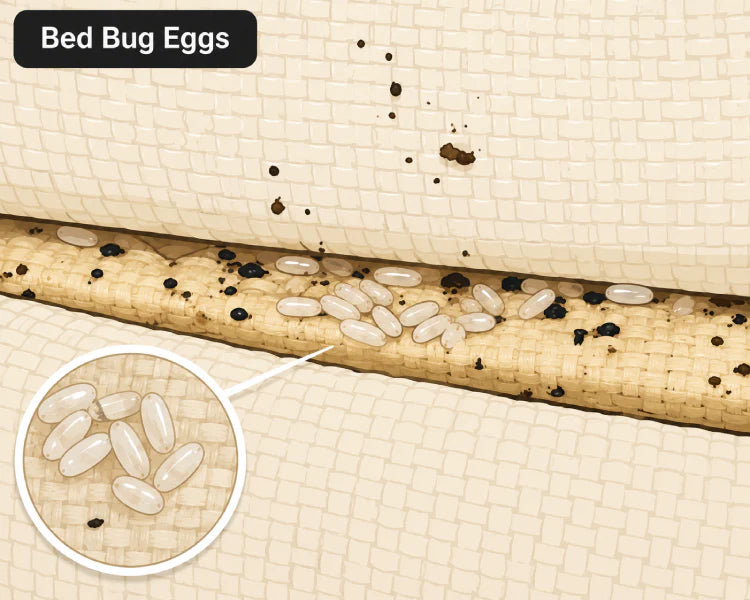
If you wake up with unexplained red welts on your skin, or you spot tiny white specks tucked along the seams of your mattress, there's a good chance you're dealing with bed bugs. And as frustrating as a bed bug infestation is, the real problem isn't the adults crawling around — it's the eggs they leave behind.
Bed bug eggs are the silent reset button of any infestation. Miss even a handful of them, and your problem will come back within two weeks, seemingly out of nowhere. This guide will walk you through everything you need to know about bed bug eggs: what they look like, where they hide, how they hatch, and — most importantly — how to get rid of them for good.

What Do Bed Bug Eggs Look Like
Bed bug eggs are notoriously easy to overlook, but knowing exactly what to look for makes all the difference.
Key identifying characteristics:
● Size: Approximately 1 mm in length (about 1/25 of an inch) — roughly the size of a pinhead
● Color: Freshly laid eggs are pearl-white or slightly translucent with a faint sheen. As they develop, they turn a dull, opaque white or pale yellow
● Shape: Elongated and oval, often described as resembling a tiny grain of rice
● Texture: Eggs have a naturally sticky coating that allows them to adhere firmly to fabric, wood, and other rough surfaces
● After hatching: Empty eggshells (called eggcases or eggshells) remain at the site — semi-transparent, flat, and slightly crumpled. Finding these is strong evidence of a past or ongoing infestation
One important detail: bed bug eggs are rarely found alone. They're typically laid in clusters of 5 to 15, grouped together in the same sheltered location. A flashlight and a magnifying glass will dramatically improve your chances of spotting them.
The Bed Bug Life Cycle: Why the Eggs Are the Real Problem
Understanding the bed bug life cycle is essential to eliminating an infestation completely — not just temporarily.
Stage 1 — Eggs: A single female bed bug lays 1 to 7 eggs per day and up to 500 eggs over her lifetime. Eggs are cemented in place with a glue-like substance and are extremely difficult to dislodge.
Stage 2 — Hatching: Under ideal conditions (temperatures between 70–80°F / 21–27°C), eggs hatch in just 6 to 10 days. Cooler temperatures slow this down significantly, but cold alone rarely kills the eggs — it just delays hatching.
Stage 3 — Nymphs: Newly hatched bed bugs are called nymphs. They look like tiny adults — same basic shape, but smaller and nearly colorless. They immediately begin seeking their first blood meal. Nymphs molt five times before reaching adulthood, requiring a blood meal between each molt.
Stage 4 — Adults: Under favorable conditions, a bed bug can progress from egg to reproductive adult in as little as 4 to 6 weeks. Adults can live for 6 to 12 months.
Why this matters for elimination: If your treatment kills every adult and nymph but leaves even a few eggs behind, you'll be facing a fresh wave of nymphs in under two weeks. This is the most common reason bed bug infestations seem to "come back" after treatment — the eggs were never destroyed in the first place.
Where Do Bed Bug Eggs Hide
Bed bugs are remarkably strategic about where they lay their eggs — always close to a sleeping human host, always in the most difficult-to-reach spots.
On and around your mattress:
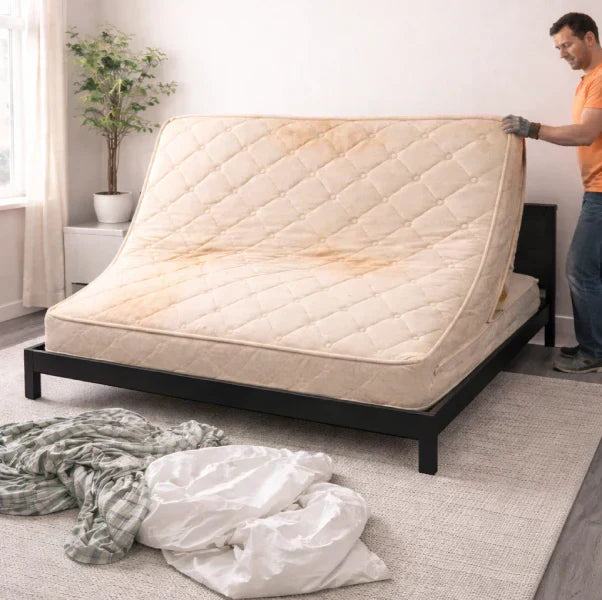
● Inside mattress seams, piping, and tufts
● Under mattress tags and along zipper tracks
● Along the edge where the mattress meets the bed frame
In the bed frame and surrounding area:
● Inside the box spring, especially along internal frame joints
● Behind the headboard and around mounting hardware
● In wood grain, dovetail joints, and screw holes of the bed frame
● At the base of bed legs
Elsewhere in the bedroom:
● Along the junction of carpet and baseboards
● Behind peeling wallpaper and inside electrical outlet covers
● In cracks and crevices of nearby furniture
● In piles of clothing, clutter, or soft items near the bed
The common thread: bed bugs prefer enclosed, undisturbed spaces within 1–2 meters of where you sleep. This is why your mattress is ground zero. A mattress with worn seams, cracked tufting, or deteriorating inner fabric is practically an invitation for bed bugs to settle in and start reproducing.
How to Get Rid of Bed Bug Eggs Effectively
Bed bug eggs are tougher to kill than adults. Their protective shell gives them a degree of resistance to many chemical pesticides. You need a multi-method approach.
Heat Treatment (Most Effective)
High temperatures are the most reliable way to kill bed bug eggs at every stage.
● Lethal threshold: Sustained exposure to 118°F (48°C) for 20 minutes or more is sufficient to kill all life stages, including eggs
● Steam cleaning: A professional steam cleaner producing temperatures above 200°F (93°C) can be applied directly to mattress seams, box spring joints, baseboards, and carpet edges. The steam penetrates fabric and crevices where eggs are hiding
● Laundry: Wash all bedding, pillowcases, and clothing in hot water (at least 120°F / 49°C), then dry on the highest heat setting for at least 30 minutes. The dryer is especially effective — the tumbling ensures even heat distribution. This is one of the most accessible and reliable steps you can take immediately
● Whole-room heat treatment: Professional pest control companies can heat an entire room or home to the lethal threshold, penetrating furniture, walls, and flooring. This is the most thorough option available and is recommended for severe infestations
Diatomaceous Earth (Physical Control)
Food-grade diatomaceous earth (DE) is a naturally occurring mineral powder made from fossilized algae. Its microscopic sharp edges pierce the exoskeleton of bed bugs — and direct contact can also damage eggs.
● Apply a thin, even layer around bed legs, along baseboards, and in any cracks where bed bugs travel
● DE works slowly (typically 1–2 weeks to show results), but its effects are lasting as long as it remains dry
● It's non-toxic, free of chemical residues, and bed bugs cannot develop resistance to it
Isopropyl Alcohol (Spot Treatment)
A 70% isopropyl alcohol solution sprayed directly onto eggs and live bugs can kill on contact by dehydrating them.
● Best used as a targeted spot treatment when you visually identify a cluster of eggs
● Has no residual effect — only kills what it directly contacts
● Highly flammable: keep away from open flames and don't use near heat treatment equipment
Chemical Insecticides
If you choose to use pesticides, look for EPA-registered products that specifically list egg kill on the label. The most effective formulations for eggs include:
● Pyrethroids — synthetic compounds that attack the nervous system; eggs are more resistant than adults, so coverage and contact are critical
● Insect Growth Regulators (IGRs) — these don't kill eggs outright but disrupt the development of nymphs after hatching, preventing them from maturing and reproducing. IGRs are most effective when used alongside a direct-kill treatment
Follow-Up Is Non-Negotiable
No single treatment eliminates 100% of bed bug eggs. A follow-up plan is essential:
● Day 1: Perform your first full treatment (steam + hot laundry + vacuuming)
● Days 2–13: Vacuum daily, monitor interceptors placed under bed legs, inspect treated areas
● Day 14: Conduct a second round of treatment, targeting any nymphs that hatched from surviving eggs
● Day 30: Final comprehensive inspection to confirm complete elimination
Vacuum thoroughly after each inspection — and immediately seal and dispose of the vacuum bag or canister contents outside your home.
How to Prevent Bed Bug Eggs in Your Mattress
Once you've eliminated an infestation, the goal is to make sure it never returns. Your mattress is the most important line of defense.
Practical prevention strategies:
1. Use a mattress encasement. A high-quality, fully zippered mattress encasement seals your mattress completely, eliminating all the seams, tufts, and crevices where bed bugs prefer to lay eggs. Any bugs already inside are trapped without access to a blood meal and will eventually die. This is one of the most cost-effective protective investments you can make for your sleep environment.
2. Inspect regularly. Every 7 to 10 days, pull back your bedding and use a flashlight to check mattress seams and bed frame joints. Early detection makes a huge difference in how manageable the situation is.
3. Install bed leg interceptors. These cups placed under each bed leg catch bed bugs attempting to climb up from the floor and provide early warning of activity.
4. Be cautious when traveling. In hotel rooms, check the headboard and mattress seams before settling in. Keep luggage on a rack rather than the floor. When you return home, run all travel clothing through a hot dryer cycle before putting it away.
5. Think twice before buying secondhand. Used mattresses and upholstered furniture are the most common vectors for bringing bed bugs into a home. If you do buy secondhand, inspect every seam and crevice carefully before bringing the item inside.
6. Reduce clutter around the bed. Piles of clothing, boxes, and soft items near your sleeping area provide perfect additional hiding spots. The fewer places bed bugs have to hide, the easier any infestation is to detect and treat.
Final Thoughts
Bed bug eggs may be nearly invisible to the naked eye, but they are the foundation of every infestation. Adults can be killed with a single treatment; eggs require a sustained, multi-method strategy and careful follow-up to truly eliminate.
The most important thing to understand is this: effective bed bug control isn't just about killing what you can see. It's about systematically targeting every life stage — especially the eggs — and then building a physical barrier that prevents them from ever getting established again.
A clean, well-protected mattress is your first and most important line of defense. Whether you're dealing with an active infestation or simply want to protect your sleep environment going forward, choosing the right mattress and the right protective encasement is an investment that pays off every single night.


Leave a comment
This site is protected by hCaptcha and the hCaptcha Privacy Policy and Terms of Service apply.